Thank you for visiting SNEWPapers!
Sign up free
Editorial
August 13, 1804
Jenks' Portland Gazette
Portland, Cumberland County, Maine
What is this article about?
Editorial by Hume critiques Jefferson's administration for neglecting the U.S. Navy, exemplified by generous treatment of captured French ship Berceau and court-martial of USS Boston's Capt. Little on false charges, signaling hostility to naval power and national honor.
Clipping
OCR Quality
92%
Excellent
Full Text
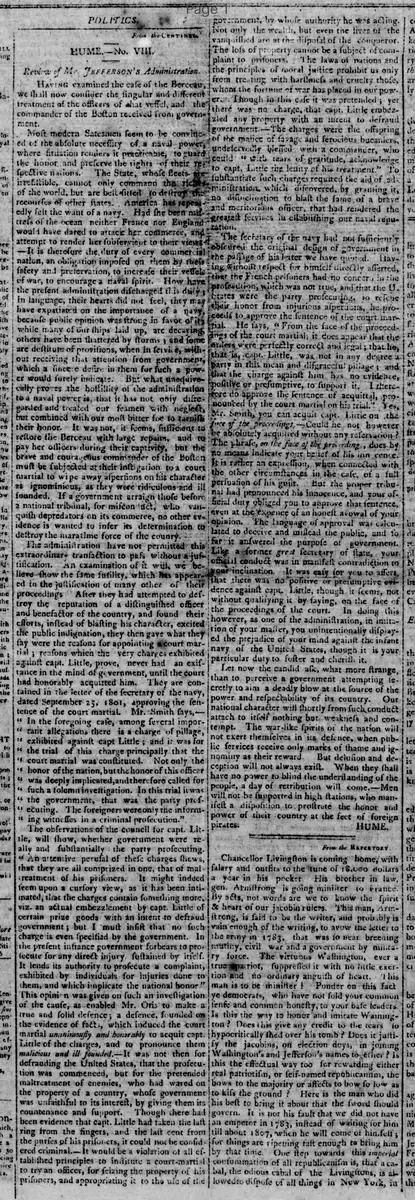
POLITICS.
HUME.-No. VIII.
Review of Mr. Jefferson's Administration.
Having examined the case of the Berceau, we shall now consider the singular and different treatment of the officers of that vessel, and the commander of the Boston received from government.
Most modern Statesmen seem to be convinced of the absolute necessity of a naval power where situation renders it practicable, to guard the honor and preserve the rights of their respective nations. The State whose fleets are irresistible, cannot only command the riches of the world, but are best fitted to destroy the resources of other states. America has repeatedly felt the want of a navy. Had she been mistress of the ocean neither France nor England would have dared to attack her commerce, and attempt to render her subservient to their views. It is therefore the duty of every commercial nation, an obligation imposed on them by their safety and preservation, to increase their vessels of war, to encourage a naval spirit. How have the present administration discharged this duty?
In language, their hearts did not feel, they may have expatiated on the importance of a navy, because public opinion was strong in favor of it while many of our ships laid up, are decaying, others have been shattered by storms; and some are destitute of provisions, when in service without receiving that attention from government which a sincere desire in them for such a power would surely indicate. But what unequivocally proves the hostility of the administration to a naval power is, that it has not only disregarded and treated our seamen with neglect but combined with our most bitter foe to tarnish their honor. It was not, it seems, sufficient to restore the Berceau with large repairs, and to pay her officers during their captivity, but the brave and courageous commander of the Boston must be subjected at their instigation, to a court martial to wipe away aspersions on his character as ignominious, as they were ridiculous and ill founded. If a government arraign those before a national tribunal, for misconduct, who have vindicated depredations on its commerce, no other evidence is wanted to infer its determination to destroy the maritime force of the country.
The administration have not permitted this extraordinary transaction to pass without a justification. An examination of it will, we believe show the same futility, which has appeared in the justification of many other of their proceedings. After they had attempted to destroy the reputation of a distinguished officer and benefactor of the country, and found their efforts, instead of blasting his character, excited the public indignation, they then gave what they say were the reasons for appointing court martial; reasons which the very charges exhibited against capt. Little, prove, never had an existence in the mind of government, until the court had honorably acquitted him. They are contained in the letter of the secretary of the navy, dated September 25, 1801, approving the sentence of the court martial. Mr. Smith says,--
"In the foregoing case, among several important and delicate allegations there is a charge of pillage, exhibited against capt Little; and it was for the trial of this charge principally that the court martial was constituted. Not only the honor of the nation, but the honor of this officer was deeply implicated, and therefore called for such a solemn investigation. In this trial it was the government, that was the party prosecuting. The foreigners were only the informing witnesses in a criminal prosecution."
The observations of the counsel for capt. Little, will show, whether government were really and substantially the party prosecuting.
"An attentive perusal of these charges shows, that they are all comprised in one, that of maltreatment of his prisoners. It might indeed seem upon a cursory view, as it has been intimated, that the charges contain something more, viz. an actual embezzlement by capt. Little of certain prize goods with an intent to defraud government; but, I must insist that no such charge is even specified by the government. In the present instance government forbears to prosecute for any direct injury sustained by itself. It lends its authority to prosecute a complaint, exhibited by individuals for injuries done to them, and which implicate the national honor"
This opinion was given on such an investigation of the cause, as enabled Mr. Otis to make a true and solid defence; a defence, founded on the evidence of facts, which induced the court martial unanimously and honorably to acquit capt. Little of the charges, and to pronounce them malicious and ill founded. It was not then for defrauding the United States, that the prosecution was commenced, but for the pretended maltreatment of enemies, who had warred on the property of a country, whose government was unfaithful to its interest, by giving them its countenance and support. Though there had been evidence that capt. Little had taken the last ring from the fingers, and the last cent from the purses of his prisoners, it could not be considered criminal. It would be a violation of all established principles to institute a court-martial to try an officer, for seizing the property of his prisoners, and appropriating it to the use of the government, by whose authority he was acting Not only the wealth, but even the lives of the vanquished are at the disposal of the conqueror. The loss of property cannot be a subject of complaint to prisoners. The laws of nations and the principles of moral justice prohibit us only from treating with harshness and cruelty those, whom the fortune of war has placed in our power. Though in this case it was pretended; yet there was no charge, that capt. Little embezzled any property with an intent to defraud government. The charges were the offspring of the malice of savage and ferocious buccaniers, undeservedly blessed with a commander, who could "with tears of gratitude, acknowledge to capt. Little the lenity of his treatment." To substantiate such charges required the aid of administration, which discovered, by granting it, no disinclination to blast the name, of a brave and meritorious officer, that had rendered the greatest services in establishing our naval reputation.
The secretary of the navy had not sufficiently obscured the criminal design of government in the passage of his letter we have quoted. Having without respect for himself directly asserted, that the French prisoners had no concern in the prosecution, which was not true, and that the U. States were the party prosecuting, to rescue their honor from injurious aspersions, he proceeds to approve the sentence of the court martial. He says, "From the face of the proceedings of the court martial; it does appear that the oniers were perfectly correct and legal; that he, that is, capt. Little, was not in any degree a party in this mean and disgraceful pillage; and that the charge against him has no evidence, positive or presumptive, to support it. I therefore do approve the sentence of acquittal, pronounced by the court martial on his trial." Yes, Mr. Smith, you can acquit capt. Little on the face of the proceedings. Could he not however be absolutely acquitted without any reservation? The phrase, on the face of the proceedings, does by no means indicate your belief of his innocence. It is rather an expression, when connected with the other circumstances in the case, of a full persuasion of his guilt. But the proper tribunal had pronounced his innocence, and your official duty obliged you to approve that sentence, even at the expense of an honest avowal of your opinion. The language of approval was calculated to deceive and mislead the public, and to far it answered the purpose of government. Like a former great secretary of state, your official conduct was in manifest contradiction to your inclination. It was easy for you to assert that there was no positive or presumptive evidence against capt. Little, though it seems, not without qualifying it by saying, on the face of the proceedings of the court. In doing this however, as one of the administration, in imitation of your master, you unintentionally displayed the prejudice of your mind against the infant navy of the United States, though it is your particular duty to foster and cherish it.
Let now the candid ask, what more strange than to perceive a government attempting secretly to aim a deadly blow at the source of the power and respectability of its country. Our national character will shortly from such conduct attach to itself nothing but weakness and contempt. The war-like spirits of the nation will not exert themselves in its defence, when public services receive only marks of shame and ignominy as their reward. But delusion and deception will not always exist. When they shall have no power to blind the understanding of the people, a day of retribution will come. Men will not be supported in high stations, who manifest a disposition to prostrate the honor and power of their country at the feet of foreign pirates.
HUME.
HUME.-No. VIII.
Review of Mr. Jefferson's Administration.
Having examined the case of the Berceau, we shall now consider the singular and different treatment of the officers of that vessel, and the commander of the Boston received from government.
Most modern Statesmen seem to be convinced of the absolute necessity of a naval power where situation renders it practicable, to guard the honor and preserve the rights of their respective nations. The State whose fleets are irresistible, cannot only command the riches of the world, but are best fitted to destroy the resources of other states. America has repeatedly felt the want of a navy. Had she been mistress of the ocean neither France nor England would have dared to attack her commerce, and attempt to render her subservient to their views. It is therefore the duty of every commercial nation, an obligation imposed on them by their safety and preservation, to increase their vessels of war, to encourage a naval spirit. How have the present administration discharged this duty?
In language, their hearts did not feel, they may have expatiated on the importance of a navy, because public opinion was strong in favor of it while many of our ships laid up, are decaying, others have been shattered by storms; and some are destitute of provisions, when in service without receiving that attention from government which a sincere desire in them for such a power would surely indicate. But what unequivocally proves the hostility of the administration to a naval power is, that it has not only disregarded and treated our seamen with neglect but combined with our most bitter foe to tarnish their honor. It was not, it seems, sufficient to restore the Berceau with large repairs, and to pay her officers during their captivity, but the brave and courageous commander of the Boston must be subjected at their instigation, to a court martial to wipe away aspersions on his character as ignominious, as they were ridiculous and ill founded. If a government arraign those before a national tribunal, for misconduct, who have vindicated depredations on its commerce, no other evidence is wanted to infer its determination to destroy the maritime force of the country.
The administration have not permitted this extraordinary transaction to pass without a justification. An examination of it will, we believe show the same futility, which has appeared in the justification of many other of their proceedings. After they had attempted to destroy the reputation of a distinguished officer and benefactor of the country, and found their efforts, instead of blasting his character, excited the public indignation, they then gave what they say were the reasons for appointing court martial; reasons which the very charges exhibited against capt. Little, prove, never had an existence in the mind of government, until the court had honorably acquitted him. They are contained in the letter of the secretary of the navy, dated September 25, 1801, approving the sentence of the court martial. Mr. Smith says,--
"In the foregoing case, among several important and delicate allegations there is a charge of pillage, exhibited against capt Little; and it was for the trial of this charge principally that the court martial was constituted. Not only the honor of the nation, but the honor of this officer was deeply implicated, and therefore called for such a solemn investigation. In this trial it was the government, that was the party prosecuting. The foreigners were only the informing witnesses in a criminal prosecution."
The observations of the counsel for capt. Little, will show, whether government were really and substantially the party prosecuting.
"An attentive perusal of these charges shows, that they are all comprised in one, that of maltreatment of his prisoners. It might indeed seem upon a cursory view, as it has been intimated, that the charges contain something more, viz. an actual embezzlement by capt. Little of certain prize goods with an intent to defraud government; but, I must insist that no such charge is even specified by the government. In the present instance government forbears to prosecute for any direct injury sustained by itself. It lends its authority to prosecute a complaint, exhibited by individuals for injuries done to them, and which implicate the national honor"
This opinion was given on such an investigation of the cause, as enabled Mr. Otis to make a true and solid defence; a defence, founded on the evidence of facts, which induced the court martial unanimously and honorably to acquit capt. Little of the charges, and to pronounce them malicious and ill founded. It was not then for defrauding the United States, that the prosecution was commenced, but for the pretended maltreatment of enemies, who had warred on the property of a country, whose government was unfaithful to its interest, by giving them its countenance and support. Though there had been evidence that capt. Little had taken the last ring from the fingers, and the last cent from the purses of his prisoners, it could not be considered criminal. It would be a violation of all established principles to institute a court-martial to try an officer, for seizing the property of his prisoners, and appropriating it to the use of the government, by whose authority he was acting Not only the wealth, but even the lives of the vanquished are at the disposal of the conqueror. The loss of property cannot be a subject of complaint to prisoners. The laws of nations and the principles of moral justice prohibit us only from treating with harshness and cruelty those, whom the fortune of war has placed in our power. Though in this case it was pretended; yet there was no charge, that capt. Little embezzled any property with an intent to defraud government. The charges were the offspring of the malice of savage and ferocious buccaniers, undeservedly blessed with a commander, who could "with tears of gratitude, acknowledge to capt. Little the lenity of his treatment." To substantiate such charges required the aid of administration, which discovered, by granting it, no disinclination to blast the name, of a brave and meritorious officer, that had rendered the greatest services in establishing our naval reputation.
The secretary of the navy had not sufficiently obscured the criminal design of government in the passage of his letter we have quoted. Having without respect for himself directly asserted, that the French prisoners had no concern in the prosecution, which was not true, and that the U. States were the party prosecuting, to rescue their honor from injurious aspersions, he proceeds to approve the sentence of the court martial. He says, "From the face of the proceedings of the court martial; it does appear that the oniers were perfectly correct and legal; that he, that is, capt. Little, was not in any degree a party in this mean and disgraceful pillage; and that the charge against him has no evidence, positive or presumptive, to support it. I therefore do approve the sentence of acquittal, pronounced by the court martial on his trial." Yes, Mr. Smith, you can acquit capt. Little on the face of the proceedings. Could he not however be absolutely acquitted without any reservation? The phrase, on the face of the proceedings, does by no means indicate your belief of his innocence. It is rather an expression, when connected with the other circumstances in the case, of a full persuasion of his guilt. But the proper tribunal had pronounced his innocence, and your official duty obliged you to approve that sentence, even at the expense of an honest avowal of your opinion. The language of approval was calculated to deceive and mislead the public, and to far it answered the purpose of government. Like a former great secretary of state, your official conduct was in manifest contradiction to your inclination. It was easy for you to assert that there was no positive or presumptive evidence against capt. Little, though it seems, not without qualifying it by saying, on the face of the proceedings of the court. In doing this however, as one of the administration, in imitation of your master, you unintentionally displayed the prejudice of your mind against the infant navy of the United States, though it is your particular duty to foster and cherish it.
Let now the candid ask, what more strange than to perceive a government attempting secretly to aim a deadly blow at the source of the power and respectability of its country. Our national character will shortly from such conduct attach to itself nothing but weakness and contempt. The war-like spirits of the nation will not exert themselves in its defence, when public services receive only marks of shame and ignominy as their reward. But delusion and deception will not always exist. When they shall have no power to blind the understanding of the people, a day of retribution will come. Men will not be supported in high stations, who manifest a disposition to prostrate the honor and power of their country at the feet of foreign pirates.
HUME.
What sub-type of article is it?
Partisan Politics
Military Affairs
Foreign Affairs
What keywords are associated?
Jefferson Administration
Naval Power
Berceau
Uss Boston
Capt Little
Court Martial
Navy Neglect
French Prisoners
What entities or persons were involved?
Mr. Jefferson's Administration
Capt. Little
Secretary Of The Navy Mr. Smith
French Officers Of Berceau
Hume
Editorial Details
Primary Topic
Review Of Jefferson Administration's Handling Of Berceau And Uss Boston Incidents
Stance / Tone
Strongly Critical Of Administration's Naval Neglect And Hostility
Key Figures
Mr. Jefferson's Administration
Capt. Little
Secretary Of The Navy Mr. Smith
French Officers Of Berceau
Hume
Key Arguments
Administration Neglected Decaying U.S. Ships Despite Public Support For Navy.
Generously Repaired And Paid French Berceau Officers While Court Martialing Capt. Little On False Charges.
This Treatment Shows Hostility To Naval Power And Alliance With Enemies.
Secretary Smith's Letter Reveals Inconsistent Justification And Prejudice Against Navy.
Such Actions Undermine National Honor And Maritime Strength.
Public Will Eventually Demand Retribution For Prostrating Country To Foreign Pirates.