Thank you for visiting SNEWPapers!
Sign up free
Springfield Weekly Republican
Springfield, Hampden County, Massachusetts
What is this article about?
Rev. Dr. Fred Winslow Adams's pronouncement on church architecture, adopted unanimously by the Methodist Episcopal church board in Syracuse, N.Y., calls for buildings that enhance worship, education, and recreation while inspiring spiritual reverence. (198 characters)
Clipping
OCR Quality
Full Text
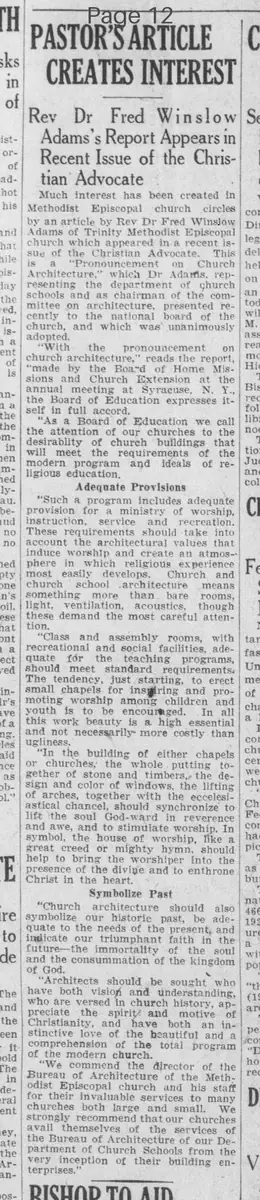
Rev. Dr. Fred Winslow Adams's Report Appears in Recent Issue of the Christian Advocate
Much interest has been created in Methodist Episcopal church circles by an article by Rev. Dr. Fred Winslow Adams of Trinity Methodist Episcopal church which appeared in a recent issue of the Christian Advocate. This is a "Pronouncement on Church Architecture," which Dr. Adams, representing the department of church schools and as chairman of the committee on architecture, presented recently to the national board of the church, and which was unanimously adopted.
"With the pronouncement on church architecture," reads the report, "made by the Board of Home Missions and Church Extension at the annual meeting at Syracuse, N. Y., the Board of Education expresses itself in full accord.
"As a Board of Education we call the attention of our churches to the desirability of church buildings that will meet the requirements of the modern program and ideals of religious education.
"Such a program includes adequate provision for a ministry of worship, instruction, service and recreation. These requirements should take into account the architectural values that induce worship and create an atmosphere in which religious experience most easily develops. Church and church school architecture means something more than bare rooms, light, ventilation, acoustics, though these demand the most careful attention.
"Class and assembly rooms, with recreational and social facilities, adequate for the teaching programs, should meet standard requirements. The tendency, just starting, to erect small chapels for inspiring and promoting worship among children and youth is to be encouraged. In all this work beauty is a high essential and not necessarily more costly than ugliness.
"In the building of either chapels or churches, the whole putting together of stone and timbers, the design and color of windows, the lifting of arches, together with the ecclesiastical chancel, should synchronize to lift the soul God-ward in reverence and awe, and to stimulate worship. In symbol, the house of worship, like a great creed or mighty hymn, should help to bring the worshiper into the presence of the divine and to enthrone Christ in the heart.
"Church architecture should also symbolize our historic past, be adequate to the needs of the present, and indicate our triumphant faith in the future—the immortality of the soul and the consummation of the kingdom of God.
"Architects should be sought who have both vision and understanding, who are versed in church history, appreciate the spirit and motive of Christianity, and have both an instinctive love of the beautiful and a comprehension of the total program of the modern church.
"We commend the director of the Bureau of Architecture of the Methodist Episcopal church and his staff for their invaluable services to many churches both large and small. We strongly recommend that our churches avail themselves of the services of the Bureau of Architecture of our Department of Church Schools from the very inception of their building enterprises."
What sub-type of article is it?
What themes does it cover?
What keywords are associated?
What entities or persons were involved?
Where did it happen?
Story Details
Key Persons
Location
Syracuse, N. Y.
Story Details
Rev. Dr. Fred Winslow Adams presented a pronouncement on church architecture to the national board of the Methodist Episcopal church, which was unanimously adopted. The report emphasizes church buildings that support modern religious education programs including worship, instruction, service, and recreation, with architectural elements that inspire reverence and symbolize historic, present, and future faith.