Thank you for visiting SNEWPapers!
Sign up free
The Enquirer
Richmond, Henrico County, Virginia
What is this article about?
Thomas Pope writes to the editor criticizing the defective design of existing bridges, which fail due to rain and ice, and promotes his patented single-arch bridge invention as stronger, more durable, cheaper, and better for navigation. He claims approval from U.S. officials and offers consultations in New York.
Clipping
OCR Quality
Full Text
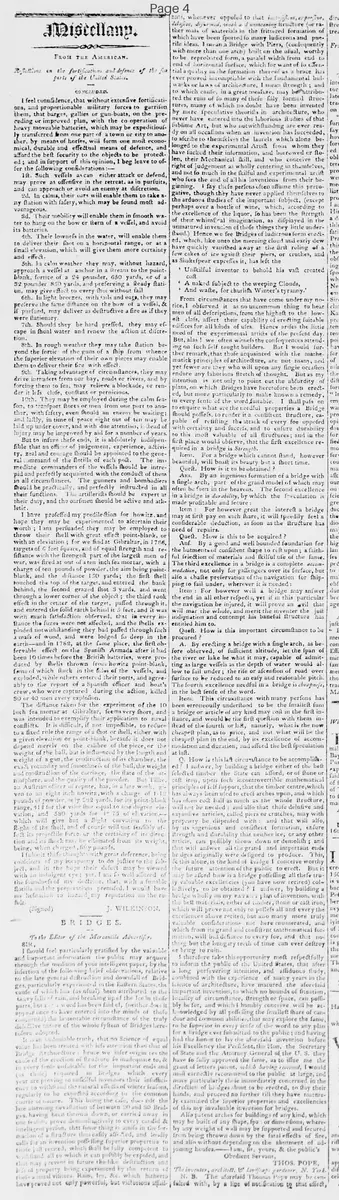
To the Editor of the Mercantile Advertiser.
SIR,
I should feel particularly gratified by the valuable and important information the public may acquire through the medium of your intelligent paper, by the insertion of the following brief observations, relative to the late general destruction and downfall of Bridges, particularly experienced in the Eastern States, the cause of which has (as usual) been attributed to the heavy falls of rain, and breaking up of the Ice in those parts, but no word has been said of, neither does it appear once to have entered into the minds of those interested, the lamentable circumstance of the truly defective nature of the whole system of Bridges heretofore adopted.
It is an undeniable truth, that no Science of equal value has been treated with less attention than that of Bridge architecture: hence we infer origin to the cause of the erection of structures so inadequate to, & in every sense unsuitable for the important ends and (uses) required in Bridges; which every year are proving to unskilful inventors their insufficiency to withstand the natural etc. of winter seasons, regularly to be expected according to the common course of nature. This being the case, does not the late alarming devastation of between 20 and 30 Bridges, having been thrown down, or carried away in one season, prove demonstratively to every candid & intelligent person, that some thing is amiss in the formation of & structure thus easily assailed, and loudly calls for an invention possessing superior properties to those now received, which shall be fully competent to withstand all to which it can possibly be exposed, and that may prevent in future the like destruction and loss of property being experienced by the return of those usual visitors Rain, Ice, &c. which hitherto have proved not only powerful, but victorious assailants, whenever opposed to that ill-shaped, expensive, deceptive, weak and unmeaning structure (or rather mass of materials in the frittered formation of which have been sported so many ludicrous and puerile ideas. I mean a Bridge with Piers, (consequently with more than one arch) built on the usual, worthy to be reprobated form, a parallel width from end to end of horizontal surface, which for want of so essential a quality in the formation thereof as a brace has ever proved incompatible with the fundamental bulwarks or laws of architecture, I mean strength; and to which cause, in a great measure, may be attributed the ruin of so many of these silly formed structures, many of which no doubt have been invented by mere speculative theorists in architecture, who never have entered into the laborious studies of that sublime Art, but who notwithstanding are ever ready on all occasions when an invention has succeeded, to ascribe to themselves the laurels which alone belonged to the experimental Artist from whom they have sucked their information, and borrowed or stolen, their Mechanical skill, and who conceive the right of judgement as wholly centering in themselves, and not so much in the skilful and experimental artist who sees the end of all his inventions from their beginning. I say these persons often assume this prerogative, though they have never applied themselves to the arduous studies of the important subject, (except perhaps over a bottle of wine, which, according to the excellence of the liquor, so has been the strength of their whimsical imagination, as displayed in the unmatured invention of those things they little understood.) Hence we see Bridges of ludicrous form erected, which, like unto the morning cloud and early dew have quickly vanished away at the first rolling of a few cakes of ice against their piers, or crutches, and as Shakespeare expresses it, has left the
'Unskilful inventor to behold his vast created cost
A naked subject to the weeping Clouds,
And waste, for churlish Winter's tyranny.'
From circumstances that have come under my notice, I observed it as no uncommon thing to hear men of all descriptions, from the highest to the lowest class, assert their capability of erecting suitable edifices for all kinds of uses. Hence arises the little need of the experimental artists of the present day. But, alas! we often witness the consequences attending on such self taught builders. But I would further remark, that those acquainted with the mathematic principles of architecture, are not many, and yet fewer are they who will upon any single occasion endure any laborious stretch of thought. But as my intention is not only to point out the absurdity of plans, on which Bridges have heretofore been erected, but more particularly to make known a remedy, in every sense of the word suitable. I shall pass on to enquire what are the needful properties a Bridge should possess, to render it a consistent structure, capable of resisting the attack of every foe opposed with certainty and success, and to ensure durability to this most valuable of all structures; and in the first place would observe, that the first excellence required in a bridge is Strength.
Item. For a bridge which cannot stand, however beautiful, will boast its beauty but a short time.
Quest. How is it to be obtained?
Ans. By an ingenious formation of a bridge with a single arch, part of the grand model of which may often be seen in the heavens. The second excellence in a bridge is durability, by which the speculation is made profitable and secure:
Item. For however great the interest a bridge may at first pay on each share, it will speedily feel a considerable deduction, as soon as the structure has need of repairs.
Quest. How is this to be acquired?
Ans. By a good and well founded foundation for the butments of consistent shape to rest upon; a faithful selection of materials and skilful use of the same.
The third excellence in a bridge is a complete accommodation, not only for passengers over its surface, but also a chaste preservation of the navigation for shipping to sail under, wherever it is needed:
Item. For however well a bridge may answer the end in all other respects, yet if in this particular the navigation be injured, it will prove an evil that will mar the whole, and merit the inventor the just indignation and contempt his baneful structure has entitled him to.
Quest. How is this important circumstance to be procured?
A. By erecting a bridge with a single arch, as before observed, of sufficient altitude, let the span of the river or lake be what it may, capable of admitting as large vessels as the depth of water would allow to sail under; the rise or ascension of road over surface to be reduced to an easy and reasonable pitch.
The fourth excellence needful in a bridge is cheapness, in the best sense of the word.
Item. This circumstance with many persons has been erroneously understood to be the smallest sum a bridge or article of any kind may cost in the first instance, and would be the first question with them instead of the fourth or last, namely, what is the now cheapest plan, as to price, and not what will be the cheapest plan in the end, by its excellence of accommodation and duration, and afford the best speculation at last.
Q. How is this last circumstance to be accomplished? I answer, by building a bridge either of the best selected timber the State can afford, or of stone or cast iron, upon such incontrovertible mathematical principles of self support, that the timber centre, which has always been used to erect arches upon, and which has often cost half as much as the whole structure, will not be needed: and also that those delusive and expensive articles, called piers or crutches, may with propriety be dispensed with: and that will also, by its ingenious and consistent formation, ensure strength and durability that neither ice, or any other article, can possibly throw down or demolish; and that will answer all the grand and important ends Bridges originally were designed to produce. This, & this alone, is the kind of bridge I conceive worthy the future attention of the public to erect. But it may be asked how is a bridge possessing all these truly valuable excellencies (you have now recited) collectively, to be obtained? I answer, by building a bridge wholly on my Patent plan of invention, with the best materials, either of timber, stone or cast iron, which will prove not only to possess all and every the excellences above recited, but also many more truly valuable considerations not here enumerated, and which from its grand and consistent mathematical formation, will bid defiance to every foe, and that nothing but the hungry teeth of time can ever destroy or bring to ruin.
I therefore take this opportunity most respectfully to inform the public of the United States, that after a long persevering attention, and assiduous study, combined with the experience of many years in the science of architecture, have matured the aforesaid important invention, to which no bounds of situation, locality of circumstance, strength or space, can possibly beset, and which I humbly conceive will be acknowledged by all possessing the smallest share of candour and common abilities, that may explore the same, to be superior in every sense of the word to any plan for a bridge ever submitted to the public; and having had the honor to lay the aforesaid invention before his Excellency the President, the Hon, the Secretary of State and the Attorney General of the U. S. they have so fully approved the same, as to issue me the grant of letters patent, which having received, I would most earnestly recommend to the public at large, and more particularly those immediately concerned in the direction of Bridges about to be erected, to stay their hands, and proceed no further till they have maturely examined the superior properties and excellencies of this my invaluable invention for bridges.
Also patent arches for buildings of any kind, which may be built of any shape, span or dimensions, whereby any weight of wall may be supported and secured from being thrown down by the fatal effects of fire. and also without depending on the abutment of adjoining houses.—Jam, sir, yours, & the public's
Obedient Servant,
THOS. POPE,
The inventor, architect, & landscape gardener. N. York.
N. B. The aforesaid Thomas Pope may be consulted with, by a line of notification to that effect directed No. 80 Wall-street, or 412 Greenwich street, N. York.—He intends shortly to publish a treatise on Bridge Architecture.
What sub-type of article is it?
What themes does it cover?
What keywords are associated?
What entities or persons were involved?
Letter to Editor Details
Author
Thos. Pope, The Inventor, Architect, & Landscape Gardener. N. York.
Recipient
To The Editor Of The Mercantile Advertiser.
Main Argument
current multi-arch bridges with piers are defective and prone to destruction by natural forces; the author promotes his patented single-arch bridge design as superior in strength, durability, accommodation for navigation, and long-term cost-effectiveness, endorsed by u.s. officials.
Notable Details