Thank you for visiting SNEWPapers!
Sign up free
Story
January 26, 1915
The Democratic Banner
Mount Vernon, Knox County, Ohio
What is this article about?
University of Pennsylvania Museum announces discovery of three ancient brick coin counterfeiting molds in Egyptian relics, dating to 313-367 A.D. during reigns of Roman Emperors Maximus, Licinus, and Constantius. Method involved clay impressions burned into molds for pouring molten metal.
Clipping
OCR Quality
98%
Excellent
Full Text
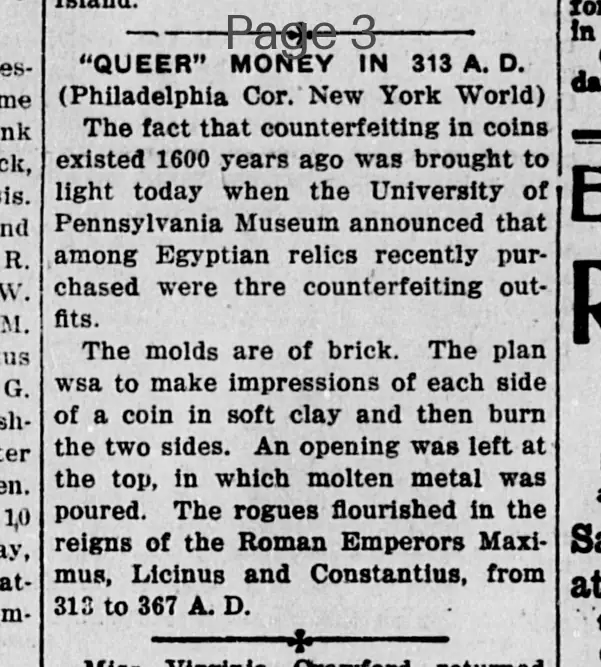
"QUEER" MONEY IN 313 A. D.
(Philadelphia Cor. New York World)
The fact that counterfeiting in coins existed 1600 years ago was brought to light today when the University of Pennsylvania Museum announced that among Egyptian relics recently purchased were three counterfeiting outfits.
The molds are of brick. The plan was to make impressions of each side of a coin in soft clay and then burn the two sides. An opening was left at the top, in which molten metal was poured. The rogues flourished in the reigns of the Roman Emperors Maximus, Licinus and Constantius, from 313 to 367 A. D.
(Philadelphia Cor. New York World)
The fact that counterfeiting in coins existed 1600 years ago was brought to light today when the University of Pennsylvania Museum announced that among Egyptian relics recently purchased were three counterfeiting outfits.
The molds are of brick. The plan was to make impressions of each side of a coin in soft clay and then burn the two sides. An opening was left at the top, in which molten metal was poured. The rogues flourished in the reigns of the Roman Emperors Maximus, Licinus and Constantius, from 313 to 367 A. D.
What sub-type of article is it?
Curiosity
Crime Story
Historical Event
What themes does it cover?
Deception
Crime Punishment
What keywords are associated?
Counterfeiting
Ancient Coins
Roman Emperors
Egyptian Relics
University Of Pennsylvania Museum
What entities or persons were involved?
Maximus
Licinus
Constantius
Where did it happen?
Egypt
Story Details
Key Persons
Maximus
Licinus
Constantius
Location
Egypt
Event Date
313 To 367 A. D.
Story Details
Announcement of ancient counterfeiting outfits found in Egyptian relics, detailing brick molds used to counterfeit coins during Roman emperors' reigns by pouring molten metal into clay impressions.