Thank you for visiting SNEWPapers!
Sign up free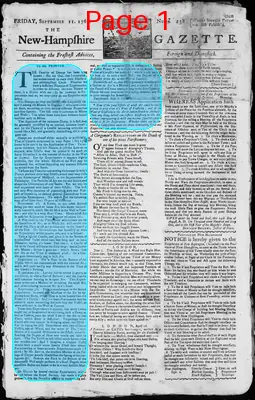
Letter to Editor
September 11, 1761
The New Hampshire Gazette
Portsmouth, Rockingham County, New Hampshire
What is this article about?
A scientific letter to the printer explaining 'damps' in mines and wells as adust (burnt) air unfit for respiration, demonstrated through experiments with candles and animals. References Taunton well incident and suggests measuring air elasticity for remedies. Dated Portsmouth, Sept. 7, 1761.
Clipping
OCR Quality
97%
Excellent
Full Text
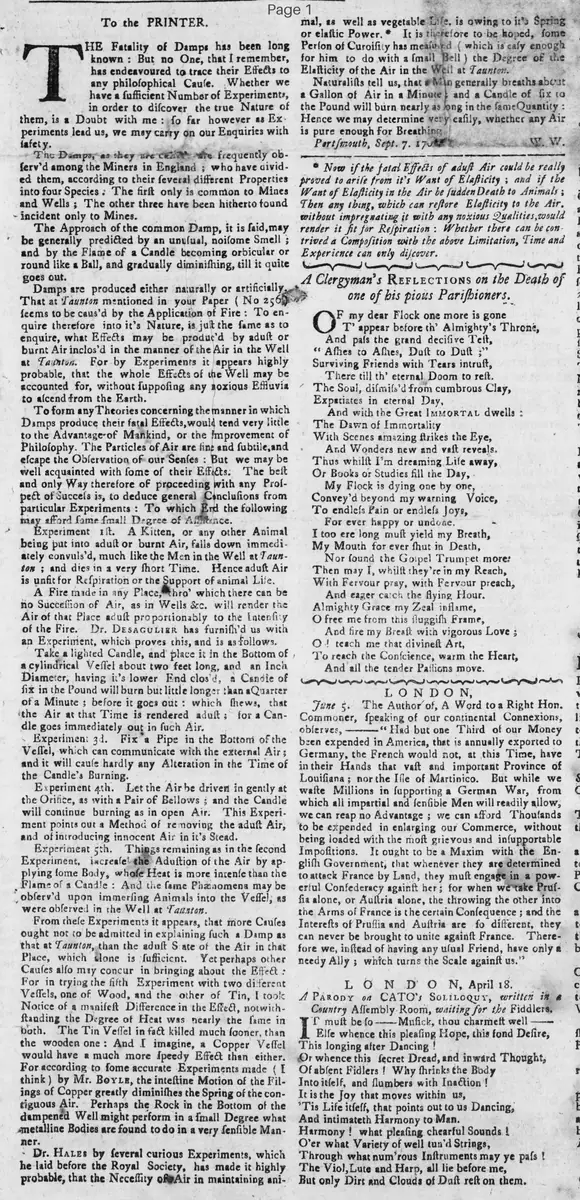
To the PRINTER.
The Fatality of Damps has been long known: But no One, that I remember, has endeavoured to trace their Effects to any philosophical Cause. Whether we have a sufficient Number of Experiments, in order to discover the true Nature of them, is a Doubt with me: So far however as Experiments lead us, we may carry on our Enquiries with safety.
The Damps, as they are called, are frequently observed among the Miners in England: who have divided them, according to their several different Properties into four Species: The first only is common to Mines and Wells: The other three have been hitherto found incident only to Mines.
The Approach of the common Damp, it is said, may be generally predicted by an unusual, noisome Smell; and by the Flame of a Candle becoming orbicular or round like a Ball, and gradually diminishing, till it quite goes out.
Damps are produced either naturally or artificially. That at Taunton mentioned in your Paper (No 256) seems to be caus'd by the Application of Fire: To enquire therefore into it's Nature, is just the same as to enquire, what Effects may be produc'd by adust or burnt Air inclosed in the manner of the Air in the Well at Taunton. For, by Experiments it appears highly probable, that the whole Effects of the Well may be accounted for, without supposing any noxious Effluvia to ascend from the Earth.
To form any Theories concerning the manner in which Damps produce their fatal Effects, would tend very little to the Advantage of Mankind, or the Improvement of Philosophy. The Particles of Air are fine and subtle, and escape the Observation of our Senses: But we may be well acquainted with some of their Effects: The best and only Way therefore of proceeding with any Prospect of Success is, to deduce general Conclusions from particular Experiments: To which End the following may afford some small Degree of Assistance.
Experiment 1st. A Kitten, or any other Animal being put into adust or burnt Air, falls down immediately convuls'd, much like the Men in the Well at Taunton; and dies in a very short Time. Hence adust Air is unfit for Respiration or the Support of animal Life.
A Fire made in any Place, thro' which there can be no Succession of Air, as in Wells &c. will render the Air of that Place adust proportionably to the Intensity of the Fire. Dr. Desaguliers has furnish'd us with an Experiment, which proves this, and is as follows.
Take a lighted Candle, and place it in the Bottom of a cylindrical Vessel about two feet long, and an Inch Diameter, having it's lower End clos'd. A Candle of six in the Pound will burn but little longer than a Quarter of a Minute; before it goes out: which shews, that the Air at that Time is rendered adust: for a Candle goes immediately out in such Air.
Experiment 3d. Fix a Pipe in the Bottom of the Vessel, which can communicate with the external Air; and it will cause hardly any Alteration in the Time of the Candle's Burning.
Experiment 4th. Let the Air be driven in gently at the Orifice, as with a Pair of Bellows; and the Candle will continue burning as in open Air. This Experiment points out a Method of removing the adust Air, and of introducing innocent Air in it's Stead.
Experiment 5th. Things remaining as in the second Experiment, increase the Adustion of the Air by applying some Body, whose Heat is more intense than the Flame of a Candle: And the same Phænomena may be observed upon immersing Animals into the Vessel; as were observed in the Well at Taunton.
From these Experiments it appears, that more Causes ought not to be admitted in explaining such a Damp as that at Taunton, than the adust State of the Air in that Place, which alone is Sufficient. Yet perhaps other Causes also may concur in bringing about the Effect: For in trying the fifth Experiment with two different Vessels, one of Wood, and the other of Tin, I took Notice of a manifest Difference in the Effect, notwithstanding the Degree of Heat was nearly the same in both. The Tin Vessel in fact killed much sooner, than the wooden one: And I imagine, a Copper Vessel would have a much more speedy Effect than either. For according to some accurate Experiments made (I think) by Mr. BOYLE, the intestine Motion of the Filings of Copper greatly diminishes the Spring of the contiguous Air. -- Perhaps the Rock in the Bottom of the dampened Well might perform in a small Degree what metalline Bodies are found to do in a very sensible Manner.
Dr. HALES by several curious Experiments, which he laid before the Royal Society, has made it highly probable, that the Necessity of Air in maintaining animal, as well as vegetable Life, is owing to it's Spring or elastic Power. * It is therefore to be hoped, some Person of Curiosity has measured (which is easy enough for him to do with a small Bell) the Degree of the Elasticity of the Air in the Well at Taunton.
Naturalists tell us, that a Man generally breathes about a Gallon of Air in a Minute and a Candle of six to the Pound will burn nearly as long in the same Quantity: Hence we may determine very easily, whether any Air is pure enough for Breathing.
Portsmouth, Sept. 7, 1761. A. W. W.
Now if the fatal Effects of adust Air could be really proved to arise from it's Want of Elasticity; and if the Want of Elasticity in the Air be sudden Death to Animals: Then any thing, which can restore Elasticity to the Air, without impregnating it with any noxious Qualities, would render it fit for Respiration: Whether there can be contrived a Composition with the above Limitation, Time and Experience can only discover.
The Fatality of Damps has been long known: But no One, that I remember, has endeavoured to trace their Effects to any philosophical Cause. Whether we have a sufficient Number of Experiments, in order to discover the true Nature of them, is a Doubt with me: So far however as Experiments lead us, we may carry on our Enquiries with safety.
The Damps, as they are called, are frequently observed among the Miners in England: who have divided them, according to their several different Properties into four Species: The first only is common to Mines and Wells: The other three have been hitherto found incident only to Mines.
The Approach of the common Damp, it is said, may be generally predicted by an unusual, noisome Smell; and by the Flame of a Candle becoming orbicular or round like a Ball, and gradually diminishing, till it quite goes out.
Damps are produced either naturally or artificially. That at Taunton mentioned in your Paper (No 256) seems to be caus'd by the Application of Fire: To enquire therefore into it's Nature, is just the same as to enquire, what Effects may be produc'd by adust or burnt Air inclosed in the manner of the Air in the Well at Taunton. For, by Experiments it appears highly probable, that the whole Effects of the Well may be accounted for, without supposing any noxious Effluvia to ascend from the Earth.
To form any Theories concerning the manner in which Damps produce their fatal Effects, would tend very little to the Advantage of Mankind, or the Improvement of Philosophy. The Particles of Air are fine and subtle, and escape the Observation of our Senses: But we may be well acquainted with some of their Effects: The best and only Way therefore of proceeding with any Prospect of Success is, to deduce general Conclusions from particular Experiments: To which End the following may afford some small Degree of Assistance.
Experiment 1st. A Kitten, or any other Animal being put into adust or burnt Air, falls down immediately convuls'd, much like the Men in the Well at Taunton; and dies in a very short Time. Hence adust Air is unfit for Respiration or the Support of animal Life.
A Fire made in any Place, thro' which there can be no Succession of Air, as in Wells &c. will render the Air of that Place adust proportionably to the Intensity of the Fire. Dr. Desaguliers has furnish'd us with an Experiment, which proves this, and is as follows.
Take a lighted Candle, and place it in the Bottom of a cylindrical Vessel about two feet long, and an Inch Diameter, having it's lower End clos'd. A Candle of six in the Pound will burn but little longer than a Quarter of a Minute; before it goes out: which shews, that the Air at that Time is rendered adust: for a Candle goes immediately out in such Air.
Experiment 3d. Fix a Pipe in the Bottom of the Vessel, which can communicate with the external Air; and it will cause hardly any Alteration in the Time of the Candle's Burning.
Experiment 4th. Let the Air be driven in gently at the Orifice, as with a Pair of Bellows; and the Candle will continue burning as in open Air. This Experiment points out a Method of removing the adust Air, and of introducing innocent Air in it's Stead.
Experiment 5th. Things remaining as in the second Experiment, increase the Adustion of the Air by applying some Body, whose Heat is more intense than the Flame of a Candle: And the same Phænomena may be observed upon immersing Animals into the Vessel; as were observed in the Well at Taunton.
From these Experiments it appears, that more Causes ought not to be admitted in explaining such a Damp as that at Taunton, than the adust State of the Air in that Place, which alone is Sufficient. Yet perhaps other Causes also may concur in bringing about the Effect: For in trying the fifth Experiment with two different Vessels, one of Wood, and the other of Tin, I took Notice of a manifest Difference in the Effect, notwithstanding the Degree of Heat was nearly the same in both. The Tin Vessel in fact killed much sooner, than the wooden one: And I imagine, a Copper Vessel would have a much more speedy Effect than either. For according to some accurate Experiments made (I think) by Mr. BOYLE, the intestine Motion of the Filings of Copper greatly diminishes the Spring of the contiguous Air. -- Perhaps the Rock in the Bottom of the dampened Well might perform in a small Degree what metalline Bodies are found to do in a very sensible Manner.
Dr. HALES by several curious Experiments, which he laid before the Royal Society, has made it highly probable, that the Necessity of Air in maintaining animal, as well as vegetable Life, is owing to it's Spring or elastic Power. * It is therefore to be hoped, some Person of Curiosity has measured (which is easy enough for him to do with a small Bell) the Degree of the Elasticity of the Air in the Well at Taunton.
Naturalists tell us, that a Man generally breathes about a Gallon of Air in a Minute and a Candle of six to the Pound will burn nearly as long in the same Quantity: Hence we may determine very easily, whether any Air is pure enough for Breathing.
Portsmouth, Sept. 7, 1761. A. W. W.
Now if the fatal Effects of adust Air could be really proved to arise from it's Want of Elasticity; and if the Want of Elasticity in the Air be sudden Death to Animals: Then any thing, which can restore Elasticity to the Air, without impregnating it with any noxious Qualities, would render it fit for Respiration: Whether there can be contrived a Composition with the above Limitation, Time and Experience can only discover.
What sub-type of article is it?
Informative
Philosophical
What themes does it cover?
Science Nature
What keywords are associated?
Damps
Adust Air
Experiments
Respiration
Taunton Well
Air Elasticity
Ventilation
What entities or persons were involved?
A. W. W.
To The Printer.
Letter to Editor Details
Author
A. W. W.
Recipient
To The Printer.
Main Argument
damps in wells and mines, such as at taunton, result from adust (burnt) air unfit for respiration, as demonstrated by experiments with candles and animals; remedies involve restoring air elasticity and ventilation.
Notable Details
References Taunton Well Incident From Paper No. 256
Experiments By Dr. Desaguliers, Mr. Boyle, Dr. Hales
Observations On Effects Of Metal Vessels Vs. Wood
Suggestions For Measuring Air Elasticity With A Bell