Thank you for visiting SNEWPapers!
Sign up free
Editorial
February 25, 1834
The New Hampshire Gazette
Portsmouth, Rockingham County, New Hampshire
What is this article about?
Editorial mocks the Journal newspaper's hypocritical promotion of the Conflagration of Moscow exhibition as morally beneficial due to clerical visits, while it condemns theaters as temptations to crime, defending personal rights to amusement without harming others.
Clipping
OCR Quality
98%
Excellent
Full Text
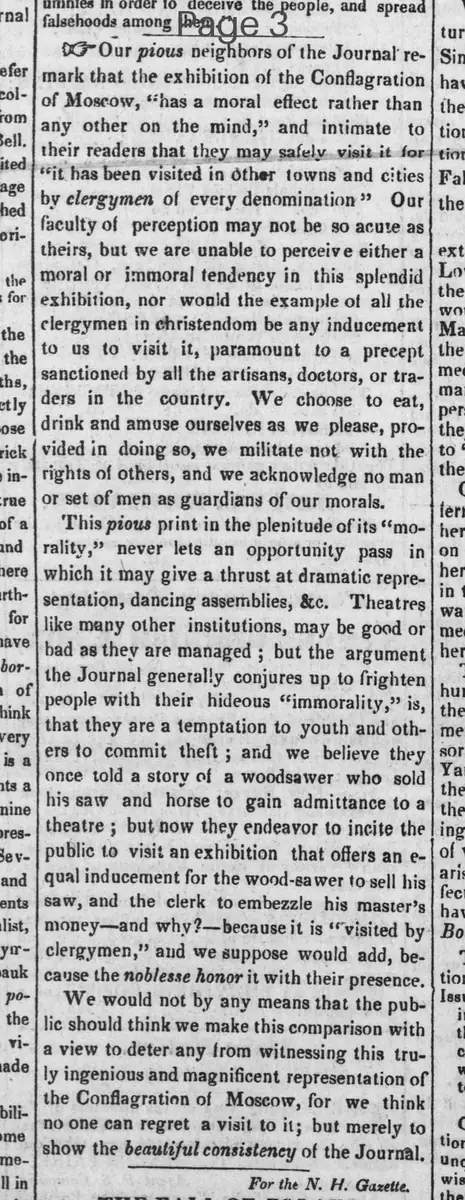
Our pious neighbors of the Journal remark that the exhibition of the Conflagration of Moscow, "has a moral effect rather than any other on the mind," and intimate to their readers that they may safely visit it for "it has been visited in other towns and cities by clergymen of every denomination" Our faculty of perception may not be so acute as theirs, but we are unable to perceive either a moral or immoral tendency in this splendid exhibition, nor would the example of all the clergymen in christendom be any inducement to us to visit it, paramount to a precept sanctioned by all the artisans, doctors, or traders in the country. We choose to eat, drink and amuse ourselves as we please, provided in doing so, we militate not with the rights of others, and we acknowledge no man or set of men as guardians of our morals.
This pious print in the plenitude of its "morality," never lets an opportunity pass in which it may give a thrust at dramatic representation, dancing assemblies, &c. Theatres like many other institutions, may be good or bad as they are managed ; but the argument the Journal generally conjures up to frighten people with their hideous "immorality," is, that they are a temptation to youth and others to commit theft; and we believe they once told a story of a woodsawer who sold his saw and horse to gain admittance to a theatre ; but now they endeavor to incite the public to visit an exhibition that offers an equal inducement for the wood-sawer to sell his saw, and the clerk to embezzle his master's money—and why?—because it is "visited by clergymen," and we suppose would add, because the noblesse honor it with their presence.
We would not by any means that the public should think we make this comparison with a view to deter any from witnessing this truly ingenious and magnificent representation of the Conflagration of Moscow, or we think no one can regret a visit to it; but merely to show the beautiful consistency of the Journal.
This pious print in the plenitude of its "morality," never lets an opportunity pass in which it may give a thrust at dramatic representation, dancing assemblies, &c. Theatres like many other institutions, may be good or bad as they are managed ; but the argument the Journal generally conjures up to frighten people with their hideous "immorality," is, that they are a temptation to youth and others to commit theft; and we believe they once told a story of a woodsawer who sold his saw and horse to gain admittance to a theatre ; but now they endeavor to incite the public to visit an exhibition that offers an equal inducement for the wood-sawer to sell his saw, and the clerk to embezzle his master's money—and why?—because it is "visited by clergymen," and we suppose would add, because the noblesse honor it with their presence.
We would not by any means that the public should think we make this comparison with a view to deter any from witnessing this truly ingenious and magnificent representation of the Conflagration of Moscow, or we think no one can regret a visit to it; but merely to show the beautiful consistency of the Journal.
What sub-type of article is it?
Moral Or Religious
Satire
Press Freedom
What keywords are associated?
Conflagration Of Moscow
Moral Exhibition
Journal Hypocrisy
Personal Amusement
Theater Criticism
What entities or persons were involved?
Journal
Clergymen
Noblesse
Editorial Details
Primary Topic
Critique Of Journalistic Hypocrisy On Moral Entertainment
Stance / Tone
Mocking Defense Of Personal Freedoms In Amusement
Key Figures
Journal
Clergymen
Noblesse
Key Arguments
The Conflagration Of Moscow Exhibition Has No Moral Or Immoral Tendency
Individuals Should Eat, Drink, And Amuse Themselves As They Please Without Harming Others
The Journal Hypocritically Attacks Theaters As Immoral While Promoting The Exhibition Because It Is Visited By Clergymen
Theatres Can Be Good Or Bad Depending On Management, Not Inherently Immoral