Thank you for visiting SNEWPapers!
Sign up free
Southern Christian Advocate
Charleston, Charleston County, South Carolina
What is this article about?
The Post Office Bill, passed in the Senate 20-14, abolishes most franking privileges, sets tiered postage rates for letters (3-15 cents based on distance), regulates newspaper mailing (free locally, low rates elsewhere), allows Congress limited free mail, suppresses private expresses, and permits bulk newspaper shipments.
Clipping
OCR Quality
Full Text
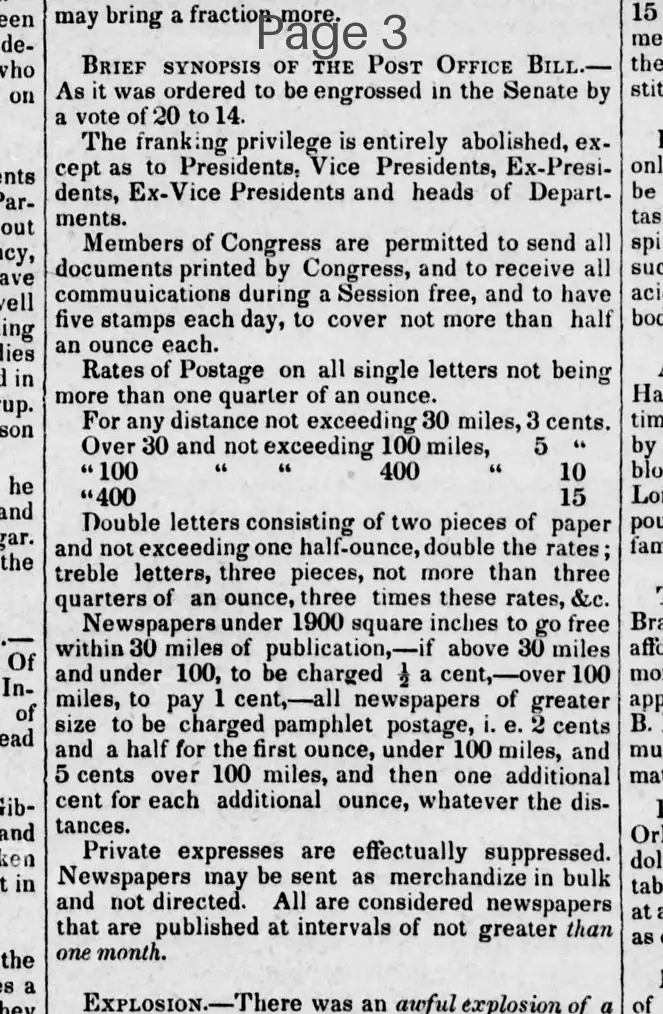
As it was ordered to be engrossed in the Senate by a vote of 20 to 14.
The franking privilege is entirely abolished, except as to Presidents, Vice Presidents, Ex-Presidents, Ex-Vice Presidents and heads of Departments.
Members of Congress are permitted to send all documents printed by Congress, and to receive all communications during a Session free, and to have five stamps each day, to cover not more than half an ounce each.
Rates of Postage on all single letters not being more than one quarter of an ounce.
For any distance not exceeding 30 miles, 3 cents.
Over 30 and not exceeding 100 miles, 5 cents.
Over 100 and not exceeding 400 miles, 10 cents.
Over 400 miles, 15 cents.
Double letters consisting of two pieces of paper and not exceeding one half-ounce, double the rates; treble letters, three pieces, not more than three quarters of an ounce, three times these rates, &c.
Newspapers under 1900 square inches to go free within 30 miles of publication,—if above 30 miles and under 100, to be charged a cent,—over 100 miles, to pay 1 cent,—all newspapers of greater size to be charged pamphlet postage, i. e. 2 cents and a half for the first ounce, under 100 miles, and 5 cents over 100 miles, and then one additional cent for each additional ounce, whatever the distances.
Private expresses are effectually suppressed.
Newspapers may be sent as merchandise in bulk and not directed. All are considered newspapers that are published at intervals of not greater than one month.
What sub-type of article is it?
What keywords are associated?
Domestic News Details
Outcome
the bill was ordered to be engrossed in the senate by a vote of 20 to 14. it abolishes the franking privilege except for specified officials, sets postage rates for letters and newspapers, allows members of congress limited free mailing, suppresses private expresses, and defines newspapers for bulk mailing.
Event Details
Synopsis of the Post Office Bill as ordered to be engrossed in the Senate. Franking privilege abolished except for Presidents, Vice Presidents, Ex-Presidents, Ex-Vice Presidents, and heads of Departments. Members of Congress can send printed documents and receive communications free during session, with five daily stamps for half-ounce items. Postage rates: single letters (up to 1/4 oz) - 3 cents under 30 miles, 5 cents 30-100 miles, 10 cents 100-400 miles, 15 cents over 400 miles. Double letters double rates, etc. Newspapers under 1900 sq in free within 30 miles, 1 cent 30-100 miles, 1 cent over 100 miles; larger charged as pamphlets. Private expresses suppressed. Newspapers may be sent in bulk if published at intervals not greater than one month.