Thank you for visiting SNEWPapers!
Sign up free
Kentucky Gazette
Lexington, Fayette County, Kentucky
What is this article about?
Address by the American Society for the Encouragement of Domestic Manufactures, dated December 31, 1816, in New York, urging protection for U.S. industries against British imports to ensure national independence, economic prosperity, and moral health. Refutes objections and calls for public support.
Merged-components note: Long editorial titled 'Domestic Manufactures' continued across pages 1, 2, and 3 in sequential reading order.
Clippings
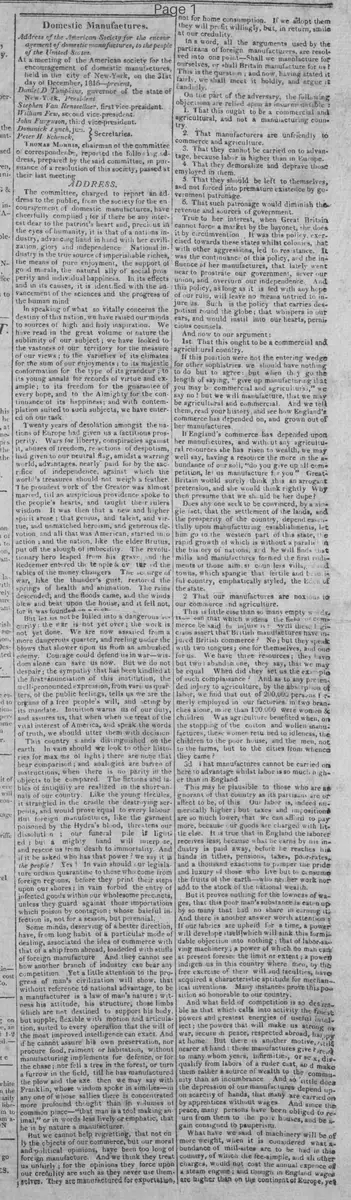
1 of 3
OCR Quality
Full Text
Address of the American Society for the encouragement of domestic manufactures, to the people of the United States.
At a meeting of the American society for the encouragement of domestic manufactures, held in the city of New-York, on the 31st day of December, 1816-present,
Daniel D. Tompkins, governor of the state of New-York, President
Stephen Van Rensselaer, first vice-president.
William Few, second vice-president.
John Ferguson, third vice-president.
Dominick Lynch, jun.
Secretaries.
Peter H. Schenck,
Thomas Morris, chairman of the committee of correspondence, reported the following address, prepared by the said committee, in pursuance of a resolution of this society, passed at their last meeting
ADDRESS.
The committee, charged to report an address to the public, from the society for the encouragement of domestic manufactures, have cheerfully complied: for if there be any interest dear to the patriot's heart and, precious in the eyes of humanity, it is that of a nations industry, advancing hand in hand with her civilization, glory and independence National industry is the true source of imperishable riches, the means of pure enjoyment, the support of good morals, the natural ally of social prosperity and individual happiness. In its effects and in its causes, it is identified with the advancement of the sciences and the progress of the human mind
In speaking of what so vitally concerns the destiny of this nation, we have raised our minds to sources of high and holy inspiration. We have read in the great volume of nature the sublimity of our subject; we have looked to the vastness of our territory for the measure of our views; to the varieties of its climates for the sum of our enjoyments; to its majestic conformation for the type of its grandeur; to its young annals for records of virtue and example; to its freedom for the guarantee of every hope, and to the Almighty for the continuance of its happiness; and with contemplation suited to such subjects, we have entered on our task
Twenty years of desolation amongst the nations of Europe had given us a factitious prosperity. Wars for liberty, conspiracies against it, abuses of freedom, re-actions of despotism, had given to our neutral flag, amidst a warring world, advantages, nearly paid for by the sacrifice of independence, against which the world's treasures should not weigh a feather. The proudest work of the Creator was almost marred, till an auspicious providence spoke to the people's hearts, and taught their rulers wisdom It was then that a new and higher spirit arose; that genius, and talent, and virtue, and unmatched heroism, and generous devotion, and all that was American, started into action; and the nation, like the elder Brutus, put off the slough of imbecility The revolutionary hero leaped from his grave, and the Redeemer entered the temple & overthrew the tables of the money changers The occurrence of war, like the thunder's gust, restored the springs of health and animation. The rains descended, and the floods came, and the winds blew and beat upon the house, and it fell not, for it was founded on a rock.
But let us not be lulled into a dangerous security: the war is not yet over; the work is not yet done. We are now assailed from a more dangerous quarter, and reeling under the blows that shower upon us from an ambushed enemy. Courage could defend us in war—wisdom alone can save us now. But we do not despair; the sympathy that has been kindled at the first annunciation of this institution, the well-pronounced expression, from various quarters, of the public feelings, tells us we are the organs of a free people's will, and acting by its mandate. Intuition warns us of our duty, and assures us, that when we treat of the vital interest of America, and speak the words of truth, we should utter them with decision
This country stands distinguished on the earth In vain should we look to other histories for maxims of light; there are none that bear comparison; and analogies are barren of instructions, when there is no parity in the objects to be compared. The fictions and fables of antiquity are realized in the short annals of our country. Like the young Hercules, it strangled in the cradle the destroying serpents, and would prove equal to every labour
But foreign manufactures, like the garment poisoned by the Hydra's blood, threatens our dissolution; our funeral pile is lighted; but a mighty hand will interpose, and rescue us from death to immortality. And if it be asked who has that power? we say it is the people! Yes! In vain should our legislature ordain quarantine to those who come from foreign regions, before they print their steps upon our shores; in vain forbid the entry of infected goods within our wholesome precincts, unless they guard against those importations which poison by contagion; whose baleful infection is, not for a season, but perennial.
Some minds, deserving of a better direction, have, from long habit of a particular mode of dealing, associated the idea of commerce with that of a ship from abroad, loaded with stuffs of foreign manufacture And they cannot see how another branch of industry can bear any competition. Yet a little attention to the progress of man's civilization will show, that without reference to national advantage, to be a manufacturer is a law of man's nature; witness his attitude, his structure, those limbs which are not destined to support his body, but supple, flexible with motion and articulation, suited to every operation that the will of the most improved intelligence can exact. And if he cannot assure his own preservation, nor procure food, raiment or habitation, without manufacturing implements for defence, or for the chase; nor fell a tree in the forest, or turn a furrow in the field, till he has manufactured the plow and the axe. then we may say with Franklin, whose wisdom spoke in similes-in any one of whose sallies there is concentrated more profound thought than in volumes of common place-"that man is a tool making animal," or in words less lively or emphatic, that he is by nature a manufacturer.
But we cannot help regretting, that not only the objects of our commerce, but our moral and political opinions, have been too long of foreign manufacture. And we think they treat us unfairly; for the opinions they force upon our credulity are such as they never use themselves. They are manufactured for exportation, not for home consumption. If we adopt them they will profit willingly, but, in return, smile at our credulity.
In a word, all the arguments used by the partizans of foreign manufacturers, are resolved into one point-Shall we manufacture for ourselves, or shall Britain manufacture for us? This is the question; and now, having stated it fairly, we shall meet it boldly, and argue it candidly.
On the part of the adversary, the following objections are relied upon as insurmountable
1. That this ought to be a commercial and agricultural, and not a manufacturing country.
2. That manufacturers are unfriendly to commerce and agriculture.
3. That they cannot be carried on to advantage, because labor is higher than in Europe.
4 That they demoralize and deprave those employed in them.
5. That they should be left to themselves, and not forced into premature existence by government patronage.
6.That such patronage would diminish the revenue and sources of government.
True to her interest, when Great Britain cannot force a market by the bayonet, she does it by circumvention It was this policy, exercised towards these states whilst colonies, that with other aggressions, led to resistance. It was the continuance of this policy, and the influence of her manufactures, that lately went near to prostrate our government, sever our union, and overturn our independence. And this policy, as long as it is fed with any hope of our ruin, will leave no means untried to injure us. Such is the policy that carries despotism round the globe; that whispers in our ears, and would instil into our hearts, pernicious counsels
And now to our argument:
1st. That this ought to be a commercial and agricultural country.
If this position were not the entering wedge for other sophistries we should have nothing to do but to agree: but when they go the length of saying, " give up manufacturing that you may be commercial and agricultural," we say no! but we will manufacture, that we may be agricultural and commercial. And we tell them, read your history, and see how England's commerce has depended on, and grown out of her manufactures.
If England's commerce has depended upon her manufactures, and without any agricultural resources she has risen to wealth, we may well say, having a resource the more in the abundance of our soil, "do you give up all competition, let us manufacture for you" Great Britain would surely think this an arrogant pretension, and she would think rightly Why then presume that we should be her dupe?
Does any one seek to be convinced, by a single fact, that the settlement of the lands, and the prosperity of the country, depend essentially upon manufacturing establishments, let him go to the western part of this state, the rapid growth of which is without a parallel in the history of nations, and he will find that mills and manufactures formed the first rudiments of those almost countless villages and towns, which spangle that fertile and beautiful country, emphatically styled, the Eden of the state.
2 That our manufactures are noxious to our commerce and agriculture.
This is little else than so many empty words. How can that which widens the field of commerce be said to injure it: will these logicians assert that British manufactures have injured British commerce? No; but they speak with two tongues; one for themselves, and one for us. We have three resources; they have but two: abandon one, they say, that we may be equal When did they set us the example of such complaisance? And as to any pretended injury to agriculture, by the absorption of labor, we find that out of 200,000 persons formerly employed in our factories. in two branches alone, more than 120,000 were women & children Was agriculture benefited when, on the stopping of the cotton and woolen manufactures, these women returned to idleness, the children to the poor house, and the men, not to the farms, but to the cities from whence they came?
3d That manufactures cannot be carried on here to advantage whilst labor is so much higher than in England
This may be plausible to those who are as ignorant of that country as its partizans are or affect to be, of this Our labor is, indeed numerically higher; but taxes and impositions are so much lower, that we can afford to pay more, because our goods are charged with little else. It is true that in England the laborer receives less; because what he earns by his industry is paid away, before he reaches his hands in tithes, pensions, taxes, poor-rates, and a thousand exactions to pamper the pride and luxury of those who live but to consume the fruits of the earth—who neither work nor add to the stock of the national wealth.
But it proves nothing for the lowness of wages, that this poor man's substance is eaten up by so many that had no share in earning it. And there is another answer worth attention If our fabrics are upheld for a time, a power will develope itself which will sink this formidable objection into nothing; that of labor-saving machinery: a power of which no man can at present foresee the limit or extent; a power indigenous in this country where men, by the free exercise of their will and faculties, have acquired a characteristic aptitude for mechanical inventions. Many instances prove this position so honorable to our country.
And what field of competition is so desirable as that which calls into activity the highest powers and greatest energies of useful intellect; the powers that will make us strong in war, secure in peace, respected abroad, happy at home. But there is another motive, still nearer at hand : these manufactures give employment to many whom years, infirmities, or sex, disqualify from labors of a ruder cast, and make them rather a source of wealth to the community than an incumbrance. And so little does the depression of our manufactures depend upon scarcity of hands, that many are carried on by apprentices without wages. And since the peace, many persons have been obliged to return from them to the poor houses, and be again consigned to pauperism.
What have we said of machinery will be of more weight, when it is considered what a abundance of mill-sites are to be had in this country, of which the fee-simple, and all other charges, would not cost the annual expence of a steam engine ; and though in England wages are higher than on the continent of Europe, yet that has not prevented her from underselling all her rivals. except such as have lately adopted the counteracting policy we would recommend.
It is worthy also of notice, that all these labor-saving machines, and mechanical improvements, which would be hailed by us as new planets in the firmament, are in that country. the signals of mobs, assassinations, and revolt and are in fact, at last established by the sole protection of the strong arm of government.
We refer on this head to Mr. Tench Coxe's "statement of the arts and manufactures of the United States," who asserts that the diminution of manual labor in 1808 was estimated in England, in regard to the cotton business, at 200 to 1. And who observes further. that Mr John Duncan, of Glasgow, an able writer and artist, considers it to be much more. In the same work, Mr Coxe instances the saw gin. invented by Mr. Eli Whitney of Connecticut, as saving manual labor in the proportion of 1000, to 1 If it were Consistent with our limits of our present object, we quote abundance of valuable matter from this authentic and useful work. We can only here recommend it to the perusal of all who take interest in their country's welfare.
4th. That manufactures degrade and demoralize.
We are inclined to believe that in the British factories are found disgusting exhibitions of human depravity and wretchedness. But we cannot believe that the exercise of industry could ever be the cause of demoralizing any race of men; although unequal laws and bad examples may have that tendency. In this country there are extensive manufactories, and yet no such consequences are observed.
The best account we have of the pollution of British manufactures is in a work entitled "Espriella's letters." To judge from that work. British manufactories are objects of abhorrence But, for the honor of humanity, we must suppose the picture something over colored.
Surely. we have not witnessed in our fabrics any of those fearful apparitions, flitting through the smoke of their dismal repairs, like the spirit of the damned. squalid and pallid, with green hair, red eyes, distorted members, and ghastly aspect. But whoever has travelled thro the towns and cities of the British Isles, during the last five years of war, must know that it is not alone in manufacturing districts, or manufacturing countries that beggary and wretchedness are to be found. Whoever would describe depravity and immorality, may visit barracks, camps, and men of war; and moreover, those nations which are not manufacturing will be found more to abound in profligacy & disorder In those countries that enjoy the benefit of manufactures. their wholesome effect upon the morals of the people is too often defeated by the immoderate use of spirituous liquors, which, and not manufactories, are the most prolific source of poverty and immorality.
Experience has shown that the persons employed in manufactories are as sober as any of the working class A reason for which may be, that the employers have better means of watching over their conduct, and controlling their disorders; or where that cannot be effected, discharging those whose bad example might corrupt the rest.
And it appears, from the authentic treatise of Mr Colquhoun, that before the present unparalleled state of distress in England, there were only seven paupers to every hundred inhabitants in the manufacturing districts and in others not manufacturing, there were twenty-one
Was it manufactures that humbled Spain. whose power and pride stood once as high as England's? What manufactures strew the streets of Naples with idle Lazaroni ? What manufactures debase Portugal ? Is it the manufacturing of tooth picks at the university of Coimbra? or is it the stripping off the bark from the cork tree in the forest, to be carried to England, cut, and sent back to bottle their wine? Is it the encouragement of domestic manufactures that has degraded the children of Erin ? or is it that every demoniac effort has been used, to depress its industry, stifle its genius, and trample down its virtues?
And why is Canada so different from the U. States, although untaxed? Because even the timbers of their woods is sent to be made into ships, & returned, ready framed, to be launched on the lakes for their defence.
But at length, though late, the continental nations have taken the alarm and combinations are formed, by both sexes, against the importation of these manufactures! Shall we be less quicksighted? It in war, they could not overcome us ? If they feel now the effects of their ambition they cannot complain:"They are the general challengers We come but as others do, to try with them the strength of our youth."
We have, besides, none of those great manufacturing cities; nor do we wish for such Our fabrics will not require to be situated near mines of coal, to be worked by fire or steam, but rather unchosen sites, by the fall of waters and the running stream, the seats of health and cheerfulness, where good instruction will secure the morals of the young and good regulations will promote, in all, order, cleanliness, and the exercise of the civil duties. This with the beneficial clauses usual in our indentures of apprenticeship and the vigilant eye of the magistrate to enforce them, will obviate every apprehension And we hazard nothing by the assertion, that some of the best educated of the poor class, in this country, are those brought up in factories, and such as would otherwise have been destitute of education altogether to make this objection are requested to reflect, that the paternal regard of the legislature is awake to this subject; and that, to every institution of this kind a school will be appendant. Then, if it please heaven to redeem the thousands, and tens of thousands, that groan in the land of bondage, and open them a passage through the waves, as to the Israelites of old, this shall be their land of promise Here shall their industry find its reward; and if they fear sickness or decrepitude in our factories, there is no authority, power or necessity, that can confine them for a day. They may shape their course to any part of a territory as expansive as the ocean they have traversed, find a thousand ways to bestow their industry to their advantage, with land, free and unoccupied, on which to settle; and under no circumstances need they fear the dreadful calamity of famine from which they fled.
5th. That manufactures should be left to their natural growth.
To the friends of America, it will be argument enough that domestic manufactures are for the permanent interest of their country, and the only sure means of our independence. What Would not wisdom and patriotism do to secure such objects ?
We ask not one-third of the protection which Britain has bestowed upon her manufactures We ask not more protection than our commerce has received by discriminating duties and navigation laws, and what we do ask, is but until our tender gristle shall be hardened, and our joints knit. But under what protection British manufactures grew, and still maintained themselves, we shall now show: and then, in our turn, ask these advisers, why ours should be left to themselves rather than their own.
Co eval with the first dawn of English prosperity, we find in the British code. laws for the protection of British manufactures. One of their ancient kings, the third Edward, is magnified in their history for his wise foresight in enacting these statutes, to which their increasing greatness is ascribed. To those acts is referred the consequence to which that little island has since attained ; the bursting of the feudal chains : the growth of art and science; and that power, of which the abuse has at length recoiled upon the head of pride and usurpation.
We do not ask for such laws as the British code exhibits. We would not sacrifice to a golden idol the rights or feelings of humanity. We would not chain to the ground the harmless artificer : nor under accumulated penalties restrain his natural rights. Yet such are British statutes. The oppressor may trample on him; famine stare him in the face; his children cry for bread, when he has none to give them; be his disguise or his enterprise what it may, he must abide the pelting of the storm;" his native land is his dungeon, and his industry his crime. If a master of an American vessel offer to transport him to a country where his heart's hopes are centred, he, too, is condemned, as " a seducer of artisans," to like ruinous inflictions, and punished for his charitable ministry. The exporter of a tool or implement used in any art, or the master who receives it in his ship, is subject to similar pains and forfeitures.
Nor is this like the feudal laws, or monastic institutions. an obsolete system: many of these statutes are of modern date, and some of the time of the reigning monarch. We wish for nothing that can affect the personal right of any individual, citizen, alien, native, or foreigner; we claim only for our country the honorable protection of its very dearest interests. But, we think this argument may show how far Great Britain is from doing that herself which her emissaries never fail to preach to us-that is, letting her manufactures take care of themselves. Nor is it the king, nor his cabinet, nor his parliament, to whom this policy is to be ascribed. It is the public voice. So dearly do Englishmen prize that interest they would have us forego.
We would here notice two branches of domestic manufactures, the shoe and hat manufactures, which have, by the means of the protection of government, prospered to that degree that they, at this day, render us independent of foreign supply. But facts are so abundant that the details would lead to interminable length.
We find a member of parliament, the celebrated Mr. Brougham, who brought about the repeal of the orders in council, by showing the effects of our non-importation law upon their manufactures, this energetic denouncer of the abuses of power, versed in the subject, and speaking for popularity, in arraigning as madness the excessive exportations to the continent of Europe, admits nevertheless, "that it is well worth while to incur a loss on the first exportation, in order by the glut, to stifle in the cradle those rising manufactures in the United States which the war had forced into premature existence, contrary." as he is pleased to assert, " to the natural course of things"
And a celebrated writer on the colonial policy of Great Britain, whose words are considered next to official, in a chapter on the relative situation of Great Britain and America. as manufacturing rivals, speaks thus : " This is the era (he says) of a systematic contest which must, eventually. endanger the safety of the manufactures of the one or the other." Now, though this is not a war of arms, yet it is a war more subtle and more deadly : a war that can deprive us of every means of future resistance, and insure success to some future invasion. It is that warfare, which, two years after victory, has left us worse than a conquered nation ; without a single piece of coined money in the purse of any individual --If we hesitate now, we deserve our adversary's scorn; if we will be deceived, why should he not deceive us; if we are content to be undone, why should he feel remorse! if we have no remedy, we are to be pitied and not blamed; if we have, and want courage to apply it, we are to be blamed, but not pitied If we do not make a stand upon this ground, we need defend no other post ; their interest supported by the government, by their laws, by public patronage, and wealthy combinations, by export duties, and bounties on exportation, will prevail against our's unsupported and neglected, and our interest will be more than endangered in this systematic contest, if one gives all the blows, and the other passively receives them.
Nor is it a principle of English origin merely to encourage and protect domestic arts. All wise states have acted on it. In ancient Rome, though artificers were of the class of slaves, they were greatly favored. They had their own temples, chose their own patrons to defend their causes, and were exempt from personal services-to the state. They were incorporated into colleges or companies, had their own tutelary gods, and when their labours were ended, they hung up their tools with ceremonial rites, as votive offerings ; and all this for their utility alone, having to fear no hostile competition
Besides, it is not against an armed force we are now to array ourselves, nor against legitimate or liberal competition, but against concealed hostility, and practices full of dishonor. Whether these proceed from the government or the people, or from an interested class, they will not be less ruinous to us, unless we oppose them by means prompt, vigorous, and effective. If in ordinary times such conspiracy against our prosperity was dangerous, how much more animated must it now become, when they have no other way left of destroying us, no other market wherein to vend their goods; when they are willing to incur such loss for the purpose of stifling in the cradle that resource of which they can see the advantage to us though we ourselves be blind to it? And we have too many proofs that neither people nor government think it below their dignity, nor above their ability, to do by us as by every other nation whose industry stands in the way of their monopoly. by sea or land.
Will a nation, then, which spends millions to destroy the manufactures of other nations, and find markets for her own, hesitate to expend a few million to crush the manufactures of one whom she honors with the name of rival? Her restraints on our growing prosperity and national industry, and on the migration of arts and artisans to our shores, led to resistance; that resistance to independence; and that independence to our present greatness. The second war she waged against us gave us manufactures ; against these she is now waging the third war, she calculates rightly upon our ruin and subjection.
* Geo. I. c 27. Geo. III. c. 13. Geo. IV. c. 17. Geo. III. c. 37. Geo. II. c. 60.
It may be well to state a few instances of the operation of the policy we have denounced, that the well-wishers of this country may the better understand what passes daily before their eyes.
At an epoch when the Spanish government seemed to rouse itself a little from its usual torpor, and to occupy itself with the interests of the country, a manufactory of superfine woollen hats was established at the Escurial, under its special protection. Great sums were advanced by enlightened and public spirited individuals, and the government took a large share in the enterprise. But the London hatters determined to put down so portentious an innovation. Immense quantities of the finest beavers were profusely scattered over all Spain, with orders to sell them uniformly at one half of the Spanish price. The consequences may be easily foreseen. The Spanish manufactures were ruined, the government was too timid to maintain the contest, and too economical to support a national branch of industry. The fabric of the Escurial was given up, and the ensuing year the English, by raising their prices, repaired the momentary and voluntary loss they had sustained-a proof at least of their skilful policy.
Similar practices were played off against France during the whole course of the war, and had more effect in reducing her to her present calamitous situation, than the valor of the invincibles, or the genius of Wellington. When other means failed to force a market, agents were sent to establish manufactures, not for the purpose of fabricating French goods, but to cloak the introduction of British : and though pains of death were denounced against the smugglers, corruption found its way, and opened itself a channel.
History will yet bring to light from what mine those riches sprang, that could corrupt ministers and generals, and determine the fate of a nation; and mark it well, mistake it not, remember it forever, it was BRITISH MANUFACTURES. It was their subtle poison that first polluted those hearts, that having once proved false to their country's good, could never more be true to any thing; for how should honor outlive honesty ? Oh America! what a beacon for your guidance, what a lesson for your statesmen and your people.
There is living testimony within the reach of this society, that, in certain British manufactories, the French marks were put upon their goods without affectation of concealment, and the purpose openly avowed, as well as the connexion that subsisted between the real manufacture in Britain and the fictitious one in France.
And, at the commencement of our woollen manufactures, for the purpose of degrading our fabrics, goods of the worst quality, but highly finished to the eye, were sent to this city from England, marked "Humphrey's Ville," that they might, by passing for the productions of that manufactory, injure its well-merited reputation
It is well known to many, that, during the late war, British goods were smuggled into this country, and exposed to sale as American, Spanish, and Portuguese; it is quite of course, too, for their agents who have come out here since the war, in speaking of the glutting of the European markets, to say, that the speculation was not so unwise as unfortunate, for if the government and people had not taken the alarm, they should have destroyed their manufactures, and afterwards had their own price.
In the beginning of the year 1792, when the report of general Hamilton, then secretary of the treasury, made, by orders of the house of representatives, was published in England, it created such alarm, that meetings were called in the manufacturing towns: and Manchester alone, at a single meeting, subscribed 50,000 pounds sterling. towards a fund to be vested in English goods, and shipped to this country for the purpose of glutting our market, and blasting the hopes of our manufactures in the bud
The lucrative speculations which the wars of Europe gave rise to, the examples of rapid fortunes made by foreign commerce, and the temporary advantages of our neutral state amongst so many powers, eager for each other's destruction, prevailed over the prophetic wisdom of that illustrious statesman ; but things being now restored to their natural order, that important document which has been almost smothered in oblivion, and is of all his works that which has been least noticed or appreciated, must now be brought into full view. And we call upon the friends of American independence, upon those who raised to his memory an humble monument suited to the record of private affection. and to number his days, to join with us in raising the fallen columns of his true renown.
And before we despatch this important head of " leaving manufactures to themselves," we must advert to that phenomenon of art, the steam boat. that proudest specimen of American manufacture Had it been left to itself there would have been lost to the human race an inestimable benefit, and to this republic the proudest monument of its glory It came forth with throbs and pangs of travail like a giant's birth : and had not an enlightened legislature fostered its inventor with encouragement and hope, and renewed from time to time the period limited for its production, it would not now be seen stemming the current of our magnificent rivers, glittering like the enchanted gallery on the tide of fate, topping the ocean's wave, or gliding like the pride of swans upon the lake.
6th.We come now to the last head of our argument, " the public revenue." And here we would remove that error which supposes that foreign importations pay the revenue to government. It is not so! they are barely the medium through which the government collects the revenue from the private purses of the private citizens. It is the citizen and not the ship that pays. It is the citizen, and not the foreign goods, that pay' It is the consumer and not the importer. During the recent war, so far from supporting the revenue, these importations (too often carried on in partnership with treason) developed their characters. drained the country of its specie, and its bullion, and left the government in a situation too humiliating to be recollected without pain by any patriot.
But, happily for this country. fortune has brought this evil to a period. And few will be so headstrong as to acquiesce in the change of times and circumstances.
It surely makes no difference to our citizens which way they pay the money that goes to support their government, and they can have no objection to pay it in the way most beneficial to the country, by raising it on the domestic manufactures.--The necessity of a direct tax will be lessened, which will come in ease of the landed interest and of the merchant.
Mr. Isaac Briggs, in his statement to the chairman of commerce and manufactures, has proved, by exact calculations, founded on a present and prospective view of our population. wants, produce, and the foreign markets, that if our agriculturalists depend, in future, upon any other market than that which domestic manufactures will afford, that their produce will lie upon their hands, or they must accept of whatever price the foreign merchant may be pleased to offer. for such portion as he will condescend to accept. For produce will no longer serve as payment where it is no longer wanted, and payment in specie will clearly be impossible.
For the tables and calculations we refer to the 9th volume of Niles' Weekly Register. where this valuable document will be found.
As the public may not be aware of the great interest, even now in jeopardy, we will barely mention, upon good authority that there were, at the peace, 600,000 spindles employed in the cotton factories alone, the value of each of which with the appendages, averaged 80 dollars, embracing in capital, about forty millions, besides the capital employed in working the raw material, which amounted to twenty millions more; and the woolen factories, though of much more recent origin, a capital, of about the same amount, all which appeared, from a report to the representatives of the people of the United States, by the committee of commerce and manufactures of the last session, founded upon authentic data, furnished by the agents of the manufacturing interest, who were examined before separate committees of senate and representatives -It has, moreover, been since ascertained, that preparations were made for the extension of both branches, which would have augmented the capital employed in them respectively to a much greater amount.
Let us now look back and see what this idol. foreign importation, was, and whether it is wiser to keep life in our own manufactures, or to struggle unnaturally to revive that unprofitable traffick
It is a fact, which we assert on the authority of intelligent merchants, that the importing commerce has, in the two last years, (since peace has brought things to their natural course,) diminished the mercantile capital one-third, &, if continued, will result in the total impoverishment of every class. But what in its best days did it do for us? It corrupted our patriotism ; domineered over our opinions; excited party spirit ; embarrassed the government. and aimed mortal blow at our union and independence. It carried the views of fortune of many good citizens from their own, to a foreign land, and brought amongst us a host of mischievous agents, whose business was, by night and by day, to irritate the public mind. fester every sore, and warp the measures of the government to a foreign interest. Instead of furnishing money, the sinew of war, it cut that sinew in the critical moment when its action was most wanted. Before a blow was struck on our part, it had stained our own waters with the blood of our countrymen; taught the nations of the earth to disrespect us, placed six thousand of our kidnapped citizens in British prisons, and forced others to shed the blood of their fellows and kindred in battle ; and now, at the end of two years from the cessation of the war which it induced, although victory crowned our arms, bankruptcy stares us in the face. It is, then, upon this rope of sand that government can rely in the event of any future War?
Happily the frauds of the foreign merchants have brought conviction home to the knowledge and sensibilities of our importers. Our merchants have found out that their order is no sooner executed by the English merchant, than other cargoes. of the like kind and quality, invoiced at reduced prices' are immediately shipped on their own account. And the duties being as much less as the invoice is lower, the revenue is defrauded of so much, and these goods are then thrown upon the market at the reduced price : added to which, the facilities afforded them by sales at auctions. (where the foreign merchant is exempt from licence duty,) enable them to " glut our markets," as their term is, to the ruin of the merchant and manufacturer, and to the prejudice of the revenue By all these means they reap the profits of smuggling without incurring any of its risks.
Mr. Brougham, indeed, has flattered them. that though these enterprises are desperate as regards the continent of Europe, where the merchants will not pay, that the American merchants will pay ; and these practices of glutting and destroying may be safely adventured against them. Mr. Brougham could not have known that our merchants were already reeling under their balance-sheets of foreign commerce, uncertain whether the next assault of the unsteady element, on which they ride, may not send them to the abyss of ruin.
It is no time for jealousies between farmer, merchant and manufacturer : one common bond of interest and patriotism unites them now. Let the government take advantage of the propitious crisis, stand firmly to its post and do its duty, as we trust it will; confidence will soon revive, capital be vested, machines improved, competition will bring our own goods to market at a reasonable price, and prevent those exactions which some affect to anticipate on the exclusion of foreign manufactures. On the other hand, if the foreign importations are ever again relied on as the means of revenue, what can ensue but a repetition of those vexatious embarrassments which our government experienced during the war, and which it cost the best blood of our country to surmount.
If it clearly now appears that Europe will not take from us the produce of our soil, upon terms consistent with our interest., the natural remedy is to contract as far as possible our want of her productions. And if there be no other way to independence than that of manufacturing for ourselves, at least for our own consumption, it is hoped that the prejudice against home is not so strong in the mind of any American, but that it may be overcome.
The encouragement, besides of domestic manufactures will increase the capital of the country as the manufactured article exceeds the value of the first material; sometimes an hundred fold, without speaking of the saving of all extra charges of shipping and re shipping, increasing in proportion the value of the land, and easing the landholder of his burden in supporting the expense of government It has been exultingly asserted by a great statistical writer in England, that one man in a factory maintains four soldiers, and one steam engine subsidizes three hundred German mercenaries.
Having discussed the various topics of argument, as far as the time allotted to our labor would permit, we shall set forth the titles upon which we presume to solicit universal co-operation.
In the first place, we can safely affirm, that our society is not the diminutive offspring of selfish or party combination, nor the foundling of accidental caprice. it is the legitimate birth of circumstance and occasion, and has burst forth into existence spontaneously and full grown, like the goddess of wisdom from the brain of the great progenitor : for it is the child of mighty and irresistable necessity.
Its object is to give to national industry the impulse it is susceptible of, by all the means within our power , and endeavor to discover what helps it most needs. We must solicit the patronage of an enlightened public, and the protection of a wise government. We must rescue opinion from the dominion of prejudice, and enlist in our ranks genius, knowledge and experience. Our activity must depend less on the feelings of private interest than the more exalted interest of love of country, But when individual interest is blended with the general good, why should it not prosper ? how can it but succeed !
We must aim at acquiring extensive knowledge of all useful facts that have relation to our subject; the power of generalizing will follow of course. The artificer and philosopher must combine their efforts, and theory walk by the side of practice Useful knowledge will thus be acquired and disseminated, like rays converged in one focus, and reflected wherever their application may be wanted.
The head that conceives, will soon find the hand that can execute, and nothing of the stock of intellect will go to loss. Inventions already known will be improved, and their use rendered easy and familiar, All the powers of enquiry, experiment and combination, will be in full activity. The embryo conception will not be chilled by neglect; but, cheered by timely attention will exceed the hopes of the projector himself. If we have not a treasury to dispense pecuniary recompences, yet there are rewards more grateful to genius, because more worthy of acceptance ; and the most animating of all rewards of a free and noble heart will be the civic crown.
Our proceedings must be squared with the public good as to be no more than echoes of the public wants and wishes Servile passion, and all the baleful prejudices that dedicate to foreign production; the tribute of their devotion, must fly before the majesty of the public voice, and the pride of national character rise on the ruins of prejudice
Let nothing. then. check our onward march, nor the vigor of our efforts. Let genius and patriotism, from whatever quarter of the earth, be naturalized amongst us, and nothing be exotic in this generous republic that blooms and bears good fruit.
And we now respectfully invite our fellow-citizens throughout the union, to unite with us in this great national concern, to establish societies with as much promptitude as possible, and to correspond with us, and with each other. Such diversified and rapid communication, will bring important truths to light, dispel prejudice, refute sophistry, excite patriotism, cherish industry, and, above all, give to public opinion that expansive swell that will harmonize with the rising tide of our country's prosperity
It is not to one class, nor to one interest, that we address ourselves, but to the whole, and each respectively.
We call on our manufacturing brethren and artists of every description, to communicate directly, or through the medium of some affiliated society. all such facts and information as may be subservient to the prosperity of domestic manufactures in general, or of any in particular.
And you, agriculturalists, owners and possessors of the soil, the standing pillars of our nation's independence, enjoy it for yourselves and your country, to second us by all your energies. Explore, with new activity, and determine, by new inquiries, the nature and productions of your estates, and the adjoining territories. Every view, statistical, economical, geological or topographical, is connected with this great national concern.
You may find that you have been unconsciously walking upon hidden treasures, richer than the mines of Golconda. The three kingdoms of nature have been long tendering to your acceptance the willing tribute which you have heedlessly disregarded Who can have so much interest as you in the opening of canals and roads, the increase of national capital, with all its ramifications, which must reach you like irrigating streams of living waters? and enhance the value of your possessions The great improvement that must follow in the train of national industry, are too far beyond ordinary calculations to be readily conceived. You will have, not one, but a choice of markets for your produce, of which wars, blockades, or the casualties of foreign nations cannot deprive you. You will have speedy returns of whatever you want; and your approximation to the mart of exchange, will put it in your power to be the comptrollers of your own fortunes, and the arbiters of your own concerns Our southern agricultural brethren, in particular, would do well to reflect that Great Britain is now, and has been for some time, creating new sources for a supply of cotton, by encouraging its culture in India, on the Coromandel and Malabar coasts, Africa, Brazil, & other places; and will shortly render herself independent of any supply from this country. & probably prohibit the importation of American cotton into her market When this event which is not far distant, shall take place, you will be destitute of a vent for your cotton, unless a market can be found in our own country, by the establishment of domestic manufactures.
To you, merchants, now striking by these foreign importations to ruin and bankruptcy, we appeal, by your dearest interest, & those of your country, we conjure you to contribute all the power of your intelligence and enterprize, and to aid in counteracting those frauds upon yourselves and the revenue; of which you, the, your fellow-citizens, and the government, are the common victims. A new and unforeseen crisis has put an end to those delusions, which heretofore arrayed agriculture against domestic manufactures It is now demonstrated, that whatever adds prosperity to either of these modes of industry is beneficial to them all.
And of you, sons of science, who possess the rich treasures of cultivated intellect, and can teach their application to the useful arts of life, we claim the lights you can shed on this great subject. Too many of your former important communications have been lost to the public, from the inauspicious times in which they appeared, and have perished like seed sown by the way side. We entreat you to come forth anew in the pride of intellectual vigor, to break the spell of ignorance, and emancipate the genius of your country.
You who redeemed your fellow-citizens from the barbarian's yoke and foreign captivity : who, mingling the battle's thunder with the cataract's roar, made Niagra's falls the eternal record of the well-fought field; and you citizen soldiers who re echoed victory where Mississippi rolls her latest waves along —we invite you to participate in our civic triumphs. If your country's cause should call you forth hereafter, you will go girded with swords of native steel; and the arms you wield, will be committed to you by the hands of your affectionate countrymen.
And you, fair daughters of Columbia, whose sway is most ascendant when the hearts of freemen do you homage, assert your dignity: disdain the fashions of foreign climes; let not the daughters of Belgium, Austria or Russia, exceed in patriotism the free-born fair; let your dress be national; let your ornaments be of your country's fabric, and exercise your independent taste in suiting the array of your toilet to your climate and to your seasons.
You do not vote in the councils of your nation, but your empire is every where where man is civilized. Let the power of beauty add impulse to the springing fortunes of the land which you adorn: and let the charms of your persons be ever associated with your country's love.
With this view of the past and present we might conclude; but we may look forward with anticipated delight to the prospect that bursts upon our senses: not through the vista of a long perspective, but which our children may enjoy in all its splendor; when a territory, vast as the European continent, shall pour its riches forth; when the protecting shade of equal laws, and the misery of another hemisphere shall have increased our population to the measure of our wide domain; when the gods of our republic, towering like the eagle on the Appalachian heights, shall, looking from the proud summit to either ocean's wave, survey the wealth of every soil, the fruit of every clime. Where the bear roams, and the wild-cat prowls, flocks and herds shall pasture, and the savage's dreary repair out-bloom the gardens of Hesperia. There cities, towns and villages, centres of intersecting orbits through which domestic commerce will revolve, shall rise and flourish. And whilst the plough shall trace the silent furrow, the mill shall turn, the anvil ring, and the merry shuttle dance. The exhaustless stores of mind and matter shall be this nation's treasury. Adventurous man, triumphing over the obstacles of nature, shall search the recesses of the stubborn mountain. The sounding tools, and the voice of human speech shall wake the echo in the vaulted space, where, from the beginning silence and darkness reigned; the rich ore shall quit its hidden bed, and sparkle in the upper day. Innumerable communications, by land and by water, shall bear in all directions, the native produce of the soil and of its industry. Majestic rivers, enriched by the tributary streams, shall waft on the smooth tide the treasures of teeming abundance. And those proud cars, to which magic genius has yoked the discordant elements of fire and flood, shortening the distance of time and space, shall stem the mighty current. The immeasurable coasts, with all their bays and inlets, shall invite the mariner to commerce, or beckon him to shelter from the storm. Those inland seas, memorable by the victories of free men, the classic scenes of future muses, shall be studded with barks which national industry set in motion; the white canvass swelling to the breeze, the ensign of freedom waving to the sky. One people, one tongue, one spirit, grappled by ten thousand relations of interest or affinity—what factious demagogue, what ambitious usurper, will then find a spot to insert the wedge to sever such a union? A thousand heartstrings must be rent before the smallest member can be separated.
Let the world, then, in arms, assail this great republic. Like a proud promontory, whose base is in the deep, whose summit strikes the clouds; the storm of fate may smite upon its breast, the fretful ocean surge upon its base; it will remain unshaken, unimpaired—type of duration—emblem of eternity!
And who is he that is not proud of such a country—jealous of its prosperity?—Who would be thought the subject of a king that could boast the title of citizen of this republic—countrymen of Franklin and Fulton—child of Washington!
(Signed) THOMAS MORRIS.
SAMUEL L. MITCHILL,
ARTHUR W. MAGILL,
WILLIAM SAMPSON,
JONATHAN LITTLE,
THOMAS HERRITELL
JAMES ROBERTSON,
THADEUS B. WAKEMAN,
ISAAC PIERSON.
J.R.B. RODGERS,
EDW'D. P. LIVINGSTON,
On motion, resolved, That the foregoing address be approved, and that the corresponding committee cause 5000 copies to be printed; and that they transmit a copy to the president of the United States, to each of the members of congress and heads of departments of the general government, and to the governor and members of the legislatures of the states, respectively.
DANIEL D. TOMPKINS, president.
STEPHEN VAN RENSSELAER, 1st vice pres't
WILLIAM FEW, 2d vice president.
JOHN F. H. VAN DER KEMP, 3d vice president.
DOMINICK LYNCH, Jr.
and Secretaries.
PETER H. SCHENCK,
N. B. Communications to the society will be addressed to any of the members of the corresponding Committee.
(William Sampson, esq. is understood to be the author of the preceding address)
What sub-type of article is it?
What keywords are associated?
What entities or persons were involved?
Editorial Details
Primary Topic
Promotion Of Domestic Manufactures Against British Competition
Stance / Tone
Strongly Pro Domestic Industry And Protectionist, Patriotic Exhortation
Key Figures
Key Arguments