Thank you for visiting SNEWPapers!
Sign up free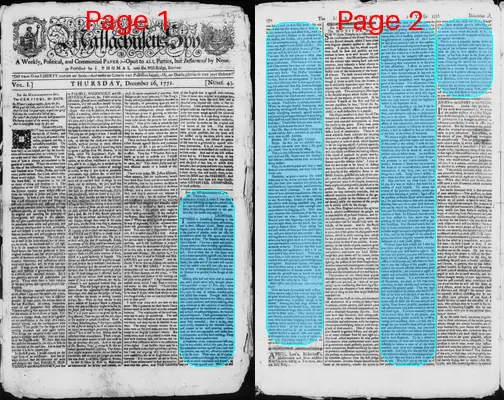
The Massachusetts Spy
Boston, Suffolk County, Massachusetts
What is this article about?
Leonidas writes to Mr. Thomas of the Massachusetts Spy, submitting satirical paragraphs from Cato's Letters that mock Cato's ineffective adversaries—paid pamphleteers, jesting critics, and opportunistic authors—who fail to gain notice or reward, urging Cato to acknowledge them as his own creations.
Merged-components note: Continuation of the same letter to the editor across pages, as text flows directly from one to the next.
Clippings
1 of 2
OCR Quality
Full Text
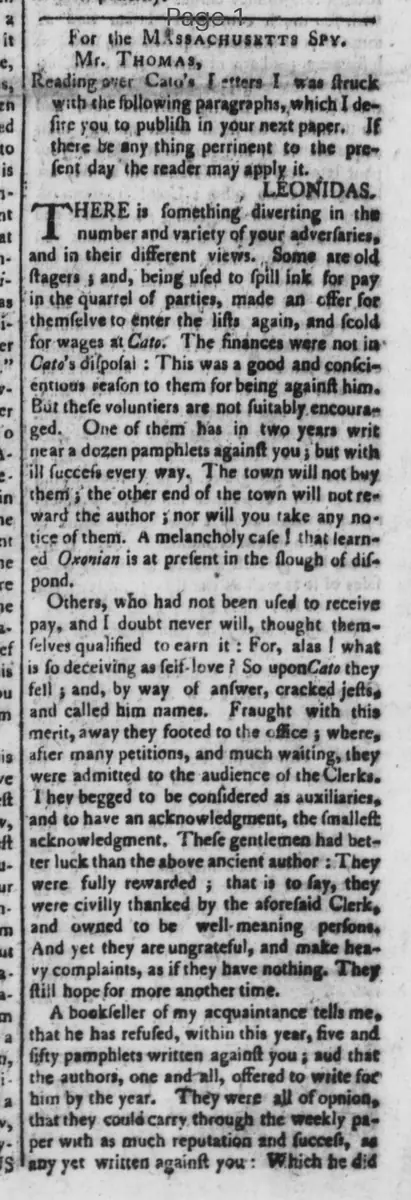
Mr. THOMAS,
Reading over Cato's Letters I was struck with the following paragraphs, which I desire you to publish in your next paper. If there be any thing pertinent to the present day the reader may apply it.
LEONIDAS.
There is something diverting in the number and variety of your adversaries, and in their different views. Some are old stagers ; and, being used to spill ink for pay in the quarrel of parties, made an offer for themselves to enter the lists again, and could for wages at Cato. The finances were not in Cato's disposal : This was a good and conscientious reason to them for being against him. But these volunteers are not suitably encouraged. One of them has in two years writ near a dozen pamphlets against you; but with ill success every way. The town will not buy them ; the other end of the town will not reward the author ; nor will you take any notice of them. A melancholy case ! that learned Oxonian is at present in the slough of despond.
Others, who had not been used to receive pay, and I doubt never will, thought themselves qualified to earn it : For, alas ! what is so deceiving as self-love ? So upon Cato they fell ; and, by way of answer, cracked jests. and called him names. Fraught with this merit, away they footed to the office ; where, after many petitions, and much waiting, they were admitted to the audience of the Clerks. They begged to be considered as auxiliaries. and to have an acknowledgment, the smallest acknowledgment, These gentlemen had better luck than the above ancient author : They were fully rewarded ; that is to say, they were civilly thanked by the aforesaid Clerk, and owned to be well-meaning persons.
And yet they are ungrateful, and make heavy complaints, as if they have nothing. They still hope for more another time.
A bookseller of my acquaintance tells me that he has refused, within this year, five and fifty pamphlets written against you; and that the authors, one and all, offered to write for him by the year. They were all of opinion, that they could carry through the weekly paper with as much reputation and success, as any yet written against you: Which he did
not deny; and yet dismissed them. He told me, it was but last winter, that a man in a livery came to him, and asked him, what he would give for a sermon to be preached by his master, the Doctor, on a publick occasion? he answered, nothing. Oh, sir, says the valet, my master's will sell like wildfire. You cannot think, sir, how purely he claws off Cato: And you will see he'll soon be made a ---. You may see, sir that you are a useful man to many, and even considered as a scale to great preferment. This sermon is since out, and it has neither hurt you nor exalted the preacher, though he has there laboured the point very hard. The Doctor wanted no good will, whatever else he wants. Unlucky for him, there is not an argument (I should have said assertion) used by him against writing, but what will bear fifty times as strongly against preaching. I will, however, acquit him from meaning this consequence, or any other besides that which his man meant; and which seems a consequence at least extremely remote. The Doctor is, indeed, admirable: While he thought himself haranguing and scattering words against libelling, he was actually inveighing virulently against himself, and preaching an angry libel against preaching. May the Press and Liberty be ever blessed with such foes! The Doctor does not want words; it is pity but he knew the use of them. Says Mr. Bayes in the rehearsal, I bring out my bull and my bear; and what do you think I make them do Mr. Johnson. Johnson. Do! why, fight, I suppose Bayes. See how you are mistaken now; I would as soon make them dance; No, i-gad, sir, I make them do no earthly thing. There is this difference between the Doctor's bull and Mr. Bayes's bull the Doctor's bull bellows; besides this he does no earthly thing neither. Pray, sir, be not too proud and lazy; -- read some of your adversaries, and their bulls will divert you. Methinks, as great a man as the world takes you to be, and as you may think yourself, you treat your intended adversaries, but real friends, too superciliously, and, I conceive, with too much contempt. I am told by some of your intimate acquaintance, that you have never read any of their works; and yet, to my knowledge, several of them please themselves with having mortified you, and do themselves no small credit amongst their acquaintance by bragging of it. Give your poor retainers this consolation, since they are like to have no other: Consider them as Brats of your own begetting; and, since you have brought them into the world, that you ought to support them. Your taking but the least notice of them and their performances, will give them food and raiment: But I will beg leave to say, that it is very unnatural, when you have given birth to so many innocent and harmless creatures, to leave them afterwards to starve. You see that they want no industry and application; and it is not their fault if they want success. Take generous Cato, a little notice of them; and I am sure they will gratefully acknowledge your indulgence. Read their labours, and condescend to throw away a few leisure hours in the contemplation of human nature. It becomes the greatest men to know the weak sides of it as well as the strong; at least you will learn this lesson by it, that Man differs more from man than man from beast. Give me leave to conclude with a story: Once upon a time, I saw a brave large bull, of great comeliness and dignity, brought out upon a green near a country village to be baited. Among the bull dogs fetched to bait him, were seen several dirty deformed curs, called house-dogs, that vented all their choler in filthy noise. They barked aloud and bitterly, and disturbed every body but the bull, who at all their snapping, sniveling, and snarling, never turned his head, nor moved a foot or horn. At last the squire of the place, who presided at the entertainment, shewed himself a man of taste and equity. Take away says he, with a voice of authority, take away these yelping mungrels: We do not use to bait bulls with turnspits.
What sub-type of article is it?
What themes does it cover?
What keywords are associated?
What entities or persons were involved?
Letter to Editor Details
Author
Leonidas
Recipient
Mr. Thomas
Main Argument
the letter satirizes cato's ineffective and unrewarded adversaries, portraying them as desperate for attention and pay, and advises cato to read and acknowledge their works to support these 'brats of his own begetting' rather than ignoring them contemptuously.
Notable Details