Thank you for visiting SNEWPapers!
Sign up free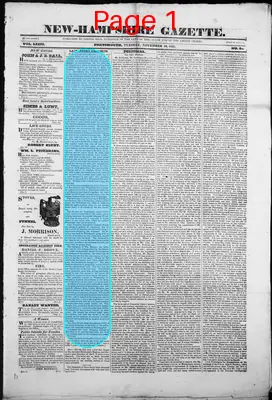
The New Hampshire Gazette
Portsmouth, Rockingham County, New Hampshire
What is this article about?
Trial of Capt. W.D. Freeman for murdering mariner David Whitehead on brig Floyd. Testimony detailed brutal beatings, lashings, and forcing weakened Whitehead aloft, leading to his fatal fall overboard. Jury convicted of manslaughter; sentenced to 2.5 years imprisonment and $100 fine.
Clipping

OCR Quality
Full Text
Trial of Capt. Freeman.—In the published
evidence given on the trial of Capt. W. D.
Freeman, for the murder of David Whitehead,
mariner, the testimony of Thomas Richardson,
mariner, of Southborough, Ms. set forth that
he shipped with others on board the brig Floyd
at Charleston, S. C. on the 6th of April, for
Antwerp. The ship's Company consisted of
nine. Whitehead, who was about 22 years
of age, shipped as cook, but not giving satisfac-
tion he exchanged places with one of the crew.
Whitehead never went into the cabin without
being beat either by the captain or by the
mate under his orders. On the 25th, ten days
after sailing he was set on the foretopgall yard
to let a reef out, and having by accident left a
point untied the sail was split. When the
captain saw the hole, and found out how it
came, he called Whitehead aft and beat and
kicked him in such a manner that the skin all
over his head was broken, and his arms were
all black and blue. On the next day he was
lashed 24 hours to the ring-bolt, and 24 to
the rail, with his hands tied behind him. In
the latter situation the captain daubed his
mouth with tar, and asked him where he had
been stealing molasses. The weather being
very cold the captain asked him if he wanted a
dram. He said he did, when the captain said
'I will give you a dram that will fix you,' and
he gave him a double dose of tartar emetic with
some kind of spirit, which made him vomit.—
The captain frequently swore that he should not
be satisfied until he saw his end. Before being
tied he was sent up to scrape the main topgal-
lantmast, and not doing it to the captain's sat-
sfaction, he tried to shake him from the rigging,
the wind at the time was blowing fresh. While
he was tied, (two days) he had but half a
biscuit to eat, which was broken up, and he
took it up in his mouth like a beast and ate it.
The captain made him take off one of two
pair of trowsers, and then pump the ship, the
water dashing over him as well as the sea break-
ing over. On the morning of the 27th, he un-
tied him and set him to scrub the deck; soon
after the mainsail was ordered to be handed;
five men went on the yard; the Capt. asked
the mate why he did not send that damned sol-
dier* aloft to help hand the mainsail; the mate
replied that he was not able, and witness said,
'Capt. Freeman, if that man goes up he never
comes on deck again alive;' the captain order-
ed him up, and as he climbed slowly struck
him with a rope; he reached the yard, went on
the lee yard arm; witness then asked him to
'hand the leach if you can.' and reaching
forward to take hold of it, Whitehead fell over-
board. Witness tried to throw him a rope, but
could not.
Upon his cross-examination, Richardson sta-
ted that Fearson and Whitehead had attempt-
ed to get ashore while in Charleston harbor by
a raft made of spars lashed together, but were
picked up and brought on board again; that the
captain treated all the men with ill language.
The testimony of John Fearson, of Baltimore,
corroborated that of Richardson, and he further
stated that Whitehead was made to walk the
deck two nights without sleep for not having
dinner ready at 12 o'clock on the day of sail-
ing.
Geo. Barber, an Englishman, stated that he
heard murder cried once in the cabin and on
looking down saw the captain whipping White-
head over the face with a rope, and a drawn
sword in one hand, with which he pricked
Whitehead once and drew blood.
Capt. Freeman, through his Counsel denied
the charge of general ill treatment, that he
had a sword on board at all and every thing of
importance alleged by the witnesses. No ob-
jection was made to Whitehead's going aloft on
the day of his death by any of the men, nor did
he hear any from the mate. The deceased at
the time he fell, was on the yard and not on the
foot-rope, as some of the witnesses had said, and
which was the proper place.
The testimony of Wm. Barrett, the mate,
who was the first witness called by the defend-
ant, rather unexpectedly tended to corroborate
the evidence of the seamen. He stated that he
told the captain that the man was not fit to go
aloft on the day of his death. When he fell
overboard, the captain said 'Poor fellow, he's
gone, who would have thought it.' The man
made no objection to going aloft, and he did not
see the captain strike him. The last time he
saw him he was on the foot rope. Whitehead
was a peaceable, quiet man, willing and steady,
though he had free access to the liquor; he
obeyed the captain as far as was in his power.
The prisoner's counsel on Wednesday at-
tempted to impeach the evidence of the mate,
but Judge Story did not allow it to be set aside.
A number of persons were produced to testify
to the good character of the prisoner; and four
captains (Messrs. Rich, Curtis, Margree and
Adams) testified that without the free use of his
hands and great physical strength, Whitehead
could never have reached the place from whence
he fell; and in regard to his being sent aloft to
scrape the mast, it was a light punishment; and
that unless he had held on with great strength
he might have been easily shaken off. Wm.
Sturgis, Esq. stated that he should have thought
it more difficult to reach the place from whence
Whitehead fell than to keep himself up when
there. He thought the captain might easily
have shaken him from the shroud if he had
pleased, on the occasion of scraping the mast,
and that the captain was in as much danger as
the man.
The Jury did not deem the prisoner guilty of
the crime of murder, as set forth in the indict-
ment, but rendered verdict of Manslaughter.
It is stated that Capt. Freeman belongs to
Wellfleet, C. C. and has risen from the birth
of a common sailor to the command of a vessel.
—Boston pap.
*Soldier among seamen signifies a lazy idle fellow.
On Tuesday, 30th ult. the Court sentenced
Capt. Freeman to pay a fine of $100, and to
suffer 2 years and 6 months imprisonment.
What sub-type of article is it?
What themes does it cover?
What keywords are associated?
What entities or persons were involved?
Where did it happen?
Story Details
Key Persons
Location
On Board The Brig Floyd At Sea From Charleston, S.C. To Antwerp; Trial In Boston
Event Date
Shipped 6th Of April; Events On 25th, 26th, 27th; Sentencing Tuesday, 30th Ult.
Story Details
Capt. Freeman brutally abused young cook David Whitehead on the brig Floyd, including beatings, lashings, poisoning with emetic, and forcing him aloft while weakened, leading to his fatal fall overboard. Trial testimony corroborated abuse; jury convicted of manslaughter.