Thank you for visiting SNEWPapers!
Sign up free
Literary
August 24, 1764
The New Hampshire Gazette And Historical Chronicle
Portsmouth, Greenland, Rockingham County, New Hampshire
What is this article about?
Philosophical reflections on the vanity of earthly possessions and human strife, quoting Pliny and Seneca on the world's smallness and transience. Urges spiritual focus for heavenly reward. Concludes with Burnett's vivid description of global conflagration erasing all human works.
Clipping
OCR Quality
95%
Excellent
Full Text
Of the World.
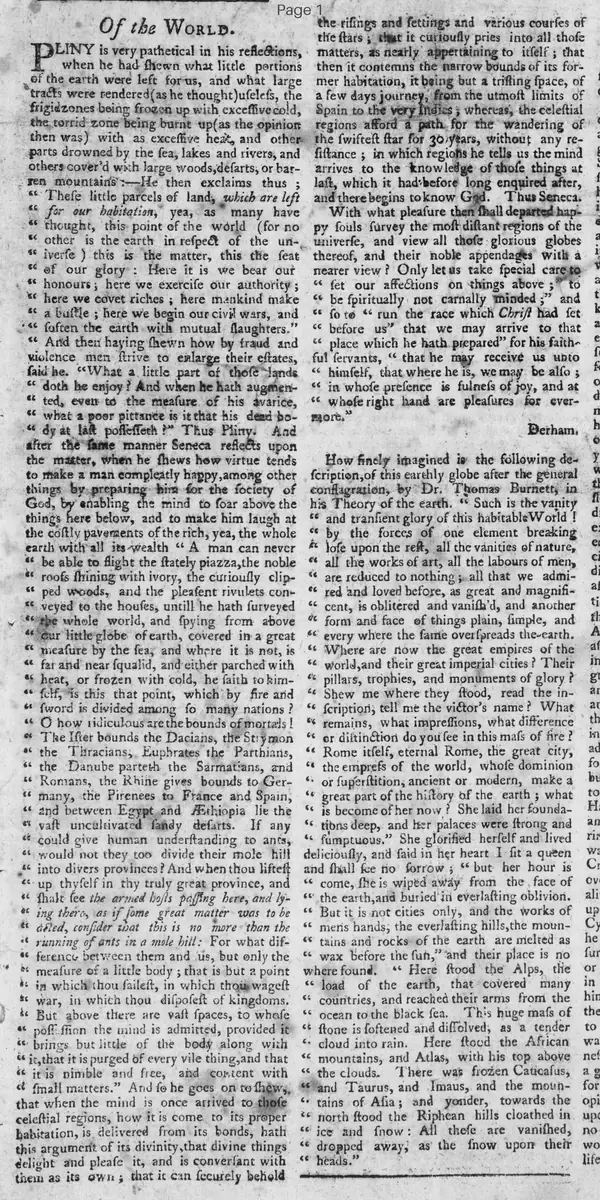
PLINY is very pathetical in his reflections, when he had shewn what little portions of the earth were left for us, and what large tracts were rendered (as he thought) useless, the frigid zones being frozen up with excessive cold, the torrid zone being burnt up (as the opinion then was) with as excessive heat, and other parts drowned by the sea, lakes and rivers, and others covered with large woods, deserts, or barren mountains. He then exclaims thus: "As these little parcels of land, which are left for our habitation, yea, as many have thought, this point of the world (for no other is the earth in respect of the universe) this is the matter, this the seat of our glory: Here it is we bear our honours: here we exercise our authority; but here we covet riches; here mankind make such a bustle; here we begin our civil wars, and often the earth with mutual slaughters." And then having shewn how by fraud and violence men strive to enlarge their estates, adds he, "What a little part of those lands doth he enjoy? And when he hath augmented even to the measure of his avarice, what a poor pittance is it that his dead body at last possesseth?" Thus Pliny. And after the same manner Seneca reflects upon the matter, when he shews how virtue tends to make a man completely happy, among other things by preparing him for the society of God, by enabling the mind to soar above the things here below, and to make him laugh at the costly pavements of the rich, yea, the whole earth with all its wealth. "A man can never be able to slight the stately piazza, the noble roofs shining with ivory, the curiously clipped woods, and the pleasant rivulets conveyed to the house, until he hath surveyed the whole world, and prying from above our little globe of earth, covered in a great measure by the sea, and where it is not, is far and near squalid, and either parched with heat or frozen with cold, he saith to himself, is this that point, which by fire and sword is divided among so many nations? O how ridiculous are the bounds of mortals! The Ister bounds the Dacians, the Strymon the Thracians; Euphrates the Parthians, the Danube parteth the Sarmatians and Romans, the Rhine gives bounds to Germany, the Pyrenees to France and Spain, and between Egypt and Ethiopia lie the vast uncultivated and sandy deserts. If any could give human understanding to ants, would not they too divide their mole hill into divers provinces? And when thou liftest up thyself in thy truly great province, and shalt see the armed hosts passing here, and lying there, as if some great matter was to be acted, consider that this is no more than the running of ants in a mole hill: For what difference between them and us, but only the measure of a little body; that is but a point in which thou sittest, in which thou wagest war, in which thou disposest of kingdoms. But above there are vast spaces, to whose possession the mind is admitted, provided it brings but little of the body along with it, that it is purged of every vile thing, and that it is humble and free, and content with small matters." And so he goes on to shew, that when the mind is once arrived to those celestial regions, how it is come to its proper habitation, is delivered from its bonds, hath this argument of its divinity, that divine things delight and please it, and is conversant with them as its own; that it can securely behold the rings and settings and various courses of the stars: that it curiously pries into all those matters as nearly appertaining to itself: that then it contemns the narrow bounds of its former habitation, it being but a trifling space of a few days journey, from the utmost limits of Spain to the very Indies; whereas, the celestial regions afford a path for the wandering of the swiftest star for 30 years, without any resistance: in which regions he tells us the mind arrives to the knowledge of those things at last, which it had before long enquired after, and there begins to know God. Thus Seneca.
With what pleasure then shall departed happy souls survey the most distant regions of the universe, and view all those glorious globes thereof, and their noble appendages with a nearer view? Only let us take special care to set our affections on things above; to be spiritually not carnally minded; and so to run the race which Christ had set before us that we may arrive to that place which he hath prepared for his faithful servants, that he may receive us unto himself, that where he is, we may be also; in whose presence is fulness of joy, and at whose right hand are pleasures for evermore.
Derham
How finely imagined is the following description of this earthly globe after the general conflagration, by Dr. Thomas Burnett, in his Theory of the Earth. "Such is the vanity and transient glory of this habitable World! By the forces of one element breaking loose upon the rest, all the vanities of nature, all the works of art, all the labours of men, are reduced to nothing; all that we admired and loved before, as great and magnificent, is obliterated and vanished, and another form and face of things plain, simple, and every where the same over spreads the earth. Where are now the great empires of the world, and their great imperial cities? Their pillars, trophies, and monuments of glory? Shew me where they stood, read the inscription; tell me the victor's name? What remains, what impressions, what difference or distinction do you see in this mass of fire? Rome itself, eternal Rome, the great city, the empress of the world, whose dominion or superstition, ancient or modern, make a great part of the history of the earth; what is become of her now? She laid her foundations deep, and her palaces were strong and sumptuous. She glorified herself and lived deliciously, and said in her heart I sit a queen and shall see no sorrow; but her hour is come, she is wiped away from the face of the earth, and buried in everlasting oblivion. But it is not cities only, and the works of men's hands; the everlasting hills, the mountains and rocks of the earth are melted as wax before the sun, and their place is no where found. Here stood the Alps, the load of the earth, that covered many countries, and reached their arms from the ocean to the black sea. This huge mass of stone is softened and dissolved, as a tender cloud into rain. Here stood the African mountains, and Atlas, with his top above the clouds. There was frozen Caucasus, and Taurus, and Imaus, and the mountains of Asia; and yonder, towards the north stood the Riphean hills clothed in ice and snow. All these are vanished, dropped away, as the snow upon their heads."
PLINY is very pathetical in his reflections, when he had shewn what little portions of the earth were left for us, and what large tracts were rendered (as he thought) useless, the frigid zones being frozen up with excessive cold, the torrid zone being burnt up (as the opinion then was) with as excessive heat, and other parts drowned by the sea, lakes and rivers, and others covered with large woods, deserts, or barren mountains. He then exclaims thus: "As these little parcels of land, which are left for our habitation, yea, as many have thought, this point of the world (for no other is the earth in respect of the universe) this is the matter, this the seat of our glory: Here it is we bear our honours: here we exercise our authority; but here we covet riches; here mankind make such a bustle; here we begin our civil wars, and often the earth with mutual slaughters." And then having shewn how by fraud and violence men strive to enlarge their estates, adds he, "What a little part of those lands doth he enjoy? And when he hath augmented even to the measure of his avarice, what a poor pittance is it that his dead body at last possesseth?" Thus Pliny. And after the same manner Seneca reflects upon the matter, when he shews how virtue tends to make a man completely happy, among other things by preparing him for the society of God, by enabling the mind to soar above the things here below, and to make him laugh at the costly pavements of the rich, yea, the whole earth with all its wealth. "A man can never be able to slight the stately piazza, the noble roofs shining with ivory, the curiously clipped woods, and the pleasant rivulets conveyed to the house, until he hath surveyed the whole world, and prying from above our little globe of earth, covered in a great measure by the sea, and where it is not, is far and near squalid, and either parched with heat or frozen with cold, he saith to himself, is this that point, which by fire and sword is divided among so many nations? O how ridiculous are the bounds of mortals! The Ister bounds the Dacians, the Strymon the Thracians; Euphrates the Parthians, the Danube parteth the Sarmatians and Romans, the Rhine gives bounds to Germany, the Pyrenees to France and Spain, and between Egypt and Ethiopia lie the vast uncultivated and sandy deserts. If any could give human understanding to ants, would not they too divide their mole hill into divers provinces? And when thou liftest up thyself in thy truly great province, and shalt see the armed hosts passing here, and lying there, as if some great matter was to be acted, consider that this is no more than the running of ants in a mole hill: For what difference between them and us, but only the measure of a little body; that is but a point in which thou sittest, in which thou wagest war, in which thou disposest of kingdoms. But above there are vast spaces, to whose possession the mind is admitted, provided it brings but little of the body along with it, that it is purged of every vile thing, and that it is humble and free, and content with small matters." And so he goes on to shew, that when the mind is once arrived to those celestial regions, how it is come to its proper habitation, is delivered from its bonds, hath this argument of its divinity, that divine things delight and please it, and is conversant with them as its own; that it can securely behold the rings and settings and various courses of the stars: that it curiously pries into all those matters as nearly appertaining to itself: that then it contemns the narrow bounds of its former habitation, it being but a trifling space of a few days journey, from the utmost limits of Spain to the very Indies; whereas, the celestial regions afford a path for the wandering of the swiftest star for 30 years, without any resistance: in which regions he tells us the mind arrives to the knowledge of those things at last, which it had before long enquired after, and there begins to know God. Thus Seneca.
With what pleasure then shall departed happy souls survey the most distant regions of the universe, and view all those glorious globes thereof, and their noble appendages with a nearer view? Only let us take special care to set our affections on things above; to be spiritually not carnally minded; and so to run the race which Christ had set before us that we may arrive to that place which he hath prepared for his faithful servants, that he may receive us unto himself, that where he is, we may be also; in whose presence is fulness of joy, and at whose right hand are pleasures for evermore.
Derham
How finely imagined is the following description of this earthly globe after the general conflagration, by Dr. Thomas Burnett, in his Theory of the Earth. "Such is the vanity and transient glory of this habitable World! By the forces of one element breaking loose upon the rest, all the vanities of nature, all the works of art, all the labours of men, are reduced to nothing; all that we admired and loved before, as great and magnificent, is obliterated and vanished, and another form and face of things plain, simple, and every where the same over spreads the earth. Where are now the great empires of the world, and their great imperial cities? Their pillars, trophies, and monuments of glory? Shew me where they stood, read the inscription; tell me the victor's name? What remains, what impressions, what difference or distinction do you see in this mass of fire? Rome itself, eternal Rome, the great city, the empress of the world, whose dominion or superstition, ancient or modern, make a great part of the history of the earth; what is become of her now? She laid her foundations deep, and her palaces were strong and sumptuous. She glorified herself and lived deliciously, and said in her heart I sit a queen and shall see no sorrow; but her hour is come, she is wiped away from the face of the earth, and buried in everlasting oblivion. But it is not cities only, and the works of men's hands; the everlasting hills, the mountains and rocks of the earth are melted as wax before the sun, and their place is no where found. Here stood the Alps, the load of the earth, that covered many countries, and reached their arms from the ocean to the black sea. This huge mass of stone is softened and dissolved, as a tender cloud into rain. Here stood the African mountains, and Atlas, with his top above the clouds. There was frozen Caucasus, and Taurus, and Imaus, and the mountains of Asia; and yonder, towards the north stood the Riphean hills clothed in ice and snow. All these are vanished, dropped away, as the snow upon their heads."
What sub-type of article is it?
Essay
What themes does it cover?
Moral Virtue
Death Mortality
Religious
What keywords are associated?
Vanity Of World
Pliny Reflections
Seneca Virtue
Spiritual Elevation
Earth Conflagration
Burnett Theory
What entities or persons were involved?
Derham
Literary Details
Title
Of The World.
Author
Derham
Subject
Reflections On The Vanity Of The World And Spiritual Elevation
Form / Style
Prose Essay With Classical Quotations
Key Lines
As These Little Parcels Of Land, Which Are Left For Our Habitation, Yea, As Many Have Thought, This Point Of The World (For No Other Is The Earth In Respect Of The Universe) This Is The Matter, This The Seat Of Our Glory: Here It Is We Bear Our Honours: Here We Exercise Our Authority; But Here We Covet Riches; Here Mankind Make Such A Bustle; Here We Begin Our Civil Wars, And Often The Earth With Mutual Slaughters.
O How Ridiculous Are The Bounds Of Mortals! The Ister Bounds The Dacians, The Strymon The Thracians; Euphrates The Parthians, The Danube Parteth The Sarmatians And Romans, The Rhine Gives Bounds To Germany, The Pyrenees To France And Spain, And Between Egypt And Ethiopia Lie The Vast Uncultivated And Sandy Deserts.
Such Is The Vanity And Transient Glory Of This Habitable World! By The Forces Of One Element Breaking Loose Upon The Rest, All The Vanities Of Nature, All The Works Of Art, All The Labours Of Men, Are Reduced To Nothing;