Thank you for visiting SNEWPapers!
Sign up free
Daily National Intelligencer
Washington, District Of Columbia
What is this article about?
In this final installment of a series, 'A Member of Congress' argues that U.S. manufacturers' current struggles stem from widespread economic issues caused by the banking system's excesses, not a lack of government support. He opposes special bounties or protections, asserting that natural economic recovery will foster sustainable domestic manufacturing without such interventions.
Clipping
OCR Quality
Full Text
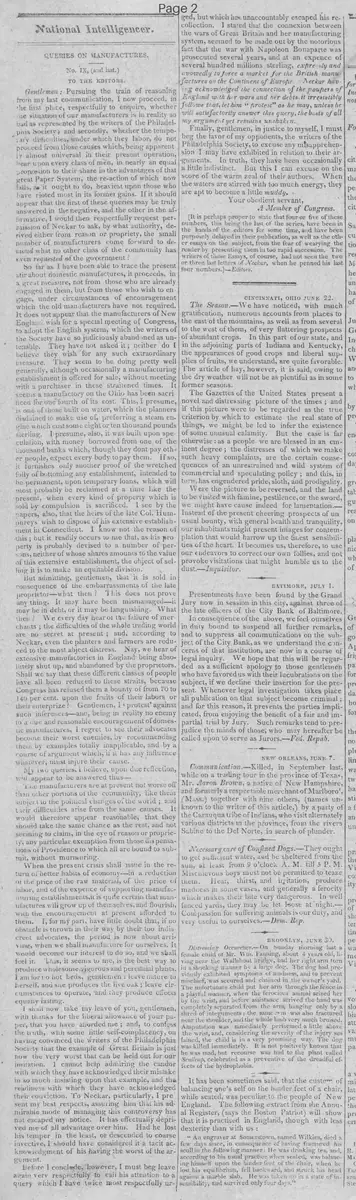
QUERIES ON MANUFACTURES.
No. IX, (and last.)
TO THE EDITORS.
Gentlemen: Pursuing the train of reasoning from my last communication, I now proceed, in the first place, respectfully to enquire, whether the situation of our manufacturers is in reality so bad as represented by the writers of the Philadelphia Society; and secondly, whether the temporary difficulties, under which they labor, do not proceed from those causes which, being apparent in almost universal in their present operation, bear upon every class of men, in nearly an equal proportion to their share in the advantages of that great Paper System, the re-action of which now falls, as it ought to do, heaviest upon those who have rioted most in its former gains. If it should appear that the first of these queries may be truly answered in the negative, and the other in the affirmative, I would then respectfully request permission of Neckar to ask, by what authority, derived either from reason or propriety, the small number of manufacturers come forward to demand what no other class of the community has even requested of the government?
So far as I have been able to trace the present stir about domestic manufactures, it proceeds, in a great measure, not from those who are already engaged in them, but from those who wish to engage, under circumstances of encouragement which the old manufacturers have not required. It does not appear that the manufacturers of New England wish for a special meeting of Congress, to adopt the English system, which the writers of the Society have so judiciously abandoned as untenable. They have not asked it; neither do I believe they wish for any such extraordinary measure. They seem to be doing pretty well generally, although occasionally a manufacturing establishment is offered for sale, without meeting with a purchaser in these straitened times. It seems a manufactory on the Ohio has been sacrificed for one fourth of its cost. This, I presume, is one of those built on water, which the planners disdained to make use of, preferring a steam engine which cost some eight or ten thousand pounds sterling. I presume, also, it was built upon speculation, with money borrowed from one of the thousand banks which, though they dont pay other people, expect every body to pay them. If so, it furnishes only another proof of the wretched folly of bottoming any establishment, intended to be permanent, upon temporary loans, which will most probably be reclaimed at a time like the present, when every kind of property which is sold by compulsion is sacrificed. I see by the papers, also, that the heirs of the late Col. Humphreys wish to dispose of his extensive establishment in Connecticut. I know not the reason of this; but it readily occurs to me that, as his property is probably devised to a number of persons, neither of whose shares amounts to the value of this extensive establishment, the object of selling it is to make an equitable division.
But admitting, gentlemen, that it is sold in consequence of the embarrassments of the late proprietor—what then? This does not prove any thing. It may have been mismanaged—it may be in debt, or it may be languishing. What then? We every day hear of the failure of merchants; the difficulties of the whole trading world are no secret at present; and, according to Neckar, even the planters and farmers are reduced to the most abject distress. Nay, we hear of extensive manufactories in England being absolutely shut up, and abandoned by the proprietors. Shall we say that these different classes of people have all been reduced to these straits, because Congress has refused them a bounty of from 70 to 140 per cent. upon the fruits of their labors or their enterprize? Gentlemen, I 'protest' against such inferences—and, being in reality no enemy to a due and reasonable encouragement of domestic manufactures, I regret to see their advocates become their worst enemies, by recommending them by examples totally inapplicable, and by a course of argument which, if it has any influence whatever, must injure their cause.
My two queries, I believe, upon due reflection, will appear to be answered thus—
'The manufacturers are at present not worse off than other portions of the community, like them subject to the political changes of the world; and their difficulties arise from the same causes. It would therefore appear reasonable, that they should take the same chance as the rest, and not seeming to claim, in the eye of reason or propriety, any particular exemption from those dispensations of Providence to which all are bound to submit, without murmuring.
When the present crisis shall issue in the return of better habits of economy—in a reduction of the price of the raw material, of the price of labor, and of the expence of supporting manufacturing establishments, it is quite certain that manufactures will grow up of themselves, and flourish, with the encouragement at present afforded to them. I, for my part, have little doubt that, if no obstacle is thrown in their way by their too indiscreet advocates, the period is now about arriving, when we shall manufacture for ourselves. It would become our interest to do so, and we shall feel it. This, it seems to me, is the best way to produce wholesome, vigorous and perennial plants. I am for no hot beds, gentlemen: leave nature to herself, and she produces the live oak; leave circumstances to operate, and they produce effects equally lasting.'
I shall now take my leave of you, gentlemen, with thanks for the liberal allowance of your paper, that you have afforded me; and, to confess the truth, with some little self-complacency, on having convinced the writers of the Philadelphia Society that the example of Great Britain is just now the very worst that can be held out for our imitation. I cannot help admiring the candor with which they have acknowledged their mistake in so much insisting upon that example, and the readiness with which they have acknowledged their conviction. To Neckar, particularly, I present my best respects, assuring him that his admirable mode of managing this controversy has not escaped my notice. It has effectually deprived me of all advantage over him. Had he lost his temper in the least, or descended to coarse invective, I should have considered it a tacit acknowledgment of his having the worst of the argument.
Before I conclude, however, I must beg leave again very respectfully to call his attention to a query which I have twice most respectfully urged, but which has unaccountably escaped his recollection. I stated that the connexion between the wars of Great Britain and her manufacturing system, seemed to be made out by the notorious fact that the war with Napoleon Bonaparte was prosecuted several years, and at an expence of several hundred millions sterling, expressly and avowedly to force a market for the British manufactures on the Continent of Europe. Neckar having acknowledged the connection of the paupers of England with her wars and her debts, it irresistibly follows that, let him "protest" as he may, unless he will satisfactorily answer this query, the basis of all my argument yet remains unshaken.
Finally, gentlemen, in justice to myself, I must beg the favor of my opponents, the writers of the Philadelphia Society, to excuse any misapprehension I may have exhibited in relation to their arguments. In truth, they have been occasionally a little indistinct. But this I can excuse on the score of the warm zeal of their authors. When the waters are stirred with too much energy, they are apt to become a little muddy.
Your obedient servant,
A Member of Congress.
[It is perhaps proper to state that four or five of these numbers, this being the last of the series, have been in the hands of the editors for some time, and have been purposely delayed in their publication, as well as the other essays on the subject, from the fear of wearying the reader by presenting them in too rapid succession. The writers of these Essays, of course, had not seen the two or three last letters of Neckar, when he penned his last four numbers.]—Editors.
What sub-type of article is it?
What themes does it cover?
What keywords are associated?
What entities or persons were involved?
Letter to Editor Details
Author
A Member Of Congress
Recipient
The Editors
Main Argument
the difficulties of u.s. manufacturers are not uniquely severe but arise from general economic pressures due to the banking system's excesses; thus, they should not demand special government bounties or protections, as natural recovery will promote sustainable domestic manufacturing.
Notable Details