Thank you for visiting SNEWPapers!
Sign up free
Story
January 20, 1912
The Freeman
Indianapolis, Marion County, Indiana
What is this article about?
Mound Bayou, Mississippi's oldest all-Black town, hosts a conference led by Hon. Charles Banks to boost Negro business, featuring speeches, stock subscriptions for a new oil mill, and showcasing the town's thriving enterprises and self-reliance.
Clipping
OCR Quality
98%
Excellent
Full Text
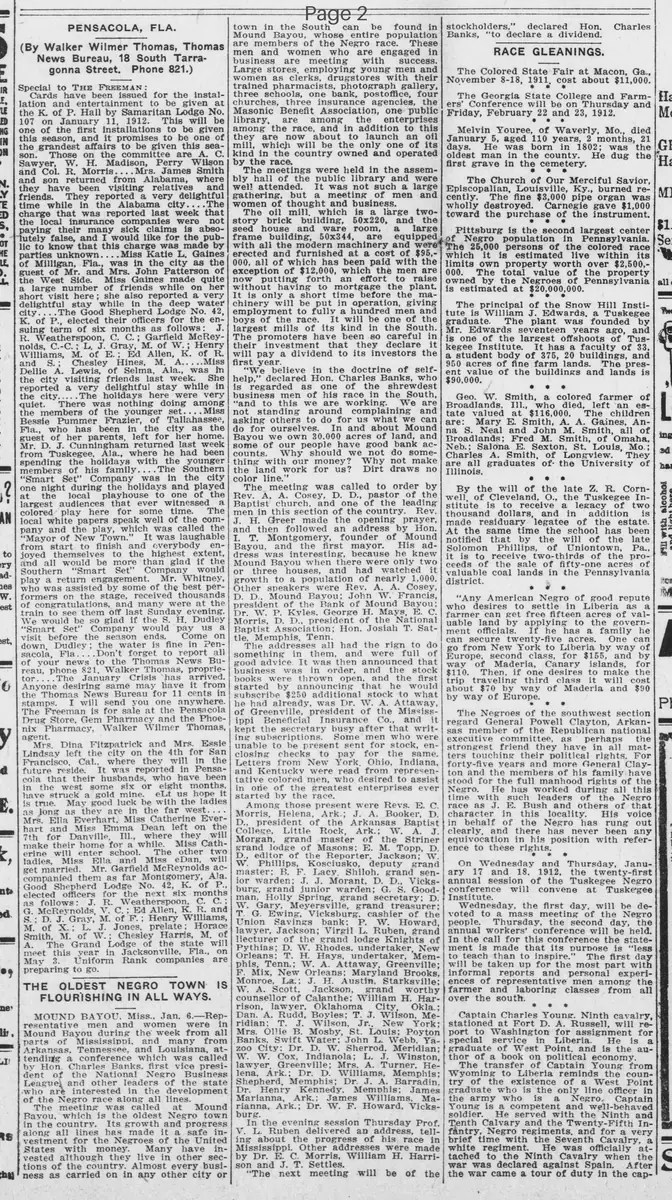
THE OLDEST NEGRO TOWN IS FLOURISHING IN ALL WAYS.
MOUND BAYOU, MISS., Jan. 6.—Representative men and women were in Mound Bayou during the week from all parts of Mississippi, and many from Arkansas, Tennessee, and Louisiana, attending a conference which was called by Hon. Charles Banks, first vice president of the National Negro Business League and other leaders of the state who are interested in the development of the Negro race along all lines.
The meeting was called at Mound Bayou, which is the oldest Negro town in the country. Its growth and progress along all lines has made it a safe investment for the Negroes of the United States with money. Many have invested although they live in other sections of the country. Almost every business as carried on in any other city or town in the South can be found in Mound Bayou, whose entire population are members of the Negro race. These men and women who are engaged in business are meeting with success. Large stores, employing young men and women as clerks, drugstores with their trained pharmacists, photograph gallery, three schools, one bank, postoffice, four churches, three insurance agencies, the Masonic Benefit Association, one public library are among the enterprises among the race, and in addition to this they are now about to launch an oil mill, which will be the only one of its kind in the country owned and operated by the race.
The meetings were held in the assembly hall of the public library and were well attended. It was not such a large gathering, but a meeting of men and women of thought and business.
The oil mill, which is a large two-story brick building, 50x220, and the seed house and ware room, a large frame building, 50x344, are equipped with all the modern machinery and were erected and furnished at a cost of $95,000, all of which has been paid with the exception of $12,000, which the men are now putting forth an effort to raise without having to mortgage the plant. It is only a short time before the machinery will be put in operation, giving employment to fully a hundred men and boys of the race. It will be one of the largest mills of its kind in the South.
The promoters have been so careful in their investment that they declare it will pay a dividend to its investors the first year.
"We believe in the doctrine of self-help," declared Hon. Charles Banks, who is regarded as one of the shrewdest business men of his race in the South. "and to this we are working. We are not standing around complaining and asking others to do for us what we can do for ourselves. In and about Mound Bayou we own 30,000 acres of land, and some of our people have good bank accounts. Why should we not do something with our money? Why not make the land work for us? Dirt draws no color line."
The meeting was called to order by Rev. A. A. Cosey, D. D., pastor of the Baptist church, and one of the leading men in this section of the country. Rev. J. H. Greer made the opening prayer, and then followed an address by Hon. I. T. Montgomery, founder of Mound Bayou, and the first mayor. His address was interesting, because he knew Mound Bayou when there were only two or three houses, and had watched its growth to a population of nearly 1,000.
Other speakers were Rev. A. A. Cosey, D. D., Mound Bayou; John W. Francis, president of the Bank of Mound Bayou; Dr. W. P. Kyles, George H. Mays, E. C. Morris, D. D., president of the National Baptist Association; Hon. Josiah T. Settle, Memphis, Tenn.
The addresses all had the ring to do something in them, and were full of good advice. It was then announced that business was in order, and the stock books were thrown open, and the first started by announcing that he would subscribe $250 additional stock to what he had already, was Dr. W. A. Attaway, of Greenville, president of the Mississippi Beneficial Insurance Co., and it kept the secretary busy after that writing subscriptions. Some men who were unable to be present sent for stock, enclosing checks to pay for the same. Letters from New York, Ohio, Indiana, and Kentucky were read from representative colored men, who desired to assist in one of the greatest enterprises ever started by the race.
Among those present were Revs. E. C. Morris, Helena, Ark.; J. A. Booker, D. D., president of the Arkansas Baptist College, Little Rock, Ark.; W. A. J. Morgan, grand master of the Striner grand lodge of Masons; E. M. Topp, D. D., editor of the Reporter, Jackson; W. W. Phillips, Kosciusko, deputy grand master; B. F. Lacy, Shiloh, grand senior warden; J. J. Morant, D. D., Vicksburg, grand junior warden; G. S. Goodman, Holly Springs, grand secretary; D. W. Gary, Meyersville, grand treasurer; T. G. Ewing, Vicksburg, cashier of the Union Savings bank; P. W. Howard, lawyer, Jackson; Virgil L. Ruben, grand lecturer of the grand lodge Knights of Pythias; D. W. Rhodes, undertaker, New Orleans; T. H. Hays, undertaker, Memphis, Tenn.; W. A. Attaway, Greenville; F. Mix, New Orleans; Maryland Brooks, Monroe, La.; J. H. Austin, Starksville; W. A. Scott, Jackson, grand worthy counsellor of Calanthe; William H. Harrison, lawyer, Oklahoma City, Okla.; Dan. A. Rudd, Boyles; T. J. Wilson, Meridian; T. J. Wilson, Jr., New York; Mrs. Ollie B. Mosby, St. Louis; Poyton Banks, Swift Water; John L. Webb, Yazoo City; Dr. D. W. Sherrod, Meridian; W. W. Cox, Indianola; L. J. Winston, lawyer, Greenville; Mrs. A. Turner, Helena, Ark.; Dr. D. Williams, Memphis; Shepherd, Memphis; Dr. J. A. Barradin, Dr. Henry Kennedy, Memphis; James Marianna, Ark.; James Williams, Marianna, Ark.; Dr. W. F. Howard, Vicksburg.
In the evening session Thursday Prof. V. L. Ruben delivered an address, telling about the progress of his race in Mississippi. Other addresses were made by Dr. E. C. Morris, William H. Harrison and J. T. Settles.
The next meeting will be of the stockholders. "to declare a dividend," declared Hon. Charles Banks.
MOUND BAYOU, MISS., Jan. 6.—Representative men and women were in Mound Bayou during the week from all parts of Mississippi, and many from Arkansas, Tennessee, and Louisiana, attending a conference which was called by Hon. Charles Banks, first vice president of the National Negro Business League and other leaders of the state who are interested in the development of the Negro race along all lines.
The meeting was called at Mound Bayou, which is the oldest Negro town in the country. Its growth and progress along all lines has made it a safe investment for the Negroes of the United States with money. Many have invested although they live in other sections of the country. Almost every business as carried on in any other city or town in the South can be found in Mound Bayou, whose entire population are members of the Negro race. These men and women who are engaged in business are meeting with success. Large stores, employing young men and women as clerks, drugstores with their trained pharmacists, photograph gallery, three schools, one bank, postoffice, four churches, three insurance agencies, the Masonic Benefit Association, one public library are among the enterprises among the race, and in addition to this they are now about to launch an oil mill, which will be the only one of its kind in the country owned and operated by the race.
The meetings were held in the assembly hall of the public library and were well attended. It was not such a large gathering, but a meeting of men and women of thought and business.
The oil mill, which is a large two-story brick building, 50x220, and the seed house and ware room, a large frame building, 50x344, are equipped with all the modern machinery and were erected and furnished at a cost of $95,000, all of which has been paid with the exception of $12,000, which the men are now putting forth an effort to raise without having to mortgage the plant. It is only a short time before the machinery will be put in operation, giving employment to fully a hundred men and boys of the race. It will be one of the largest mills of its kind in the South.
The promoters have been so careful in their investment that they declare it will pay a dividend to its investors the first year.
"We believe in the doctrine of self-help," declared Hon. Charles Banks, who is regarded as one of the shrewdest business men of his race in the South. "and to this we are working. We are not standing around complaining and asking others to do for us what we can do for ourselves. In and about Mound Bayou we own 30,000 acres of land, and some of our people have good bank accounts. Why should we not do something with our money? Why not make the land work for us? Dirt draws no color line."
The meeting was called to order by Rev. A. A. Cosey, D. D., pastor of the Baptist church, and one of the leading men in this section of the country. Rev. J. H. Greer made the opening prayer, and then followed an address by Hon. I. T. Montgomery, founder of Mound Bayou, and the first mayor. His address was interesting, because he knew Mound Bayou when there were only two or three houses, and had watched its growth to a population of nearly 1,000.
Other speakers were Rev. A. A. Cosey, D. D., Mound Bayou; John W. Francis, president of the Bank of Mound Bayou; Dr. W. P. Kyles, George H. Mays, E. C. Morris, D. D., president of the National Baptist Association; Hon. Josiah T. Settle, Memphis, Tenn.
The addresses all had the ring to do something in them, and were full of good advice. It was then announced that business was in order, and the stock books were thrown open, and the first started by announcing that he would subscribe $250 additional stock to what he had already, was Dr. W. A. Attaway, of Greenville, president of the Mississippi Beneficial Insurance Co., and it kept the secretary busy after that writing subscriptions. Some men who were unable to be present sent for stock, enclosing checks to pay for the same. Letters from New York, Ohio, Indiana, and Kentucky were read from representative colored men, who desired to assist in one of the greatest enterprises ever started by the race.
Among those present were Revs. E. C. Morris, Helena, Ark.; J. A. Booker, D. D., president of the Arkansas Baptist College, Little Rock, Ark.; W. A. J. Morgan, grand master of the Striner grand lodge of Masons; E. M. Topp, D. D., editor of the Reporter, Jackson; W. W. Phillips, Kosciusko, deputy grand master; B. F. Lacy, Shiloh, grand senior warden; J. J. Morant, D. D., Vicksburg, grand junior warden; G. S. Goodman, Holly Springs, grand secretary; D. W. Gary, Meyersville, grand treasurer; T. G. Ewing, Vicksburg, cashier of the Union Savings bank; P. W. Howard, lawyer, Jackson; Virgil L. Ruben, grand lecturer of the grand lodge Knights of Pythias; D. W. Rhodes, undertaker, New Orleans; T. H. Hays, undertaker, Memphis, Tenn.; W. A. Attaway, Greenville; F. Mix, New Orleans; Maryland Brooks, Monroe, La.; J. H. Austin, Starksville; W. A. Scott, Jackson, grand worthy counsellor of Calanthe; William H. Harrison, lawyer, Oklahoma City, Okla.; Dan. A. Rudd, Boyles; T. J. Wilson, Meridian; T. J. Wilson, Jr., New York; Mrs. Ollie B. Mosby, St. Louis; Poyton Banks, Swift Water; John L. Webb, Yazoo City; Dr. D. W. Sherrod, Meridian; W. W. Cox, Indianola; L. J. Winston, lawyer, Greenville; Mrs. A. Turner, Helena, Ark.; Dr. D. Williams, Memphis; Shepherd, Memphis; Dr. J. A. Barradin, Dr. Henry Kennedy, Memphis; James Marianna, Ark.; James Williams, Marianna, Ark.; Dr. W. F. Howard, Vicksburg.
In the evening session Thursday Prof. V. L. Ruben delivered an address, telling about the progress of his race in Mississippi. Other addresses were made by Dr. E. C. Morris, William H. Harrison and J. T. Settles.
The next meeting will be of the stockholders. "to declare a dividend," declared Hon. Charles Banks.
What sub-type of article is it?
Historical Event
Personal Triumph
What themes does it cover?
Triumph
Moral Virtue
What keywords are associated?
Mound Bayou
Negro Town
Oil Mill
Charles Banks
Self Help
Business Conference
Race Progress
What entities or persons were involved?
Hon. Charles Banks
Hon. I. T. Montgomery
Rev. A. A. Cosey
John W. Francis
Dr. W. P. Kyles
George H. Mays
E. C. Morris
Hon. Josiah T. Settle
Dr. W. A. Attaway
Where did it happen?
Mound Bayou, Miss.
Story Details
Key Persons
Hon. Charles Banks
Hon. I. T. Montgomery
Rev. A. A. Cosey
John W. Francis
Dr. W. P. Kyles
George H. Mays
E. C. Morris
Hon. Josiah T. Settle
Dr. W. A. Attaway
Location
Mound Bayou, Miss.
Event Date
Jan. 6.
Story Details
Conference in Mound Bayou, the oldest Negro town, attended by representatives to promote race development; highlights town's businesses, upcoming oil mill, and self-help ethos led by Charles Banks; speeches and stock subscriptions for the mill.