Thank you for visiting SNEWPapers!
Sign up free
Story
July 17, 1896
Foster's Daily Democrat
Dover, Strafford County, New Hampshire
What is this article about?
A Maine lawyer recounts how a young merchant's attempt to bluff creditors with letters suggesting solvency revealed his insolvency, prompting attachment of his goods and saving creditors over $1,000 in a western Maine village a quarter-century ago.
Clipping
OCR Quality
98%
Excellent
Full Text
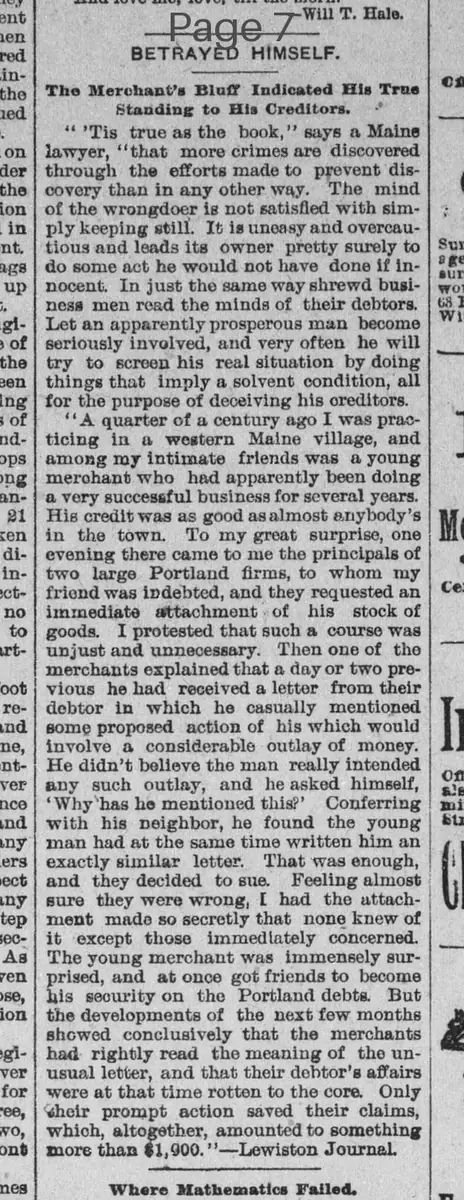
BETRAYED HIMSELF.
The Merchant's Bluff Indicated His True Standing to His Creditors.
" 'Tis true as the book," says a Maine lawyer, "that more crimes are discovered through the efforts made to prevent discovery than in any other way. The mind of the wrongdoer is not satisfied with simply keeping still. It is uneasy and overcautious and leads its owner pretty surely to do some act he would not have done if innocent. In just the same way shrewd business men read the minds of their debtors.
Let an apparently prosperous man become seriously involved, and very often he will try to screen his real situation by doing things that imply a solvent condition, all for the purpose of deceiving his creditors.
"A quarter of a century ago I was practicing in a western Maine village, and among my intimate friends was a young merchant who had apparently been doing a very successful business for several years. His credit was as good as almost anybody's in the town. To my great surprise, one evening there came to me the principals of two large Portland firms, to whom my friend was indebted, and they requested an immediate attachment of his stock of goods. I protested that such a course was unjust and unnecessary. Then one of the merchants explained that a day or two previous he had received a letter from their debtor in which he casually mentioned some proposed action of his which would involve a considerable outlay of money. He didn't believe the man really intended any such outlay, and he asked himself, 'Why has he mentioned this?' Conferring with his neighbor, he found the young man had at the same time written him an exactly similar letter. That was enough and they decided to sue. Feeling almost sure they were wrong, I had the attachment made so secretly that none knew of it except those immediately concerned.
The young merchant was immensely surprised, and at once got friends to become his security on the Portland debts. But the developments of the next few months showed conclusively that the merchants had rightly read the meaning of the unusual letter, and that their debtor's affairs were at that time rotten to the core. Only their prompt action saved their claims which, altogether, amounted to something more than $1,000."—Lewiston Journal.
The Merchant's Bluff Indicated His True Standing to His Creditors.
" 'Tis true as the book," says a Maine lawyer, "that more crimes are discovered through the efforts made to prevent discovery than in any other way. The mind of the wrongdoer is not satisfied with simply keeping still. It is uneasy and overcautious and leads its owner pretty surely to do some act he would not have done if innocent. In just the same way shrewd business men read the minds of their debtors.
Let an apparently prosperous man become seriously involved, and very often he will try to screen his real situation by doing things that imply a solvent condition, all for the purpose of deceiving his creditors.
"A quarter of a century ago I was practicing in a western Maine village, and among my intimate friends was a young merchant who had apparently been doing a very successful business for several years. His credit was as good as almost anybody's in the town. To my great surprise, one evening there came to me the principals of two large Portland firms, to whom my friend was indebted, and they requested an immediate attachment of his stock of goods. I protested that such a course was unjust and unnecessary. Then one of the merchants explained that a day or two previous he had received a letter from their debtor in which he casually mentioned some proposed action of his which would involve a considerable outlay of money. He didn't believe the man really intended any such outlay, and he asked himself, 'Why has he mentioned this?' Conferring with his neighbor, he found the young man had at the same time written him an exactly similar letter. That was enough and they decided to sue. Feeling almost sure they were wrong, I had the attachment made so secretly that none knew of it except those immediately concerned.
The young merchant was immensely surprised, and at once got friends to become his security on the Portland debts. But the developments of the next few months showed conclusively that the merchants had rightly read the meaning of the unusual letter, and that their debtor's affairs were at that time rotten to the core. Only their prompt action saved their claims which, altogether, amounted to something more than $1,000."—Lewiston Journal.
What sub-type of article is it?
Deception Fraud
Curiosity
What themes does it cover?
Deception
Justice
Fortune Reversal
What keywords are associated?
Merchant Deception
Creditors Attachment
Financial Bluff
Business Insolvency
What entities or persons were involved?
Young Merchant
Maine Lawyer
Portland Firms
Where did it happen?
Western Maine Village, Portland
Story Details
Key Persons
Young Merchant
Maine Lawyer
Portland Firms
Location
Western Maine Village, Portland
Event Date
A Quarter Of A Century Ago
Story Details
A young merchant in western Maine, facing financial ruin, writes letters to creditors implying solvency through planned expenditures, betraying his true situation. Creditors recognize the deception, attach his goods, and recover their claims exceeding $1,000.