Thank you for visiting SNEWPapers!
Sign up free
Alexandria Daily Gazette, Commercial & Political
Alexandria, Virginia
What is this article about?
On March 6, 1812, in the US House, Mr. Randolph denounces the embargo's damage to flourishing trade and war unreadiness, citing failed loans and no taxes. Mr. Johnson defends it as essential for war, claims loan success, and emphasizes rights violations by Britain demanding action. (248 characters)
Merged-components note: Continuation of the congressional debate on the embargo across pages 2 and 3; relabeled from editorial to story as it is a factual report on proceedings.
Clippings
1 of 2
OCR Quality
Full Text
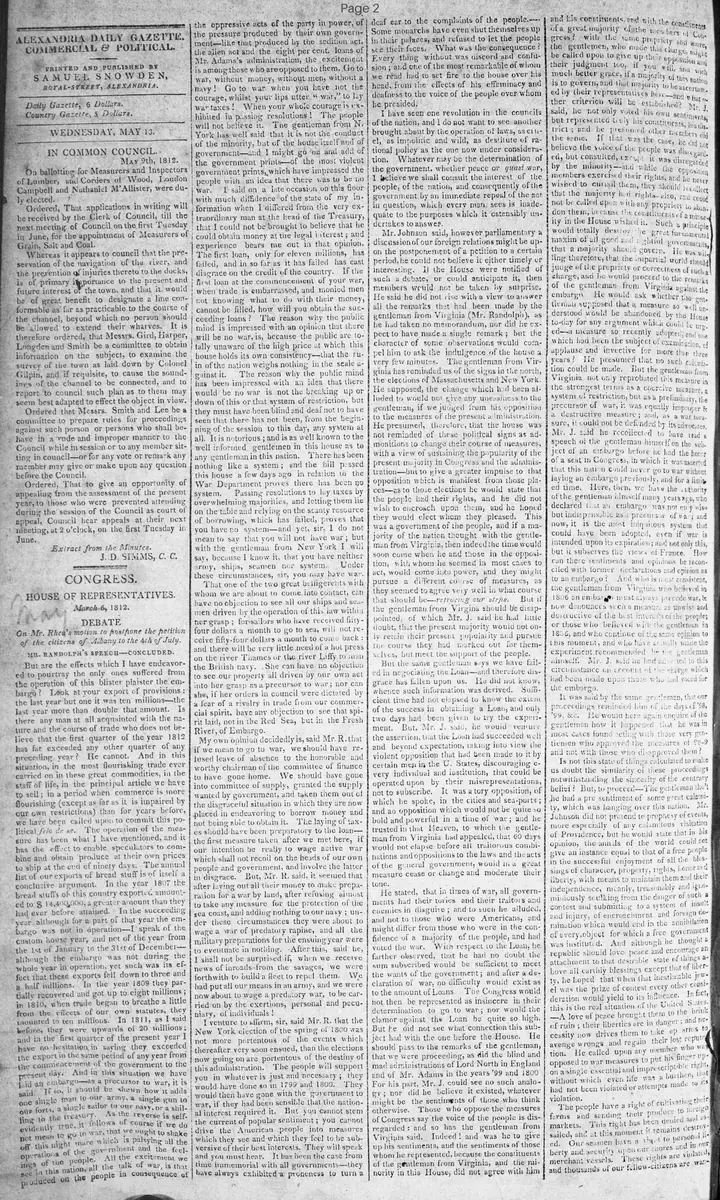
HOUSE OF REPRESENTATIVES.
March 6, 1812.
DEBATE
On Mr. Rhea's motion to postpone the petition of the citizens of Albany to the 4th of July.
MR. RANDOLPH'S SPEECH--CONCLUDED.
But are the effects which I have endeavored to portray the only ones suffered from the operation of this blister plaster the embargo? Look at your export of provisions: the last year but one it was ten millions--the last year more than double that amount. Is there any man at all acquainted with the nature and the course of trade who does not believe that the first quarter of the year 1812 has far exceeded any other quarter of any preceding year? He cannot. And in this situation, in the most flourishing trade ever carried on in these great commodities, in the staff of life, in the principal article we have to sell; in a period when commerce is more flourishing (except as far as it is impaired by our own restrictions) than for years before, we have been called upon to commit this political foi de se. The operation of the measure has been what I have mentioned, and it has the effect to enable speculators to combine and obtain produce at their own prices to ship at the end of ninety days. The annual list of our exports of bread stuff is of itself a conclusive argument. In the year 1807 the bread stuffs of this country exported amounted to $14,400,000, a greater amount than they had ever before attained. In the succeeding year although for a part of that year the embargo was not in operation--I speak of the custom house year, and not of the year from the 1st of January to the 31st of December--although the embargo was not during the whole year in operation, yet such was its effect that these exports fell down to three and a half millions. In the year 1809 they partially recovered and got up to eight millions; in 1810, when trade began to breathe a little before, they were upwards of 20 millions; in 1811, as I said from the effects of our own statutes, they mounted to ten millions. And in the first quarter of the present year I have no hesitation in saying they exceeded the export in the same period of any year from the commencement of the government to the present day. And in this situation we have laid an embargo--as a precursor to war, it is said. If so, it should be shewn how it adds one single sailor to our navy, or a single gun to our army—evidently it tolls, of course, to the treasury. As the reverse is self-evident, to shake off this nightmare which is palsying all the operations of the government and the feelings in this nation, all the talk of war, is that the people--all the excitement produced on the people in consequence of the oppressive acts of the party in power, of the pressure produced by their own government--like that produced by the sedition act, the alien act and the eight per cent. loans of Mr. Adams's administration, the excitement is among those who are opposed to them. Go to war, without money, without men, without a navy! Go to war when you have not the courage, whilst your lips utter "war," to lay war taxes! When your whole courage is exhibited in passing resolutions! The people will not believe it. The gentleman from N. York has well said that it is not the conduct of the minority, but of the house itself and of government--and I might go on and add of the government prints--of the most violent government prints, which have impressed the people with an idea that there was to be no war. I said on a late occasion on this floor with much diffidence of the state of my information when I differed from the very extraordinary man at the head of the Treasury, that I could not be brought to believe that he could obtain money at the legal interest; and experience bears me out in that opinion. The first loan, only of eleven millions, has failed, and in so far as it has failed has cast disgrace on the credit of the country. If the first loan at the commencement of your war, when trade is embarrassed, and monied men not knowing what to do with their money, cannot be filled, how will you obtain the succeeding loans? The reason why the public mind is impressed with an opinion that there will be no war, is, because the public are totally unaware of the high price at which this house holds its own consistency--that the ruin of the nation weighs nothing in the scale against it. The reason why the public mind has been impressed with an idea that there would be no war is not the breaking up or down of this or that system of restriction, but they must have been blind and deaf not to have seen that there has not been, from the beginning of the session to this day, any system at all. It is notorious; and is as well known to the well informed gentlemen in this house as to any gentleman in this nation. There has been nothing like a system; and the bill passed this house a few days ago in relation to the War Department proves there has been no system. Passing resolutions to lay taxes by overwhelming majorities, and letting them lie on the table and relying on the scanty resource of borrowing, which has failed, proves that you have no system--and yet, sir, I do not mean to say that you will not have war; but with the gentleman from New York I will say, because I know it, that you have neither army, ships, seamen nor system. Under these circumstances, sir, you may have war. That one of the two great belligerents with whom we are about to come into contact, can have no objection to see all our ships and seamen driven by the operation of this law within her grasp; for sailors who have received fifty-four dollars a month to go to sea, will not receive fifty-four dollars a month to come back: and there will be very little need of a hot press on the river Thames or the river Liffy to fill the British navy. She can have no objection to see our property all driven by our own act into her grasp as a precursor to war; nor can she, if her orders in council were dictated by a fear of a rivalry in trade from our commercial spirit, have any objection to see that spirit laid, not in the Red Sea, but in the Fresh River, of Embargo.
My own opinion decidedly is, said Mr. R. that if we mean to go to war, we should have refused leave of absence to the honorable and worthy chairman of the committee of finance to have gone home. We should have gone into committee of supply, granted the supply wanted by government, and taken them out of the disgraceful situation in which they are now placed in endeavoring to borrow money and not being able to obtain it. The laying of taxes should have been preparatory to the loan--the first measure taken after we met here, if our intention be really to wage active war which shall not recoil on the heads of our own people and government, and involve the latter in disgrace. But, Mr. R. said, it seemed that after laying out all their money to make preparation for a war by land, after refusing almost to take any measure for the protection of the sea coast, and adding nothing to our navy; under these circumstances they were about to wage a war of predatory rapine, and all the military preparations for the ensuing year were to eventuate in nothing. After this, said he, I shall not be surprised if, when we receive news of inroads from the savages, we were forthwith to build a fleet to repel them. We had put all our means in an army, and we were now about to wage a predatory war, to be carried on by the exertions, personal and pecuniary, of individuals!
I venture to affirm, sir, said Mr. R. that the New York election of the spring of 1800 was not more portentous of the events which thereafter very soon ensued, than the elections now going on are portentous of the destiny of this administration. The people will support you in whatever is just and necessary; they would have done so in 1799 and 1800. They would then have gone with the government to war, if they had been sensible that the national interest required it. But you cannot stem the current of popular sentiment; you cannot drive the American people into measures which they see and which they feel to be subversive of their best interests. They will speak and you must bear. It has been the case from time immemorial with all governments--they have always exhibited a proneness to turn a deaf ear to the complaints of the people.--Some monarchs have even shut themselves up in their palaces, and refused to let the people see their faces. What was the consequence? Every thing without was discord and confusion; and one of the most remarkable of whom we read had to set fire to the house over his head, from the effects of his effeminacy and deafness to the voice of the people over whom he presided.
I have seen one revolution in the councils of the nation, and I do not want to see another brought about by the operation of laws, as cruel, as impolitic and wild, as destitute of rational policy as the one now under consideration. Whatever may be the determination of the government, whether peace or quasi war. I believe we shall consult the interest of the people, of the nation, and consequently of the government by an immediate repeal of the act in question, which every man sees is inadequate to the purposes which it ostensibly undertakes to answer.
Mr. Johnson said, however parliamentary a discussion of our foreign relations might be upon the postponement of a petition to a certain period, he could not believe it either timely or interesting. If the House were notified of such a debate, or could anticipate it, then members would not be taken by surprise. He said he did not rise with a view to answer all the remarks that had been made by the gentleman from Virginia (Mr. Randolph), as he had taken no memorandum, nor did he expect to have made a single remark; but the character of some observations would compel him to ask the indulgence of the house a very few minutes. The gentleman from Virginia has reminded us of the signs in the north, the elections of Massachusetts and New York. He supposed, the change which had been alluded to would not give any uneasiness to the gentleman, if we judged from his opposition to the measures of the present administration. He presumed, therefore, that the house was not reminded of these political signs as admonitions to change their course of measures, with a view of sustaining the popularity of the present majority in Congress and the administration--but to give a greater impulse to that opposition which is manifest from those places--as to those elections he would state that the people had their rights, and he did not wish to encroach upon them, and he hoped they would elect whom they pleased. This was a government of the people, and if a majority of the nation thought with the gentleman from Virginia, then indeed the time would soon come when he and those in the opposition, with whom he seemed in most cases to act, would come into power, and they might pursue a different course of measures, as they seemed to agree very well in what course that should be--retracing our steps. But if the gentleman from Virginia should be disappointed, of which Mr. J. said he had little doubt, that the present majority would not only retain their present popularity and pursue the course they had marked out for themselves, but meet the support of the people.
But the same gentleman says we have failed in negotiating the Loan--and therefore disgrace has fallen upon us. He did not know, whence such information was derived. Sufficient time had not elapsed to know the extent of the success in obtaining a Loan, and only two days had been given to try the experiment. But, Mr. J. said, he would venture the assertion, that the Loan had succeeded well and beyond expectation, taking into view the violent opposition that had been made to it by certain men in the U. States, discouraging every individual and institution, that could be operated upon by their misrepresentations, not to subscribe. It was a tory opposition, of which he spoke, in the cities and sea-ports; and an opposition which would not be quite so bold and powerful in a time of war; and he trusted in that Heaven, to which the gentleman from Virginia had appealed, that 60 days would not elapse before all traitorous combinations and oppositions to the laws and the acts of the general government, would in a great measure cease or change and moderate their tone.
He stated, that in times of war, all governments had their tories and their traitors and enemies in disguise; and to such he alluded, and not to those who were Americans, and might differ from those who were in the confidence of a majority of the people, and had voted the war. With respect to the Loan, he farther observed, that he had no doubt the sum subscribed would be sufficient to meet the wants of the government; and after a declaration of war, no difficulty would exist as to the amount of Loans. The Congress would not then be represented as insincere in their determination to go to war; nor would the clamor against the Loan be quite so high.
But he did not see what connection this subject had with the one before the House. He should pass to the remarks of the gentleman, that we were proceeding, as did the blind and mad administrations of Lord North in England and of Mr. Adams in the years '99 and 1800. For his part, Mr. J. could see no such analogy; nor did he believe it existed, whatever might be the sentiments of those who think otherwise. Those who oppose the measures of Congress say the voice of the people is disregarded: and so has the gentleman from Virginia said. Indeed! and was he to give up his sentiments, and the sentiments of those whom he represented, because the constituents of the gentleman from Virginia, and the minority in this House, did not agree with him and his constituents, and with the constituents of a great majority of the members of Congress? With the same propriety and more, the gentlemen who made this charge might be called upon to give up their judgment too, if you will their opposition and with much better grace if a majority of this is to govern and that majority to be ascertained by their representatives will be established here--and what is said, he not only voted his own sentiments, but represented truly his constituents, his district; and he presumed other members did the same. If that was the case, he did not believe the voice of the people was disregarded, but consulted, except it was disregarded by the minority--and while the opposition members exercised their rights, and he never wished to curtail them, they should recollect that the majority had rights--also, and could not be called upon with any propriety to abandon them, because the constituents of a minority in the House wished it. Such a principle would totally destroy the great fundamental maxim of all good and rightful governments, that a majority should govern. He was willing therefore, that the impartial world should judge of the propriety or correctness of such a charge, and he would proceed to the remarks of the gentleman from Virginia against the embargo. He would ask whether the gentleman supposed that a measure so well understood would be abandoned by the House to-day for any argument which could be urged--a measure so recently adopted, and one which had been the subject of examination, of applause and invective for more than three years? He presumed that no such calculation could be made. But the gentleman from Virginia not only reprobated this measure in the strongest terms as a coercive measure, a system of restriction, but as a preliminary, the precursor of war, it was equally improper & a destructive measure; and, as a war measure, it could not be defended by its advocates.
Mr. J. said he recollected to have read a speech of the gentleman himself on the subject of an embargo before he had the honor of a seat in Congress, in which it was asserted that this nation could never go to war without having an embargo previously, and for a limited time. Here, then, we have the authority of the gentleman himself many years ago, who declared that an embargo was not only wise but indispensable as a precursor of war; and now, it is the most iniquitous system that could have been adopted, even if war is intended upon its expiration; and not only this, but it subserves the views of France. How can these sentiments and opinions be reconciled with former declarations and opinion as to an embargo? And who is most consistent the gentleman from Virginia who believed in 1806 an embargo must always precede war, & now denounces such a measure as unwise and destructive of the best interests of the people; or those who believed with the gentleman in 1806, and who continue of the same opinion to this moment, and who have actually made the experiment recommended by the gentleman himself. Mr. J. said he had alluded to this circumstance on account of the charge which had been made upon those who had voted for the embargo.
It was said by the same gentleman, that our proceedings reminded him of the days of '98, '99, &c. He would here again enquire of the gentleman how it happened that he was in most cases found voting with those very gentlemen who approved the measures of 98-9 and not with those who disapproved them? Is not this state of things calculated to make us doubt the similarity of these proceedings notwithstanding the sincerity of the contrary belief? But, to proceed--The gentleman tho't he had a presentiment of some great calamity, which was hanging over this nation. Mr. Johnson did not pretend to prophesy of events, more especially of any calamitous visitation of Providence, but he would state that in his opinion, the annals of the world could not give an instance equal to that of a free people in the successful enjoyment of all the blessings of character, property, rights, honor and liberty, with means to maintain them and their independence, meanly, treasonably and ignominiously sulking from the danger of such a contest and submitting to a system of insult and injury, of encroachment and foreign domination which would end in the annihilation of every object for which a free government republic should love peace and encourage an was instituted. And although he thought an attachment to that desirable state of things was the prize of contest every other consideration would yield to its influence. In fact, this is the real situation of the United States on the brink of ruin; their liberties are in danger; and necessity now drives them to take up arms to avenge wrongs and regain their lost reputation. He called upon any member who was opposed to war measures to put his finger upon a single essential and imprescriptible right, without which even life was a burthen, that had not been violated or attempts made to its violation.
The people have a right of cultivating their farms and sending their produce to foreign markets. This right has been denied and assailed, and at this moment it remains destroyed. Our seamen have a right to personal liberty and security upon our shores and in our merchant vessels. These rights are violated, and thousands of our fellow-citizens are wantonly
simply impressed in the service? The Union of these states is the ark of our safety from foreign enemies and domestic traitors. The integrity of domestic tranquility has been aimed at, that it might be succeeded by a civil war. The United States have jurisdiction in their own waters. This jurisdiction has been despised, denied and the laws violated. The frontiers are thinly settled, mostly with helpless families of men and children. These are murdered by... and British influence has not been assailed directly or indirectly--this very moment this system of destruction is not accidentally, but systematically--and at a period, and which pays no heed to remonstrances and negotiation--under this view of the grievance, to justice, to reason, the laws of nations and negociation--they must go on. He would resist and save... hazards--the U. States could not even pause--subject he should not consult dangers and ha--people, or be buried in the ruins of their o--the rights, the honor and independence of the... overthrow.
Mr. Johnson's Speech to be continued.
What sub-type of article is it?
What themes does it cover?
What keywords are associated?
What entities or persons were involved?
Where did it happen?
Story Details
Key Persons
Location
House Of Representatives, Congress
Event Date
March 6, 1812
Story Details
In a debate on postponing a petition from Albany citizens to July 4, Mr. Randolph criticizes the embargo for crippling trade, especially provisions exports, and argues the government is unprepared for war without men, ships, or funds, as the loan failed and no taxes were laid. He warns of public backlash like past elections. Mr. Johnson defends the embargo as a necessary precursor to war, counters that the loan succeeded despite opposition, asserts majority rule represents the people's voice, and highlights British violations of American rights justifying war.