Thank you for visiting SNEWPapers!
Sign up free
Gazette Of The United States, & Philadelphia Daily Advertiser
Philadelphia, Philadelphia County, Pennsylvania
What is this article about?
Debate in the U.S. House of Representatives on December 14 regarding the suspension of a law restricting foreign coin circulation to support the mint establishment. Speakers including Havens, Baldwin, Gallatin, and Otis discuss legal tender, depreciation, transportation issues, and propose extending the law's postponement.
Clipping
OCR Quality
Full Text
Thursday—December 14
Foreign Coins,
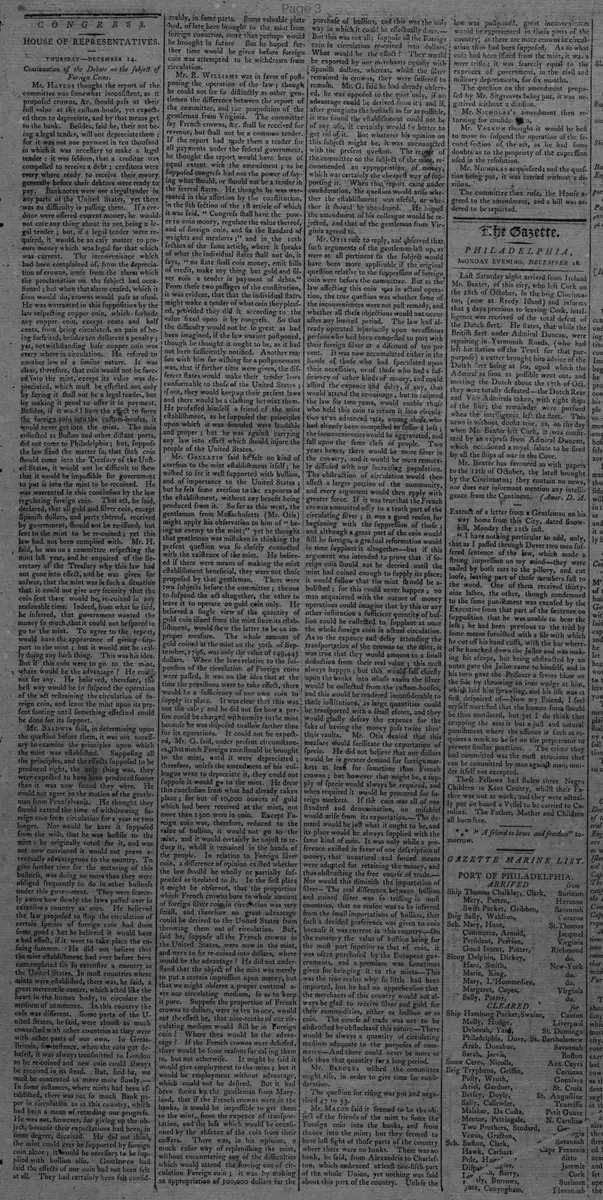
Mr. Havens thought the report of the committee was somewhat inconsistent, as it proposed crowns, &c. should pass at their full value at the custom-house, yet expected them to depreciate, and by that means get to the bank. Besides, said he, their not being a legal tender, will not depreciate them; for it was not one payment in ten thousand in which it was necessary to make a legal tender: it was seldom, that a creditor was compelled to receive a debt; creditors were every where ready to receive their money generally before their debtors were ready to pay. Bank notes were not a legal tender in any parts of the United States, yet there was no difficulty in passing them. If a creditor were offered current money, he would not care any thing about its not being a legal tender; but, if a legal tender were required, it would be an easy matter to procure money which was legal for that which was current. The inconvenience which had been complained of, from the depreciation of crowns, arose from the alarm which the proclamation on the subject had occasioned; but when that alarm ceased, which it soon would do, crowns would pass as usual. He was warranted in this supposition by the law respecting copper coin, which forbade any copper coin, except cents and half cents, from being circulated, on pain of being forfeited, besides ten dollars as a penalty; yet, notwithstanding bad copper coin was every where in circulation. He referred to another law of a similar nature. It was clear, therefore, that coin would not be forced into the mint, except its value was depreciated, which must be effected not only by saying it shall not be a legal tender, but by making it penal to offer it in payment. Besides, if it would have the effect to force the foreign coin into the custom-houses, it would never get into the mint. The coin collected at Boston and other distant ports, did not come to Philadelphia; but, suppose the law fixed the matter so, that such coin should come into the Treasury of the United States, it would not be difficult to show that it would be impossible for government to put it into the mint to be recoined. He was warranted in this conclusion by the law regulating foreign coin. That act, he said, declared, that all gold and silver coin, except Spanish dollars, and parts thereof, received by government, should not be re-issued, but sent to the mint to be re-coined; yet this law had not been complied with. Mr. H. said, he was on a committee respecting the mint last year, and he enquired of the Secretary of the Treasury why this law had not gone into effect, and he was given for answer, that the mint was in such a situation—that it could not give any security that the coin sent there would be re-coined in any reasonable time. Indeed, from what he said, he inferred, that government wanted the money so much, that it could not be spared to go to the mint. To agree to the report, would have the appearance of giving up—port to the mint; but it would not be really doing any such thing. This was his idea. But if this coin were to go to the mint, where would be the advantage? He could not see any. He believed, therefore, the best way would be to suspend the operation of the act restraining the circulation of foreign coin, and leave the mint upon its present footing until something effectual could be done for its support.
Mr. Baldwin said, in determining upon the question before them, it was not necessary to examine the principles upon which the mint was established. Supposing all the principles, and the effects supposed to be produced right, the only thing was, they were expected to have been produced sooner than it was now found they were. He could not agree to the motion of the gentleman from Pennsylvania. He thought they should extend the time of withdrawing foreign coin from circulation for a year or two longer. Nor would he have it supposed from the wish, that he was hostile to the mint: he originally voted for it, and was not now convinced it would not prove eventually advantageous to the country. To give further time for the maturing of this business, was doing no more than they were obliged frequently to do in other business under this government. They were scarcely aware how slowly the laws passed over so extensive a country as ours. He believed the law proposed to stop the circulation of certain species of foreign coin had done some good; but he believed it would have a bad effect, if it were to take place the ensuing summer. He did not believe that the mint establishment had ever before been contemplated for so extensive a country as the United States. In most countries where mints were established, there was, he said, a great mercantile center, which acted like the heart in the human body, to circulate the medium of commerce. In this country the case was different. Some parts of the United States, he said, were almost as much connected with other countries as they were with other parts of our own. In Great-Britain, for instance, when the coin got debased, it was always transmitted to London to be re-coined and new coin could always be received in its stead. But, said he, we must be contented to move more slowly.—In some instances, where mints had been established, there was not so much Bank paper in circulation as in this country, which had been a means of retarding our progress. He was not, however, for giving up the object, because their expectations had been, in some degree, deceived. He did not think the mint could ever be supported by foreign coin alone; it would be necessary to be supplied with bullion also. Gentlemen had said the effects of our coin had not been felt at all. They had certainly been felt considerably, in some parts, Some valuable plate had, of late been brought to the mint from foreign countries, more than perhaps would be brought in future. But he hoped further time would be given before foreign coin was attempted to be withdrawn from circulation.
Mr. R. Williams was in favor of postponing the operation of the law; though he could not see so distinctly as other gentlemen the difference between the report of the committee, and the proposition of the gentleman from Virginia. The committee say French crowns, &c. shall be received for revenue, but shall not be a common tender. If the report had made them a tender for all payments under the federal government, he thought the report would have been of equal extent with the amendment; as he supposed congress had not the power of saying what should, or should not be a tender in the several states. He thought he was warranted in this assertion by the constitution, in the 8th section of the 1st article of which it was said, "Congress shall have the power to coin money, regulate the value thereof, and of foreign coin, and fix the standard of weights and measures;" and in, the 10th section of the same article, where it speaks of what the individual states shall not do, it says, "no state shall coin money, emit bills of credit, make any thing but gold and silver coin a tender in payment of debts." From these two passages of the constitution, it was evident, that the individual states might make a tender of what coin they pleased, provided they did it according to the value fixed upon it by congress. So that the difficulty would not be so great as had been imagined, if the law was not postponed, though he thought it ought to be, as it had not been sufficiently notified. Another reason with him for wishing for a postponement was, that if farther time were given, the different states would make their tender laws conformable to those of the United States; if not, they would keep up their present laws and there would be a clashing betwixt them. He professed himself a friend of the mint establishment, as he supposed the principles upon which it was founded were laudable and proper; but he was against carrying any law into effect which should injure the people of the United States.
Mr. Gallatin said he felt no kind of aversion to the mint establishment itself; he wished to see it well supported with bullion, and of importance to the United States; but he felt some aversion to the expences of the establishment, without any benefit being produced from it. So far as this went, the gentleman from Massachusetts (Mr. Otis) might apply his observation to him of "being an enemy to the mint;" yet he thought that gentleman was mistaken in thinking the present question was so closely connected with the existence of the mint. He believed if there were means of making the mint establishment beneficial, they were not those proposed by that gentleman. There were two subjects before the committee; the one to suspend the act altogether, the other to leave it to operate on gold coin only. He believed a single view of the quantity of gold coin issued from the mint since its establishment, would show the latter to be an improper measure. The whole amount of gold coined at the mint on the 30th of September, 1796, was only the value of 149,445 dollars. When the laws relative to the suspension of the circulation of Foreign coins were passed, it was on the idea that at the time the provisions were to take effect, there would be a sufficiency of our own coin to supply its place. It was clear that this was not the case; and he did not see how a person could be charged with enmity to the mint because he was disposed to allow farther time for its operations. It could not be expected, Mr. G. said, under present circumstances, that much Foreign coin should be brought to the mint, until it were depreciated; therefore, unless the amendment of his colleague went to depreciate it, they could not suppose it would go to the mint. He drew this conclusion from what had already taken place; for out of 10,000 ounces of gold which had been received at the mint, not more than 1300 were in coin. Except Foreign coin was, therefore, reduced to the value of bullion, it would not go to the mint, and it would certainly be unjust to reduce it, whilst it remained in the hands of the people. In relation to Foreign silver coin, a difference of opinion existed whether the law should be wholly or partially suspended as it related to it. In the first place it might be observed, that the proportion which French crowns bore to whole amount of foreign silver coin in circulation was very small, and therefore no great advantage could be derived to the United States from throwing them out of circulation. But, said he, suppose all the French crowns in the United States, were now in the mint, and were to be re-coined into dollars, where would be the advantage? He did not understand that the object of the mint was merely to put a certain impression upon money, but that we might observe a proper controul over our circulating medium, so as to keep it pure. Suppose the proportion of French crowns to dollars, were as ten to one, would not the effect be, that nine-tenths of our circulating medium would still be in Foreign coin? Where then would be the advantage? If the French crowns were debased, there would be some reasons for calling them in, but not otherwise. It might be said it would give employment to the mint; but it would be employment without advantage, which could not be desired. But it had been shown by the gentleman from Maryland, that if the French crowns were in the banks, it would be impossible to get them to the mint, from the expence of transportation, and the loss which would be occasioned by the absence of the coin from their coffers. There was, in his opinion, a much easier way of replenishing the mint, without encountering any of the difficulties which would attend the forcing out of circulation Foreign coin; it was by making an appropriation of 100,000 dollars for the purchase of bullion, and this was the only way after going into the business as far as possible. This subject might be referred to the committee on the subject of the mint, [recommended] an appropriation of money; which was certainly the cheapest way of supporting it. When that report came under consideration, the question would arise whether the establishment was useful, or whether it should be abandoned. He hoped the amendment of his colleague would be rejected, and that of the gentleman from Virginia agreed to.
Mr. Otis rose to reply, and observed that such arguments of the gentleman last up, as were at all pertinent to the subject would have been more applicable if the original question relative to the suppression of foreign coin were before the committee. But as the law affecting this coin was in actual operation, the true question was whether some of the inconveniences were not past remedy, and whether all these objections would not occur after any limited period. The law had already operated injuriously upon necessitous persons who had been compelled to part with their foreign silver at a discount of ten per cent. It was now accumulated either in the hands of those who had speculated upon their necessities, or of those who had a sufficiency of other kinds of money, and could afford the expence and delay, if any, that would attend the re-coinage; but to suspend the law for two years, would enable those who held this coin to return it into circulation at an advanced rate, among those who had already been compelled to suffer a loss; the inconveniencies would be aggravated, and fall upon the same class of people. Two years hence, there would be more silver in the country, and it would be more remotely diffused with our increasing population. The obstruction of circulation would then affect a larger portion of the community, and every argument would then apply with greater force. If it was true that the French crowns amounted only to a tenth part of the circulating silver; it was a good reason for beginning with the suppression of those; and although a great part of the coin would still be foreign, a gradual reformation would in time supplant it altogether—but if this argument was intended to prove that if foreign coin should not be decried until the mint had coined enough to supply its place; it would follow that the mint should be abolished; for this could never happen; no man acquainted with the nature of money operations could imagine that by this or any other institution a sufficient quantity of bullion could be collected to supplant at once the whole foreign coin in actual circulation. As to the expence and delay attending the transportation of the crowns to the mint, it was true that they would amount to a small deduction from their real value: this must always happen; but this would fall chiefly upon the banks into whose vaults the silver would be collected from the custom-houses, and this would be rendered inconsiderable to those institutions, as large quantities could be transported with a small escort, and they would gladly defray the expence for the sake of having the money pass twice through their vaults. Mr. Otis denied that this measure would facilitate the exportation of specie. He did not believe that our dollars would be in greater demand for foreign markets at least for some time than French crowns; but however that might be, a supply of specie would always be required, and when required it would be procured for foreign markets. If the coin was all of one standard and denomination, no mischief would arise from its exportation. The demand would be just what it ought to be, and its place would be always supplied with the same kind of coin. It was only while a preference existed in favor of one description of money, that unnatural and forced means were adopted for retaining the money, and thus obstructing the free course of trade.—Nor would this diminish the importation of silver— The real difference between bullion and coined silver was so trifling in most countries, that no reason was to be inferred from the small importations of bullion, that such a decided preference was given to coin because it was current in this country—On the contrary the value of bullion being for the most part superior to that of coin, it was often purchased by the European governments, and a premium was sometimes given for bringing it to the mints—This was the true reason why so little had been imported, but he had no apprehension that the merchants of this country would not always be glad to receive silver and gold for their commodities, either as bullion or as coin. The course of trade was not to be obstructed by obstacles of this nature—There would be always a quantity of circulating medium adequate to the purposes of commerce—And there could never be more or less than that quantity for a long period.
Mr. Brookes wished the committee might rise, in order to give time for consideration. The question for rising was put and negatived 47 to 33.
Mr. Macon said it seemed to be the object of the friends of the mint to force the Foreign coin into the banks, and from thence into the mint; but they seemed to have lost sight of those parts of the country where there were no banks. There was no bank, he said, from Alexandria to Charleston, which embraced at least one-fifth part of the whole Union, yet nothing was said about this part of the country. Unless the law was postponed, great inconveniences would be experienced in those parts of the country, as there are more crowns in circulation than had been supposed. As to what coin had been issued from the mint, it was a mere trifle; it was scarcely equal to the expences of government, in the civil and military departments, for six months. The question on the amendment proposed by Mr. Sitgreaves being put, it was negatived without a division.
Mr. Nicholas's amendment then returning for consideration,
Mr. Varnum thought it would be best to move to suspend the operation of the second section of the act, as he had some doubts as to the propriety of the expression used in the resolution.
Mr. Nicholas acquiesced; and the question being put, it was carried without a division. The committee then rose, the House agreed to the amendment, and a bill was ordered to be reported.
What sub-type of article is it?
What themes does it cover?
What keywords are associated?
What entities or persons were involved?
Where did it happen?
Story Details
Key Persons
Location
House Of Representatives
Event Date
Thursday—December 14
Story Details
Members of the House debate the suspension of a law restricting foreign coin circulation, particularly French crowns, to aid the U.S. mint. Arguments cover legal tender status, depreciation effects, transportation challenges, constitutional powers, and the need for bullion purchases. Amendments are proposed and voted on, leading to agreement on postponing the law's operation.