Thank you for visiting SNEWPapers!
Sign up free
The Massachusetts Spy
Worcester, Worcester County, Massachusetts
What is this article about?
The ship Minerva grounded on the Bahama Banks on October 19, 1831, during a voyage from New York. Efforts to lighten and refloat her failed, a fire broke out, and the vessel burned. All aboard were rescued by the Spanish brig Leon and arrived in Havana on October 25.
Clipping
OCR Quality
Full Text
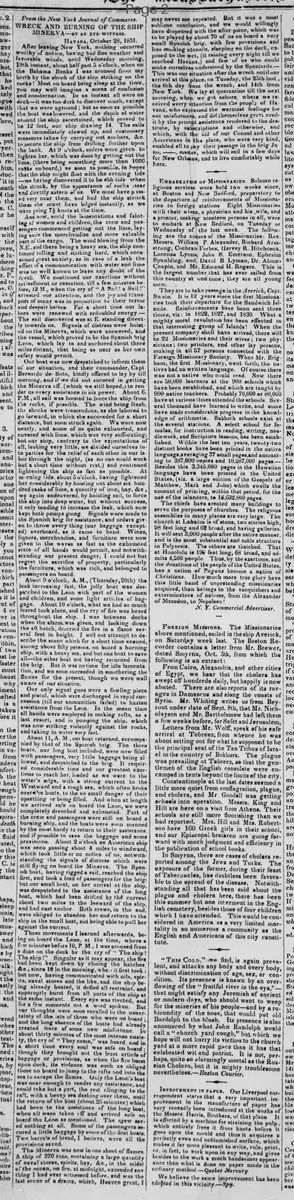
WRECK AND BURNING OF THE SHIP MINERVA-BY AN EYE-WITNESS.
Havana, October 28, 1831.
After leaving New York, nothing occurred worthy of notice, having had fine weather and favorable winds, until Wednesday morning, 19th instant, about half past 5 o'clock, when on the Bahama Banks I was aroused from my berth by the shock of the ship striking on the rocks! Most on board being asleep at the time, you may well imagine a scene of confusion and consternation. In an instant all were on deck-it was too dark to discover much, except that we were aground; but as soon as possible the boat was lowered, and the depth of water around the ship ascertained, which proved to be 12 feet, our ship drawing 14. The sails were immediately clewed up, and customary measures taken by carrying out anchors, &c. to secure the ship from drifting further upon the bank. At 9 o'clock, orders were given to lighten her, which was done by getting out the lime, (there being something more than 1000 casks onboard, as soon as possible, in hopes that the ship might get off with the evening tide—we having discovered it to be ebb-tide when she struck, by the appearance of rocks near end directly astern of us. We must have passed very near them, and had the ship struck them she must have bilged instantly, as we were going 7 knots at the time.
And now, amid the lamentations and fainting of women and children, the crew and passengers commenced getting out the lime, laying aside the merchandize and more valuable part of the cargo. The wind blowing from the N.E., and there being a heavy sea, the ship continued rolling and striking hard, which occasioned great anxiety, as in case of a leak the effect of a communication with water and lime was too well known to leave any doubt of the result. We continued our exertions without refreshment or cessation, till a few minutes before 12 M., when the cry of "A Sail! a Sail!" arrested our attention, and the joy and transport of many was in proportion to their terror and despair before For a short time our labors were renewed with redoubled energy.- The sail discovered was at E. standing directly towards us. Signals of distress were hoisted on the Minerva, which were answered, and the vessel, which proved to be the Spanish brig Leon, which lay to and anchored about three miles distant, that being as near as her own safety would permit.
Our boat was now despatched to inform them of our situation, and their commander, Capt. Bernardo de Soto, kindly offered to lay by till morning, and if we did not succeed in getting the Minerva off, (which we still hoped,) to render us every assistance in his power. About 6, P.M., all sail was hoisted to force the ship from the rocks, if possible. The wind being fresh, the shocks were tremendous, as she labored to go forward, in which she succeeded for a short distance, but soon struck again. We were now nearly, and some of us quite exhausted, and covered with lime, which was very suffocating; but our ship, contrary to the expectations of all, leaking very little, we divided ourselves into parties for the relief of each other in our labor through the night, (as no one could work but a short time without rest.) and continued lightening the ship as fast as possible. At morning tide, about 5 o'clock, having lightened her considerably by hoisting out about six hundred casks of lime, a quantity of iron, hay, &c, we again endeavored, by hoisting sail, to force the ship into deep water, but without success, it only tending to increase the leak, which now kept both pumps going. Signals were made to the Spanish brig for assistance, and orders given to throw every thing (our baggage excepted) overboard, as it came to hand. Wines, liquors, merchandise, and furniture were now given to the waves as fast as the exhausted state of all hands would permit, and notwithstanding our present danger, I could not but regret the sacrifice of property, particularly the furniture, which was rich, and belonged to passengers on board.
About 9 o'clock, A. M., (Thursday,20th) the leak increasing fast, the jolly boat was despatched to the Leon with part of the women and children, and some light articles of baggage. About 10 o'clock, what we had so much feared took place, and the cry of fire was heard throughout the ship. I was between decks when the alarm was given, and looking down the aft hatch, descried the fire in a flame several feet in height. I will not attempt to describe the scene which for a short time ensued, among above fifty persons, on board a burning ship, with a heavy sea, and but one boat to save all-the other boat not having returned from the brig. But it was no time for idle lamentation, and we soon succeeded in smothering the flames for the present, though we were well aware of our situation.
Our only signal guns were a fowling piece and pistol, which were discharged in rapid succession (till our ammunition failed) to hasten assistance from the Leon. In the mean time all hands were employed in making rafts, as a last resort, and in pumping the ship, which was now striking violently against the rocks, and taking in water very fast. About 11, A. M. our boat returned, accompanied by that of the Spanish brig. The three boats, our long boat included, were now filled with passengers, very little baggage being allowed, and despatched to the brig. It required considerable time and our greatest exertions to reach her, loaded as we were to the water's edge, with a strong current to the Westward and a rough sea, which often broke over the boats, to the no small danger of their upsetting or being filled. And when at length we arrived safe on board the Leon, we were completely drenched and exhausted. Part of the crew and passengers were still on board a burning ship, and the boats were soon manned by the most hardy to return to their assistance and if possible to save the baggage and some provisions. About 2 o'clock an American ship was seen passing about 4 miles to windward, which took little or no notice of us, notwithstanding the signals of distress which were still flying on board the Minerva. The Spanish boat, having rigged a sail, reached the ship first, and took a load of passengers for the brig: but our small boat, on her arrival at the ship, was despatched to the assistance of the long boat, which had been drifted by the current about two miles to the leeward of the ship, and had cast anchor. Both crews, in the end, were obliged to abandon her and return to the ship in the small boat, not being able to pull her against the current.
These movements I learned afterwards, being on board the Leon, at the time, where a few minutes before 10, P. M., I was aroused from a doze on the deck by the cry of "The ship! The ship!" Singular as it may appear, the fire had been kept down by closing the hatches &c, since le in the morning, when it first took: but now, having communicated with oils, spirits, naval stores and the like, and the ship being already heated, it defied all restraint, and apparently burst from all parts of the ship at the same instant. Every eye was riveted, and for a few moments not a word spoken. But our thoughts were soon recalled to the uncertainty of the fate of those who were on board; and the long absence of the boats had already created fears of some new misfortune. In about thirty minutes of the most intense anxiety, the cry of "They come," was heard, and in a short time every soul was safe on board; though they brought not the least article of baggage or provisions, as when the fire burst upon deck, its violence was such as obliged those on board to jump to the rafts and into the sea to escape the flames. Only the Leon's boat was near enough to render any assistance, and could take but a part, the rest clinging to the raft, with a heavy sea dashing over them, until the return of the boat (about 25 minutes) which had been to the assistance of the long boat, when all were taken off and arrived safe on board the Leon as mentioned. The crew saved nothing at all. Some of the passengers secured a little baggage by some of the first boats. Two barrels of bread, I believe, were all the provisions saved.
The Minerva was now in one sheet of flames. A ship of 370 tons, containing a large quantity of naval stores, spirits, hay, &c., in the midst of the ocean, on fire, at midnight, exceeded anything I had ever witnessed before, and was the last scene of a drama, which, Heaven grant, I may never see repeated. But it was a most sublime conclusion, and we would willingly have dispensed with the after-piece, which was to be played by about 70 of us on board a very small Spanish brig, with few provisions and less cooking utensils, sleeping on the deck, exposed to the wet, (it raining every night till we reached Havana) and few of us who could make ourselves understood by the Spaniards.— This was our situation after the wreck until our arrival at this place, on Tuesday, the 25th inst, the 6th day from the wreck, and 14th from New York. We lay at quarantine till the next morning, when we got ashore, where we received every attention from the people of Havana, who expressed the warmest feelings for our misfortunes, and did themselves great credit by the prompt assistance rendered to the destitute, by subscriptions and otherwise, and which, with the aid of our Consul and other Americans in the place, who were very kind, enabled all to pay their passage in the brig Juno, --- master, which will sail in a few days for New Orleans, and to live comfortably while here.
What sub-type of article is it?
What keywords are associated?
What entities or persons were involved?
Where did it happen?
Foreign News Details
Primary Location
Bahama Banks
Event Date
October 19, 1831
Key Persons
Outcome
no casualties; all passengers and crew rescued by spanish brig leon; ship minerva burned and cargo lost; survivors arrived in havana on october 25, 1831, and received aid.
Event Details
The ship Minerva, en route from New York, struck rocks on the Bahama Banks at 5:30 AM on October 19, 1831. Crew and passengers lightened the vessel by jettisoning lime, cargo, and other items but failed to refloat her. A fire broke out around 10 AM on October 20, initially suppressed but reigniting that night, leading to evacuation. All 70 aboard were rescued by boats from the Spanish brig Leon despite rough seas and currents; the ship burned completely.