Thank you for visiting SNEWPapers!
Sign up free
Phenix Gazette
Alexandria, Virginia
What is this article about?
A North Carolina farmer's 1828 letter to a congressman reports political shifts favoring the administration in several counties, recent gold and copper mine discoveries in Guilford and Chatham, economic hardships for upland farmers, and advocates for stock raising, wool production, and internal improvements to boost prosperity.
Clipping
OCR Quality
Full Text
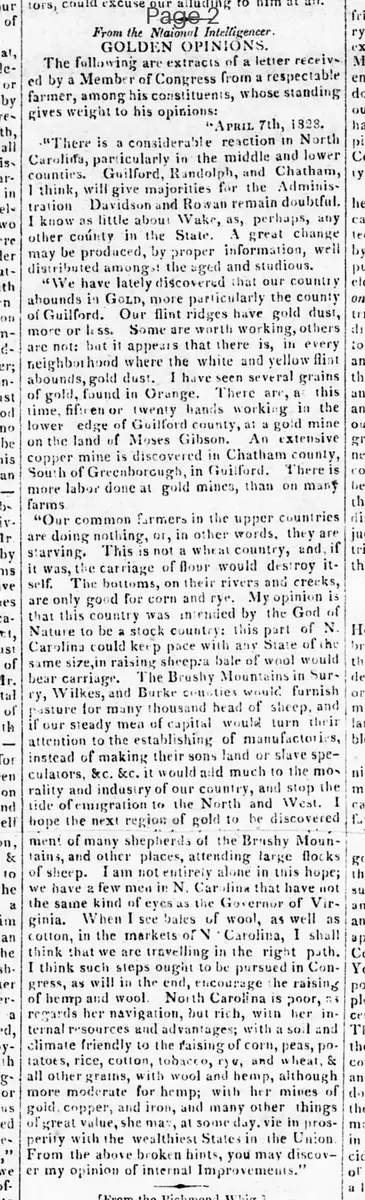
GOLDEN OPINIONS.
The following are extracts of a letter received by a Member of Congress from a respectable farmer, among his constituents, whose standing gives weight to his opinions:
"April 7th, 1828.
There is a considerable reaction in North Carolina, particularly in the middle and lower counties. Guilford, Randolph, and Chatham, I think, will give majorities for the Administration. Davidson and Rowan remain doubtful. I know as little about Wake, as, perhaps, any other county in the State. A great change may be produced, by proper information, well distributed amongst the aged and studious.
We have lately discovered that our country abounds in Gold, more particularly the county of Guilford. Our flint ridges have gold dust, more or less. Some are worth working, others are not: but it appears that there is, in every neighbourhood where the white and yellow flint abounds, gold dust. I have seen several grains of gold, found in Orange. There are, at this time, fifteen or twenty hands working in the lower edge of Guilford county, at a gold mine on the land of Moses Gibson. An extensive copper mine is discovered in Chatham county. South of Greensboro', in Guilford. There is more labor done at gold mines, than on many farms
Our common farmers in the upper countries are doing nothing, or, in other words, they are starving. This is not a wheat country, and, if it was, the carriage of flour would destroy itself. The bottoms, on their rivers and creeks, are only good for corn and rye. My opinion is that this country was intended by the God of Nature to be a stock country: this part of N. Carolina could keep pace with any State of the same size, in raising sheep: a bale of wool would bear carriage. The Brushy Mountains in Surry, Wilkes, and Burke counties would furnish pasture for many thousand head of sheep, and if our steady men of capital would turn their attention to the establishing of manufactories, instead of making their sons land or slave speculators, &c. &c. it would add much to the morality and industry of our country, and stop the tide of emigration to the North and West. I hope the next region of gold to be discovered [is by] men of many shepherds of the Brushy Mountains, and other places, attending large flocks of sheep. I am not entirely alone in this hope; we have a few men in N. Carolina that have not the same kind of eyes as the Governor of Virginia. When I see bales of wool, as well as cotton, in the markets of N Carolina, I shall think that we are travelling in the right path. I think such steps ought to be pursued in Congress, as will in the end, encourage the raising of hemp and wool. North Carolina is poor, as regards her navigation, but rich, with her internal resources and advantages: with a soil and climate friendly to the raising of corn, peas, potatoes, rice, cotton, tobacco, rye, and wheat, & all other grains, with wool and hemp, although more moderate for hemp; with her mines of gold, copper, and iron, and many other things of great value. she may, at some day, vie in prosperity with the wealthiest States in the Union From the above broken hints, you may discover my opinion of internal Improvements."
What sub-type of article is it?
What themes does it cover?
What keywords are associated?
What entities or persons were involved?
Where did it happen?
Story Details
Key Persons
Location
North Carolina, Guilford County, Chatham County
Event Date
April 7th, 1828
Story Details
A farmer reports political support for the administration in NC counties, gold dust in flint ridges and a mine on Moses Gibson's land with 15-20 workers, copper mine in Chatham, economic struggles for upland farmers, and promotes stock raising, sheep, wool, manufactories, and internal improvements for prosperity.