Thank you for visiting SNEWPapers!
Sign up free
Literary
December 9, 1870
Southern Christian Advocate
Charleston, Charleston County, South Carolina
What is this article about?
A reflective essay on Christ's cry of forsakenness on the cross, extending to human questions of divine abandonment amid suffering, oppression, and loss. It urges endurance and faith, assuring completion of God's work, as per Dean Stanley.
Clipping
OCR Quality
98%
Excellent
Full Text
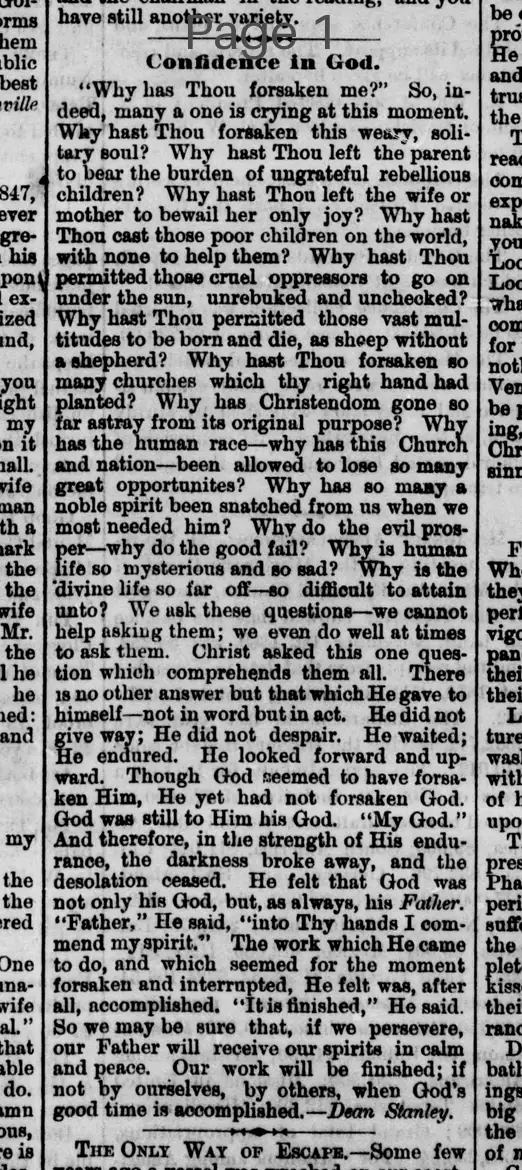
"Why hast Thou forsaken me?" So, indeed, many a one is crying at this moment. Why hast Thou forsaken this weary, solitary soul? Why hast Thou left the parent to bear the burden of ungrateful rebellious children? Why hast Thou left the wife or mother to bewail her only joy? Why hast Thou cast those poor children on the world, with none to help them? Why hast Thou permitted those cruel oppressors to go on under the sun, unrebuked and unchecked? Why hast Thou permitted those vast multitudes to be born and die, as sheep without a shepherd? Why hast Thou forsaken so many churches which thy right hand had planted? Why has Christendom gone so far astray from its original purpose? Why has the human race—why has this Church and nation—been allowed to lose so many great opportunities? Why has so many a noble spirit been snatched from us when we most needed him? Why do the evil prosper—why do the good fail? Why is human life so mysterious and so sad? Why is the divine life so far off—so difficult to attain unto? We ask these questions—we cannot help asking them; we even do well at times to ask them. Christ asked this one question which comprehends them all. There is no other answer but that which He gave to himself—not in word but in act. He did not give way; He did not despair. He waited: He endured. He looked forward and upward. Though God seemed to have forsaken Him, He yet had not forsaken God. God was still to Him his God. "My God." And therefore, in the strength of His endurance, the darkness broke away, and the desolation ceased. He felt that God was not only his God, but, as always, his Father. "Father," He said, "into Thy hands I commend my spirit." The work which He came to do, and which seemed for the moment forsaken and interrupted, He felt was, after all, accomplished. "It is finished," He said. So we may be sure that, if we persevere, our Father will receive our spirits in calm and peace. Our work will be finished; if not by ourselves, by others, when God's good time is accomplished.—Dean Stanley.
What sub-type of article is it?
Essay
What themes does it cover?
Religious
Death Mortality
Moral Virtue
What keywords are associated?
Forsakenness
Endurance
Faith
Christ
Divine Providence
Human Suffering
What entities or persons were involved?
Dean Stanley
Literary Details
Author
Dean Stanley
Subject
Reflection On Christ's Cry 'Why Hast Thou Forsaken Me?' And Human Forsakenness
Key Lines
"Why Hast Thou Forsaken Me?" So, Indeed, Many A One Is Crying At This Moment.
Christ Asked This One Question Which Comprehends Them All.
Though God Seemed To Have Forsaken Him, He Yet Had Not Forsaken God.
"Father," He Said, "Into Thy Hands I Commend My Spirit."
"It Is Finished," He Said.