Thank you for visiting SNEWPapers!
Sign up free
Story
June 19, 1907
Keowee Courier
Walhalla, Pickens, Oconee County, Pickens County, South Carolina
What is this article about?
J.A. Steck's letter from Brooklyn details his June 1906 arrival in New York with Jas. M. Moss, impressions of city sights like Brooklyn Bridge, shocking visits to Bowery bars and Chinatown dens, cultural observations, and work at Mergenthaler Linotype plant.
Clipping
OCR Quality
95%
Excellent
Full Text
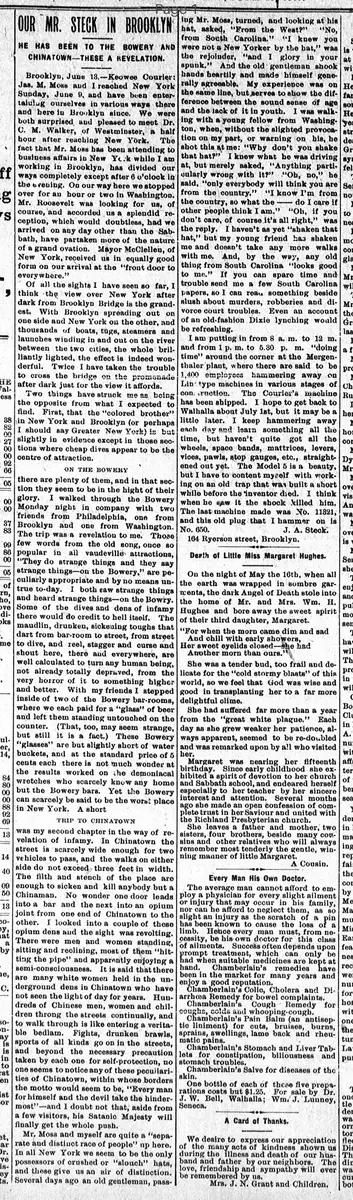
OUR MR. STECK IN BROOKLYN
HE HAS BEEN TO THE BOWERY AND CHINATOWN--THESE ARE REVELATIONS.
Brooklyn, June 13.--Keowee Courier:
Jas. M. Moss and I reached New York Sunday, June 9, and have been entertaining ourselves in various ways there and here in Brooklyn since. We were both surprised and pleased to meet Dr. C. M. Walker, of Westminster, a half hour after reaching New York. The fact that Mr. Moss has been attending to business affairs in New York while I am working in Brooklyn, has divided our ways completely except after 6 o'clock in the evening. On our way here we stopped over for an hour or two in Washington. Mr. Roosevelt was looking for us, of course, and accorded us a splendid reception, which would doubtless, had we arrived on any day other than the Sabbath, have partaken more of the nature of a grand ovation. Mayor McClellan, of New York, received us in equally good form on our arrival at the "front door to everywhere."
Of all the sights I have seen so far, I think the view over New York after dark from Brooklyn Bridge is the grandest. With Brooklyn spreading out on one side and New York on the other, and thousands of boats, tugs, steamers and launches winding in and out on the river between the two cities, the whole brilliantly lighted, the effect is indeed wonderful. Twice I have taken the trouble to cross the bridge on the promenade after dark just for the view it affords.
Two things have struck me as being the opposite from what I expected to find. First, that the "colored brother" in New York and Brooklyn (or perhaps I should say Greater New York) is but slightly in evidence except in those sections where cheap dives appear to be the centre of attraction.
ON THE BOWERY
there are plenty of them, and in that section they seem to be in the height of their glory. I walked through the Bowery Monday night in company with two friends from Philadelphia, one from Brooklyn and one from Washington. The trip was a revelation to me. Those few words from the old song, once so popular in all vaudeville attractions, "They do strange things and they say strange things--on the Bowery," are peculiarly appropriate and by no means untrue to-day. I both saw strange things and heard strange things--on the Bowery. Some of the dives and dens of infamy there would do credit to hell itself. The maudlin, drunken, sickening toughs that dart from bar-room to street, from street to dive, and reel, stagger and curse and shout here, there and everywhere, are well calculated to turn any human being, not already totally depraved, from the very horror of it to something higher and better. With my friends I stepped inside of two of the Bowery bar-rooms, where we each paid for a "glass" of beer and left them standing untouched on the counter. (That, too, may seem strange, but still it is a fact.) These Bowery "glasses" are but slightly short of water buckets, and at the standard price of 5 cents each there is not much wonder at the results worked on the demoniacal wretches who scarcely know any home but the Bowery bars. Yet the Bowery can scarcely be said to be the worst place in New York. A short
TRIP TO CHINATOWN
was my second chapter in the way of revelation of infamy. In Chinatown the street is scarcely wide enough for two vehicles to pass, and the walks on either side do not exceed three feet in width. The filth and stench of the place are enough to sicken and kill anybody but a Chinaman. No wonder one door leads into a bar and the next into an opium joint from one end of Chinatown to the other. I looked into a couple of these opium dens and the sight was revolting. There were men and women standing, sitting and reclining, most of them "hitting the pipe" and apparently enjoying a semi-consciousness. It is said that there are many white women held in the underground dens in Chinatown who have not seen the light of day for years. Hundreds of Chinese men, women and children throng the streets continually, and to walk through is like entering a veritable bedlam. Fights, drunken brawls, sports of all kinds go on in the streets, and beyond the necessary precaution taken by each one for self-protection, no one seems to notice any of these peculiarities of Chinatown, within whose borders the motto would seem to be, "Every man for himself and the devil take the hindermost"--and I doubt not that, aside from a few visitors, his Satanic Majesty will finally get the whole push.
Mr. Moss and myself are quite a "separate and distinct race of people" up here. In all New York we seem to be the only possessors of crushed or "slouch" hats, and these give us an air of distinction. Several days ago an old gentleman, passing Mr. Moss, turned, and looking at his hat, asked. "From the West?" "No, from South Carolina." "I knew you were not a New Yorker by the hat," was the rejoinder, "and I glory in your spunk." And the old gentleman shook hands heartily and made himself generally agreeable. My experience was on the same line, but serves to show the difference between the sound sense of age and the lack of it in youth. I was walking with a young fellow from Washington, when, without the slightest provocation on my part, or warning on his, he shot this at me: "Why don't you shake that hat?" I knew what he was driving at, but merely asked, "Anything particularly wrong with it?" "Oh, no," he said, "only everybody will think you are from the country." "I know I'm from the country, so what the --a-- do I care if other people think I am." "Oh, if you don't care, of course it's all right," was the reply. I haven't as yet "shaken that hat," but my young friend has shaken me and doesn't take any more walks with me. And, by the way, any old thing from South Carolina "looks good to me." If you can spare time and trouble send me a few South Carolina papers, so I can read something beside slush about murders, robberies and divorce court troubles. Even an account of an old-fashion Dixie lynching would be refreshing.
I am putting in from 8 a. m. to 12 m. and from 1 p. m. to 5.30 p. m. "doing time" around the corner at the Mergenthaler plant, where there are said to be 1,400 employees hammering away on Linotype machines in various stages of construction. The Courier's machine has been shipped. I hope to get back to Walhalla about July 1st, but it may be a little later. I keep hammering away each day and learn something all the time, but haven't quite got all the wheels, space bands, matrices, levers, vices, pawls, stop gauges, etc., straightened out yet. The Model 5 is a beauty, but I have to content myself with working on an old trap that was built a short while before the inventor died. I think when he saw it the shock killed him. The last machine made was No. 11821, and this old plug that I hammer on is No. 650.
J. A. Steck.
104 Ryerson street, Brooklyn.
HE HAS BEEN TO THE BOWERY AND CHINATOWN--THESE ARE REVELATIONS.
Brooklyn, June 13.--Keowee Courier:
Jas. M. Moss and I reached New York Sunday, June 9, and have been entertaining ourselves in various ways there and here in Brooklyn since. We were both surprised and pleased to meet Dr. C. M. Walker, of Westminster, a half hour after reaching New York. The fact that Mr. Moss has been attending to business affairs in New York while I am working in Brooklyn, has divided our ways completely except after 6 o'clock in the evening. On our way here we stopped over for an hour or two in Washington. Mr. Roosevelt was looking for us, of course, and accorded us a splendid reception, which would doubtless, had we arrived on any day other than the Sabbath, have partaken more of the nature of a grand ovation. Mayor McClellan, of New York, received us in equally good form on our arrival at the "front door to everywhere."
Of all the sights I have seen so far, I think the view over New York after dark from Brooklyn Bridge is the grandest. With Brooklyn spreading out on one side and New York on the other, and thousands of boats, tugs, steamers and launches winding in and out on the river between the two cities, the whole brilliantly lighted, the effect is indeed wonderful. Twice I have taken the trouble to cross the bridge on the promenade after dark just for the view it affords.
Two things have struck me as being the opposite from what I expected to find. First, that the "colored brother" in New York and Brooklyn (or perhaps I should say Greater New York) is but slightly in evidence except in those sections where cheap dives appear to be the centre of attraction.
ON THE BOWERY
there are plenty of them, and in that section they seem to be in the height of their glory. I walked through the Bowery Monday night in company with two friends from Philadelphia, one from Brooklyn and one from Washington. The trip was a revelation to me. Those few words from the old song, once so popular in all vaudeville attractions, "They do strange things and they say strange things--on the Bowery," are peculiarly appropriate and by no means untrue to-day. I both saw strange things and heard strange things--on the Bowery. Some of the dives and dens of infamy there would do credit to hell itself. The maudlin, drunken, sickening toughs that dart from bar-room to street, from street to dive, and reel, stagger and curse and shout here, there and everywhere, are well calculated to turn any human being, not already totally depraved, from the very horror of it to something higher and better. With my friends I stepped inside of two of the Bowery bar-rooms, where we each paid for a "glass" of beer and left them standing untouched on the counter. (That, too, may seem strange, but still it is a fact.) These Bowery "glasses" are but slightly short of water buckets, and at the standard price of 5 cents each there is not much wonder at the results worked on the demoniacal wretches who scarcely know any home but the Bowery bars. Yet the Bowery can scarcely be said to be the worst place in New York. A short
TRIP TO CHINATOWN
was my second chapter in the way of revelation of infamy. In Chinatown the street is scarcely wide enough for two vehicles to pass, and the walks on either side do not exceed three feet in width. The filth and stench of the place are enough to sicken and kill anybody but a Chinaman. No wonder one door leads into a bar and the next into an opium joint from one end of Chinatown to the other. I looked into a couple of these opium dens and the sight was revolting. There were men and women standing, sitting and reclining, most of them "hitting the pipe" and apparently enjoying a semi-consciousness. It is said that there are many white women held in the underground dens in Chinatown who have not seen the light of day for years. Hundreds of Chinese men, women and children throng the streets continually, and to walk through is like entering a veritable bedlam. Fights, drunken brawls, sports of all kinds go on in the streets, and beyond the necessary precaution taken by each one for self-protection, no one seems to notice any of these peculiarities of Chinatown, within whose borders the motto would seem to be, "Every man for himself and the devil take the hindermost"--and I doubt not that, aside from a few visitors, his Satanic Majesty will finally get the whole push.
Mr. Moss and myself are quite a "separate and distinct race of people" up here. In all New York we seem to be the only possessors of crushed or "slouch" hats, and these give us an air of distinction. Several days ago an old gentleman, passing Mr. Moss, turned, and looking at his hat, asked. "From the West?" "No, from South Carolina." "I knew you were not a New Yorker by the hat," was the rejoinder, "and I glory in your spunk." And the old gentleman shook hands heartily and made himself generally agreeable. My experience was on the same line, but serves to show the difference between the sound sense of age and the lack of it in youth. I was walking with a young fellow from Washington, when, without the slightest provocation on my part, or warning on his, he shot this at me: "Why don't you shake that hat?" I knew what he was driving at, but merely asked, "Anything particularly wrong with it?" "Oh, no," he said, "only everybody will think you are from the country." "I know I'm from the country, so what the --a-- do I care if other people think I am." "Oh, if you don't care, of course it's all right," was the reply. I haven't as yet "shaken that hat," but my young friend has shaken me and doesn't take any more walks with me. And, by the way, any old thing from South Carolina "looks good to me." If you can spare time and trouble send me a few South Carolina papers, so I can read something beside slush about murders, robberies and divorce court troubles. Even an account of an old-fashion Dixie lynching would be refreshing.
I am putting in from 8 a. m. to 12 m. and from 1 p. m. to 5.30 p. m. "doing time" around the corner at the Mergenthaler plant, where there are said to be 1,400 employees hammering away on Linotype machines in various stages of construction. The Courier's machine has been shipped. I hope to get back to Walhalla about July 1st, but it may be a little later. I keep hammering away each day and learn something all the time, but haven't quite got all the wheels, space bands, matrices, levers, vices, pawls, stop gauges, etc., straightened out yet. The Model 5 is a beauty, but I have to content myself with working on an old trap that was built a short while before the inventor died. I think when he saw it the shock killed him. The last machine made was No. 11821, and this old plug that I hammer on is No. 650.
J. A. Steck.
104 Ryerson street, Brooklyn.
What sub-type of article is it?
Journey
Curiosity
Biography
What themes does it cover?
Exploration
Social Manners
Misfortune
What keywords are associated?
New York Visit
Bowery Dives
Chinatown Opium
Linotype Installation
South Carolina Traveler
What entities or persons were involved?
J. A. Steck
Jas. M. Moss
Dr. C. M. Walker
Where did it happen?
Brooklyn, New York, Bowery, Chinatown
Story Details
Key Persons
J. A. Steck
Jas. M. Moss
Dr. C. M. Walker
Location
Brooklyn, New York, Bowery, Chinatown
Event Date
June 9 13, 1906
Story Details
J.A. Steck and Jas. M. Moss arrive in New York on June 9, meet Dr. Walker, explore sights including Brooklyn Bridge view, visit Bowery and Chinatown revealing urban vice and infamy, note cultural differences like hats, and Steck works at Mergenthaler plant on Linotype machines.