Thank you for visiting SNEWPapers!
Sign up free
The National Intelligencer And Washington Advertiser
Washington, District Of Columbia
What is this article about?
London reports detail a French government exposé on an English-backed plot to assassinate First Consul Bonaparte, implicating generals Moreau and Pichegru with royalist Georges. Arrests made; commentaries question authenticity amid Bonaparte's jealousy. Includes ship embargoes, Toulon fleet departure, and revolution rumors.
Merged-components note: Continuation of the foreign intelligence on the plot against Bonaparte and related news, text connects seamlessly.
Clippings
1 of 2
OCR Quality
Full Text
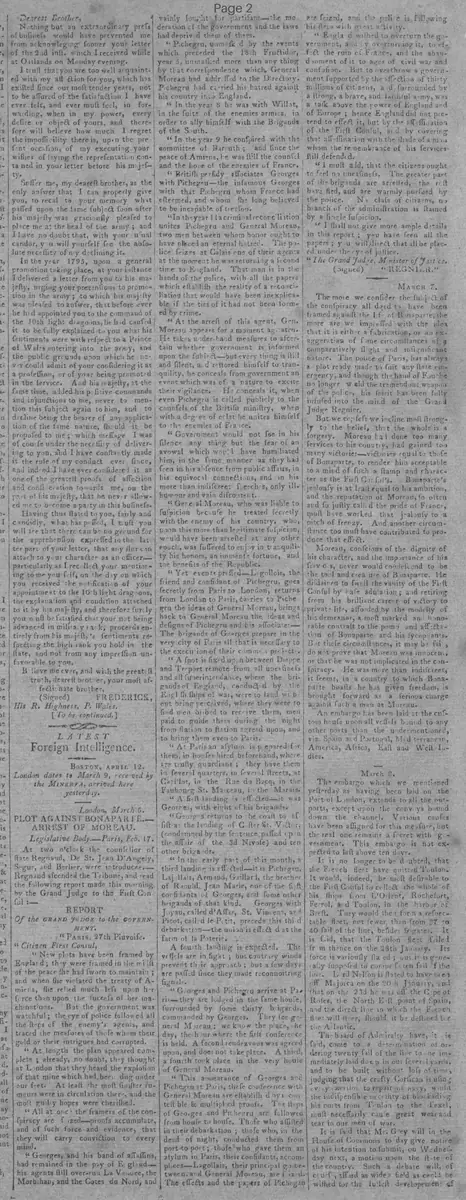
Foreign Intelligence.
BOSTON, APRIL 12.
London dates to March 9, received by the Minerva, arrived here yesterday.
London, March 6.
PLOT AGAINST BONAPARTE.
ARREST OF MOREAU.
Legislative Body. Paris, Feb. 17.
At two o'clock the counsellor of state Regnault, De St. Jean D'Angely, Segur, and Berlier, were introduced.
Regnault ascended the Tribune, and read the following report made this morning by the Grand Judge to the First Consul:-
REPORT
Of the GRAND JUDGE to the GOVERNMENT.
MEN.
Paris, 27th Pluviose.
Citizen First Consul,
New plots have been framed by England; they were framed in the midst of the peace she had sworn to maintain: and when she violated the treaty of Amiens, she relied much less upon her force than upon the success of her machinations. But the government was watchful; the eye of police followed all the steps of the enemy's agents, and traced the measures of those whom their gold or their intrigues had corrupted.
At length the plan appeared complete; already, no doubt, they thought at London that they heard the explosion of that mine which had been dug under our feet. At least the most sinister rumours were in circulation there, and the most guilty hopes were cherished.
All at once the framers of the conspiracy are seized-proofs accumulate, and of such force and evidence, that they will carry conviction to every mind.
Georges, and his band of assassins, had remained in the pay of England-- his agents still over-ran La Vendee, the Morbihan, and the Cotes du Nord, and vainly sought for partisans-the moderation of the government and the laws had deprived them of them.
Pichegru, unmasked by the events which preceded the 18th Fructidor, year 5, unmasked more than any thing by that correspondence which General Moreau had addressed to the Directory. Pichegru had carried his hatred against his country into England.
In the year 8 he was with Willot. in the suite of the enemies armies, in order to ally himself with the Brigands of the South.
In the year 9 he conspired with the committee of Barcauth; and since the peace of Amiens, he was still the counsel and the hope of the enemies of France.
British perfidy associates Georges with Pichegru-the infamous Georges with that Pichegru whom France had esteemed, and whom she long believed to be incapable of treason.
In the year 11 a criminal reconciliation unites Pichegru and General Moreau, two men between whom honor ought to have placed an eternal hatred. The police seizes at Calais one of their agents at the moment he was returning a second time to England. That man is in the hands of the police, with all the papers which establish the reality of a reconciliation that would have been inexplicable if the ties of it had not been formed by crime.
At the arrest of this agent, Gen. Moreau appears for a moment agitated. He takes underhand measures to ascertain whether government is informed upon the subject-but every thing is still and silent, and restored himself to tranquillity, he conceals from government an event which was of a nature to excite their vigilance. He conceals it, when even Pichegru is called publicly to the councils of the British ministry, when with a degree of eclat he unites himself to the enemies of France.
Government would not see in his silence any thing but the fear of an avowal which would have humiliated him, in the same manner as they had seen in his absence from public affairs, in his equivocal connections, and in his more than indiscreet speeches, only ill-humour and vain discontent.
General Moreau, who was liable to suspicion because he treated secretly with the enemy of his country, who, upon this more than legitimate suspicion, would have been arrested at any other epoch, was suffered to enjoy in tranquillity his honors, an immense fortune, and the benefits of the Republic.
Yet events preceding Pollois, the friend and confidant of Pichegru, goes secretly from Paris to London, returns from London to Paris, carries to Pichegru the ideas of General Moreau, brings back to General Moreau the ideas and designs of Pichegru and his associates:- The brigands of Georges prepare in the very city of Paris all that is necessary to the execution of their common project.
A post is fixed upon between Dieppe and Treport remote from all uneasiness and all superintendence, where the brigands of England, conducted by the English ships of war, were to land without being perceived, where they were to find men bribed to receive them, men paid to guide them during the night from station to station agreed upon, and to bring them even to Paris.
At Paris an asylum is prepared for them, in houses hired beforehand, where are trusty guardians; they have them in several quarters, in several streets, at Capitol, in the Rue du Bac, in the Faubourg St. Marceau, in the Marais.
A first landing is effected—it was Georges, with eight of his brigands.
Georges returns to the coast to assist at the landing of Coster St. Viator, (condemned by the sentence passed upon the affair of the 3d Nivose) and ten other brigands.
In the early part of this month, a third landing is effected it is Pichegru. Lajolais, Armaud, Gaillardi, the brother of Rhould, Jean Marie, one of the first confidants of Georges, and some other brigands of that kind. Georges with Joyau, called d'Aub, St. Vincent, and Picot, called le Petit, precede this third debarkation--the union is effected at the farm of la Poterie.
A fourth landing is expected. The vessels are in sight; but contrary winds prevent their approach; but a few days are passed since they made reconnoitring signals.
Gorges and Pichegru arrive at Paris-they are lodged in the same house, surrounded by some thirty brigands, commanded by Georges. They see General Moreau; we know the place, the day, the hour where the first conference is held. A second rendezvous was agreed upon, and does not take place. A third, a fourth took place in the very house of General Moreau.
This appearance of Georges and Pichegru at Paris, these conferences with General Moreau are established by incontestable & multiplied proofs. The steps of Georges and Pichegru are followed from house to house. Those who assisted in their debarkation; those who, in the dead of night, conducted them from port to port; those who gave them an asylum in Paris, their confidants, accomplices-Lagollais, their principal go-between, and General Moreau, are seized. The effects and the papers of Pichegru were seized, and the police is following his steps with great activity.
England wished to overturn the government, and by overturning it, to effect the ruin of France, and the abandonment of it to ages of civil war and confusion. But to overthrow a government supported by the affection of thirty millions of citizens, and surrounded by a strong, a brave, and faithful army, was a task above the power of England and of Europe; hence England did not pretend to effect it. but by the assassination of the First Consul, and by covering that assassination with the shade of a man whom the remembrance of his services still defended.
I must add, that the citizens ought to feel no uneasiness. The greater part of the brigands are arrested, the rest have fled, and are warmly pursued by the police. No class of citizens, no branch of the administration is stained by a single suspicion.
I shall not give more ample details in this report; you have seen all the papers; you will direct that all be placed under the eye of justice.
The Grand Judge, Minister of Justice.
(Signed) REGNIER.
MARCH 7.
The more we consider the subject of the conspiracy alleged to have been framed against the life of Bonaparte, the more are we impressed with the idea that it is either a fabrication, or an exaggeration of some circumstances of a comparatively light and insignificant nature. The police of Paris, has always a plot ready made to suit any state emergency, and though the hand of Fouche no longer wields the tremendous weapon of the police, his spirit has been fully infused into the mind of the Grand Judge Regnier.
But we confess we incline most strongly to the belief, that the whole is a forgery. Moreau has done too many services to his country, had gained too many victories-victories equal to those of Bonaparte, to render him acceptable to a mind of such a stamp and character as the First Consul's. Bonaparte's jealousy is at least equal to his ambition, and the reputation of Moreau, so often and so justly called the pride of France, must have worked that jealousy to a pitch of frenzy. And another circumstance too must have contributed to produce that effect.
Moreau, conscious of the dignity of his character, and the importance of his services, never would condescend to be the tool and creature of Bonaparte. He disdained to swell the vanity of the First Consul by tame adulation; and retiring from his brilliant career of victory to private life, afforded by the modesty of his demeanor, a most marked and honorable contrast to the pomp and affectation of Bonaparte and his sycophants.
But these circumstances, it may be said, do not prove that Moreau was innocent., or that he was not implicated in the conspiracy. He was more than indiscreet, it seems, in a country to which Bonaparte boasts he has given freedom, is brought forward as a serious charge against such a man as Moreau.
An embargo has been laid at the custom house upon all vessels bound to any other ports than the undermentioned, viz. Spain and Portugal, Mediterranean, America, Africa, East and West Indies.
March 8.
The embargo which we mentioned yesterday as having been laid on the Port of London, extends to all the out-ports, except upon the convoys bound down the channel. Various causes have been assigned for this measure, but the real one remains a secret with government. This embargo is not expected to last above ten days.
It is no longer to be doubted, that the French fleet have quitted Toulon. It would, indeed, be most desirable to the First Consul to collect the whole of his ships from L'Orient, Rochefort, Ferrol, and Toulon, in the harbor of Brest. They would then form a respectable fleet, not fewer, than from 37 to 40 sail of the line, besides frigates. It is said, that the Toulon fleet sailed from thence on the 28th January. Its force is variously stated; but it is generally supposed to comprise ten sail of the line. Lord Nelson is stated to have been off Majorca on the 20th January, and that on the 23d he was off the Cape of Roses, the North East point of Spain, and the direct line in which the French fleet will steer. should it be destined for the Atlantic.
The board of Admiralty have, it is said, come to a determination of ordering twenty sail of the line to be immediately laid down in our several yards, and to be built without loss of time, judging that the crafty Corsican is using every exertion to repair his Navy, whilst the indispensable necessity of blockading his ports from Toulon to the Texel. must necessarily cause great wear and tear in our men of war.
It is said that Mr. Grey will in the House of Commons to day give notice of his intention to submit, on Wednesday next, a motion upon the state of the country. Such a debate will, of course , afford as wide a field as could be wished for the fullest development of
the principles and views of the different parties.
General Moreau has been taken up. and the Police are in pursuit of Pichegru and Georges.
SCHIEDAM, Feb. 24.
An embargo has just been laid here, on the part of the French government, on all outward-bound ships, in order to prevent general Pichegru from escaping.
March 9.
The public curiosity has been excited not a little since the recent plot against the Consular government, to know the result, and to learn whether the intelligence was correct that states generals Moreau and Pichegru to have been guillotined—Till farther accounts be received from France, the present anxiety cannot be removed and it must be considerably heightened by accounts received this morning from Deal, which state, that another revolution has taken place in France inimical to Bonaparte. The news is said to have been brought over by a royalist general. How far it may be correct, we cannot take upon us to determine ; but the thing is far from being improbable. We shall not indulge in conjectures, but content ourselves with submitting the information that has reached us.
DEAL. March 8.
We have just received intelligence of a very important nature, which added to the late news from France. carries with it some degree of probability, especially as great bustle prevails here at present in the Downs: A general and his suite attached to the Monarchical party in France, who was some days ago received on board one of our cruisers from the heights above Dieppe, brings an account that a counter revolution has taken place in that Country, prejudicial to the interests of the African usurper.
" The whole naval department here are in the highest spirits; in consequence of this sudden change of affairs all the ships, cutters and brigs ready for sea in the Downs have received orders to get under weigh immediately Most of them have already sailed. Wind S. E. by S.
a The firing heard the other day was a salute at Boulogne; but on what occasion we have not yet learnt."
Last night dispatches were sent off express by a messenger from the admiralty to Plymouth, for admiral lord Cornwallis, to be forwarded to him from that place by a fast sailing vessel. A express was likewise sent off to Ireland.
All ships of every description have been ordered to be got ready for service as fast as possible. Every thing seems to shew that some secret expedition is in contemplation.
Last night we received Dutch papers to the 28th ult.—The most important piece of information they contain is an open acknowledgment in The Merchant that the Dutch officers who had been applied to, to take commands in the flotilla of Flushing, destined for the invasion of this country, have refused to accept of the appointments. This shews in what a hopeless light they view the whole undertaking.
The moniteurs are chiefly filled with addresses to the first consul, to congratulate him on his escape. No further mention is made of the conspiracy or of the conspirators in the official papers.
Accounts from Vienna of the 4th Feb. state, that the greatest bustle prevails among the ministers of that court ; that the troops were in motion, and that every thing indicated an approaching change of affairs.
What sub-type of article is it?
What keywords are associated?
What entities or persons were involved?
Where did it happen?
Foreign News Details
Primary Location
Paris
Event Date
Feb. 17 To March 9
Key Persons
Outcome
arrests of conspirators including moreau, pichegru, and georges; most brigands arrested or fled; no guillotining confirmed; rumors of counter-revolution; embargoes laid; french fleet quitted toulon.
Event Details
Report of a conspiracy against the First Consul Bonaparte, involving English-backed assassins led by Georges, with Pichegru and Moreau implicated in meetings and planning for assassination and government overthrow. Detailed landings of brigands near Dieppe, conferences in Paris. Police seized agents and papers. Commentary suggests possible fabrication due to Bonaparte's jealousy of Moreau. Additional news includes embargoes on ships, French fleet movements from Toulon, British Admiralty plans, and rumors of revolution in France.