Thank you for visiting SNEWPapers!
Sign up free
Phenix Gazette
Alexandria, Virginia
What is this article about?
Mr. McCarty's speech argues that the US Constitution forms a national government of the people, not states, quoting Madison, Pendleton, Nicholas from the Virginia Ratifying Convention, Washington's Farewell Address, and Jackson's Proclamation to refute states' rights claims supporting secession and nullification.
Clipping
OCR Quality
Full Text
[CONTINUED]
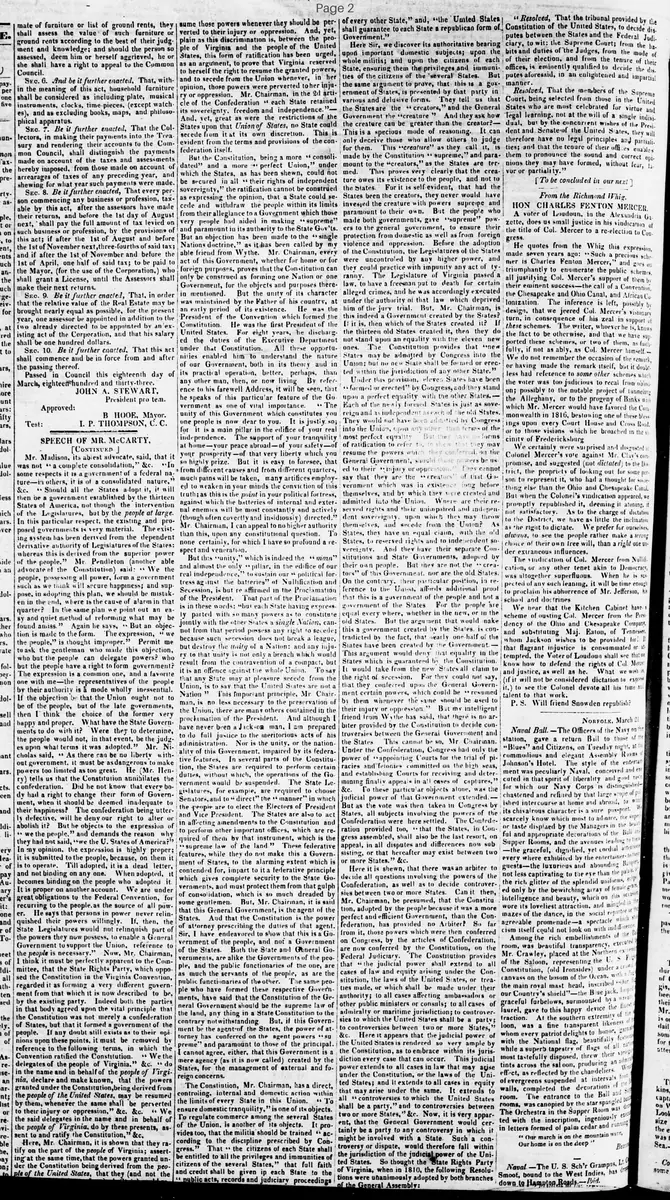
Mr. Madison, its ablest advocate, said, that it was not "a complete consolidation," &c. In some respects it is a government of a federal nature—in others, it is of a consolidated nature, &c. "Should all the States adopt it, it will then be a government established by the thirteen States of America, not through the intervention of the Legislatures, but by the people at large. In this particular respect, the existing and proposed governments is very material. The existing system has been derived from the dependent derivative authority of Legislatures of the States: whereas this is derived from the superior power of the people." Mr. Pendleton (another able advocate of the Constitution) said: "We the people, possessing all power, form a government such as we think will secure happiness; and suppose, in adopting this plan, we should be mistaken in the end, where is the cause of alarm in that quarter? In the same plan we point out an easy and quiet method of reforming what may be found amiss." Again he says, "But an objection is made to the form. The expression, 'we the people,' is thought improper." Permit me to ask the gentleman who made this objection, who but the people can delegate powers? who but the people have a right to form government? The expression is a common one, and a favorite one with me—the representatives of the people by their authority is a mode wholly inessential. If the objection be that the Union ought not to be of the people, but of the late governments, then I think the choice of the former very happy and proper. What have the State Governments to do with it? Were they to determine, the people would not, in that event, be the judges upon what terms it was adopted." Mr. Nicholas said, "As there can be no liberty without government, it must be as dangerous to make powers too limited as too great. He (Mr. Henry) tells us that the Constitution annihilates the confederation. Did he not know that every body had a right to change their form of Government, when it should be deemed inadequate to their happiness? The confederation being utterly defective, will he deny our right to alter or abolish it? But he objects to the expression of 'we the people,' and demands the reason why they had not said, 'we the U. States of America?' In my opinion, the expression is highly proper; it is submitted to the people, because, on them it is to operate. Till adopted, it is a dead letter, and not binding on any one. When adopted, it becomes binding on the people who adopted it. It is proper on another account. We are under great obligations to the Federal Convention, for recurring to the people, as the source of all power. He says that persons in power never relinquished their powers willingly. If, then, the State Legislatures would not relinquish part of the powers they now possess, to enable a General Government to support the Union, reference to the people is necessary." Now, Mr. Chairman, I think it must be perfectly apparent to the Committee, that the State Rights Party, which opposed the Constitution in the Virginia Convention, regarded it as forming a very different government from that which it is now described to be by the existing party. Indeed both the parties in that body agreed upon the vital principle that the Constitution was not merely a confederation of States, but that it formed a government of the people. If any doubt still exists as to their opinions upon these points, it must be removed by reference to the following terms, in which the Convention ratified the Constitution. "We the delegates of the people of Virginia," &c. "do in the name and in behalf of the people of Virginia, declare and make known, that the powers granted under the Constitution, being derived from the people of the United States, may be resumed by them, whenever the same shall be perverted to their injury or oppression," &c. &c. "We the said delegates in the name and in behalf of the people of Virginia, do by these presents, assent to and ratify the Constitution," &c.
Here, Mr. Chairman, it is shown that they ratify on the part of the people of Virginia; asserting at the same time, that the powers granted under the Constitution being derived from the people of the United States, that they (and not the States) may resume those powers whenever they should be perverted to their injury or oppression. And, yet, plain as this discrimination is, between the people of Virginia and the people of the United States, this form of ratification has been urged, as an argument, to prove that Virginia reserved to herself the right to resume the granted powers, and to secede from the Union whenever, in her opinion, those powers were perverted to her injury or oppression. Mr. Chairman, in the 2d article of the Confederation "each State retained its sovereignty, freedom and independence."
—And, yet, great as were the restrictions of the States upon that Union of States, no State could secede from it at its own discretion. This is evident from the terms and provisions of the confederation itself.
But the Constitution, being a more "consolidated" and a more "perfect Union," under which the States, as has been shown, could not be secured in all "their rights of independent sovereignty," the ratification cannot be construed as expressing the opinion, that a State could secede and withdraw the people within its limits from their allegiance to a Government which those very people had aided in making "supreme" and paramount in its authority to the State Gov'ts.
But an objection has been made to the "single Nation doctrine," as it has been called by my able friend from Wythe. Mr. Chairman, every act of this Government, whether for home or for foreign purposes, proves that the Constitution can only be construed as forming one Nation or one Government, for the objects and purposes therein mentioned. But the unity of its character was maintained by the Father of his country, at an early period of its existence. He was the President of the Convention which formed the Constitution. He was the first President of the United States. For eight years, he discharged the duties of the Executive Department under that Constitution. All these opportunities enabled him to understand the nature of our Government, both in its theory and in its practical operation, better, perhaps, than any other man, then, or now living. By reference to his farewell Address, it will be seen, that he speaks of this particular feature of the Government as one of vital importance. "The unity of this Government which constitutes you one people is now dear to you. It is justly so; for it is a main pillar in the edifice of your real independence. The support of your tranquility at home—your peace abroad—of your safety—of your prosperity—of that very liberty which you so highly prize. But it is easy to foresee, that from different causes and from different quarters, much pains will be taken, many artifices employed to weaken in your minds the conviction of this truth; as this is the point in your political fortress, against which the batteries of internal and external enemies will be most constantly and actively (though often covertly and insidiously) directed."
Mr. Chairman, I can appeal to no higher authority than this, upon any constitutional question. To none certainly, for which I have so profound a respect and veneration.
But this "unity," which is indeed the "main" and almost the only "pillar, in the edifice of our real independence," to sustain our political fortress against the batteries "of Nullification and Secession," is but affirmed in the Proclamation of the President. That part of the Proclamation is in these words: "but each State having expressly parted with so many powers as to constitute jointly with the other States a single Nation, cannot from that period possess any right to secede; because such secession does not break a league, but destroy the unity of a Nation: and any injury to that unity is not only a breach which would result from the contravention of a compact, but it is an offence against the whole Union." To say that any State may at pleasure secede from the Union, is to say that the United States are not a Nation. This important principle, Mr. Chairman, is no less necessary to the preservation of the Union, there are many others contained in the proclamation of the President. And although I have never been a Jackson man, I am prepared to do full justice to the meritorious acts of his administration. Nor is the unity, or the nationality of this Government, impaired by its federative features. In several parts of the Constitution, the States are required to perform certain duties, without which, the operations of the Government would be suspended. The State Legislatures, for example, are required to choose Senators, and to "direct" the "manner" in which the people are to elect the Electors of President and Vice President. The States are also to act in affecting amendments to the Constitution and to perform other important offices, which are required of them by that instrument, which is the "supreme law of the land." These federative features, while they do not make this a Government of States, to the alarming extent which is contended for, in part to it a federative principle which gives complete security to the State Governments, and must protect them from that gulph of consolidation, which is so much dreaded by some gentlemen. But, Mr. Chairman, it is said that this General Government, is the agent of the States. And that the Constitution is the power of attorney prescribing the duties of that agent. Sir, I have endeavored to show that this is a Government of the people, and not a Government of the States. Both the State and General Governments, are alike the Governments of the people, and the public functionaries of the one, are as much the servants of the people, as are the public functionaries of the other. The same people who have formed these respective Governments, have said that the Constitution of the General Government should be the supreme law of the land, any thing in a State Constitution to the contrary notwithstanding. But, if this Government be the agent of the States, the power of attorney has conferred on the agent powers "supreme" and paramount to those of the principal. I cannot agree, either, that this Government is a mere agency (as it is now called) created by the States, for the management of external and foreign concerns.
—The Constitution, Mr. Chairman, has a direct, controlling, internal and domestic action within the limits of every State in this Union. "To ensure domestic tranquility," is one of its objects. To regulate commerce among the several States of the Union, is another of its objects. It provides too, that the militia should be trained "according to the discipline prescribed by Congress." That "the citizens of each State shall be entitled to all the privileges and immunities of citizens of the several States," that full faith and credit shall be given in each State to the "public acts, records and judicial proceedings of every other State," and, "the United States shall guarantee to each State a republican form of Government."
Here Sir, we discover its authoritative bearing upon important domestic subjects; upon the whole militia; and upon the citizens of each State, ensuring them the privileges and immunities of the citizens of the several States. But the same argument to prove, that this is a government of States, is presented by that party in various and delusive forms. They tell us that the States are the "creators," and the General Government the "creature." And they ask how the creature can be greater than the creator?—This is a specious mode of reasoning. It can only deceive those who allow others to judge for them. This "creature" as they call it, is made by the Constitution "supreme," and paramount to the "creators," as the States are termed. Thus proves very clearly that the creature owes its existence to the people, and not to the States. For it is self-evident, that had the States been the creators, they never would have invested the creature with power supreme and paramount to their own. But the people who made both governments, gave "supreme" powers to the general government, to ensure their protection from domestic as well as from foreign violence and oppression. Before the adoption of the Constitution, the Legislatures of the States were uncontrolled by any higher power, and they could practice with impunity any act of tyranny. The Legislature of Virginia passed a law, to have a freeman put to death for certain alleged crimes, and he was accordingly executed under the authority of that law which deprived him of the jury trial. But, Mr. Chairman, is this indeed a Government created by the States? If it is, then which of the States created it? If the thirteen old States created it, then they do not stand upon an equality with the eleven new ones. The Constitution provides that "new States may be admitted by Congress into the Union; but no new State shall be formed or erected within the jurisdiction of any other State." Under this provision, eleven States have been "formed or erected" by Congress, and they stand upon a perfect equality with the other States. Each of the newly formed States is just as sovereign and as independent as each of the old States. They would not have been admitted by Congress into the Union, upon any other than terms of the most perfect equality. But they have no forms of ratification to refer to, to show that they may resume the powers which they conferred, on the General Government, should those powers be used to their injury or oppression." They cannot say that they are the "creators" of that Government which was in existence long before themselves, and by which they were created and admitted into the Union. Where are their reserved rights and their unimpaired and independent sovereignty, upon which they may throw themselves, and secede from the Union? As States, they have an equal claim, with the old States, to reserved rights and to independent sovereignty. And they have their separate Constitutions and State Governments, adopted by their own people. But they are not the "creators" of this Government, nor are the old States. On the contrary, their particular position, in reference to the Union, affords additional proof that this is a government of the people and not a government of the States. For the people are equal every where, whether in the new, or in the old States. But the argument that would make this a government created by the States, is contradicted by the fact, that nearly one-half of the States have been created by the Government. Thus argument would deny that equality in the States which is guaranteed by the Constitution. It would take from the new States all claim to the right of secession. For they could not say, that they conferred upon the General Government certain powers, which could be "resumed by them whenever the same should be used to their injury or oppression." But my intelligent friend from Wythe has said, that there is no arbiter provided by the Constitution to decide controversies between the General Government and the States. This cannot be so. Mr. Chairman. Under the Confederation, Congress had only the power of "appointing Courts for the trial of piracies and felonies committed on the high seas, and establishing Courts for receiving and determining finally appeals in all cases of captures." &c. To these particular objects alone, was the judicial power of that Government extended. But as the vote was then taken in Congress by States, all subjects involving the powers of the Confederation were here settled. The Confederation provided too, that the States, in Congress assembled, shall also be the last resort, on appeal, in all disputes and differences now subsisting, or that hereafter may exist between two or more States." &c.
Here it is shown, that there was an arbiter to decide all questions involving the powers of the Confederation, as well as to decide controversies between two or more States. Can it then, Mr. Chairman, be presumed, that the Constitution, adopted by the people because it was a more perfect and efficient Government, than the Confederation, has provided no Arbiter? So far from it, those powers which were then conferred on Congress, by the articles of Confederation, are now conferred by the Constitution, on the Federal Judiciary. The Constitution provides that "the judicial power shall extend to all cases of law and equity arising under the Constitution, the laws of the United States, or treaties made, or which shall be made under their authority; to all cases affecting ambassadors or other public ministers or consuls; to all cases of admiralty or maritime jurisdiction; to controversies to which the United States shall be a party; to controversies between two or more States," &c. Here it appears that the judicial power of the United States is rendered so very ample by the Constitution, as to embrace within its jurisdiction every case that can occur. This judicial power extends to all cases in law that may arise under the Constitution, or the laws of the United States; and it extends to all cases in equity that may arise under the same. It extends to all "controversies to which the United States shall be a party," and to controversies between two or more States," &c. Now, it is very apparent, that the General Government would certainly be a party to any controversy in which it might be involved with a State. Such a controversy or dispute, would therefore fall within the jurisdiction of the judicial power of the United States. So thought the State Rights Party of Virginia, when in 1810, the following Resolutions were unanimously adopted by both branches of the General Assembly:
"Resolved, That the tribunal provided by the Constitution of the United States, to decide disputes between the States and the Federal Judiciary, to wit: the Supreme Court; from the habits and duties of the Judges, from the mode of their election, and from the tenure of their offices, is eminently qualified to decide the disputes aforesaid, in an enlightened and impartial manner.
Resolved, That the members of the Supreme Court, being selected from those in the United States who are most celebrated for virtue and legal learning, not at the will of a single individual, but by the concurrent wishes of the President and Senate of the United States, they will therefore have no legal principles and partialities; —and that the tenure of their offices enables them to pronounce the sound and correct opinions they may have formed, without fear, favor or partiality."
[To be concluded in our next]
What sub-type of article is it?
What themes does it cover?
What keywords are associated?
What entities or persons were involved?
Where did it happen?
Story Details
Key Persons
Location
Virginia
Story Details
Mr. McCarty delivers a speech defending the US Constitution as a government derived from the people, not states, quoting advocates from the 1788 Virginia Ratifying Convention, Washington's 1796 Farewell Address emphasizing national unity, and Jackson's Proclamation against secession, arguing against states' rights interpretations allowing nullification or secession, and affirming the Supreme Court's role as arbiter.