Thank you for visiting SNEWPapers!
Sign up free
Domestic News
February 9, 1809
Alexandria Daily Gazette, Commercial & Political
Alexandria, Virginia
What is this article about?
In the U.S. House of Representatives on January 20, Mr. Bacon delivers a speech rebutting his colleague's remarks during the debate on an extra session, criticizing their inflammatory nature amid national tensions and warning against provoking a crisis of disunion.
Clipping
OCR Quality
95%
Excellent
Full Text
CONGRESS.
HOUSE OF REPRESENTATIVES.
FRIDAY, January 20.
DEBATE ON EXTRA SESSION.
[CONTINUED.]
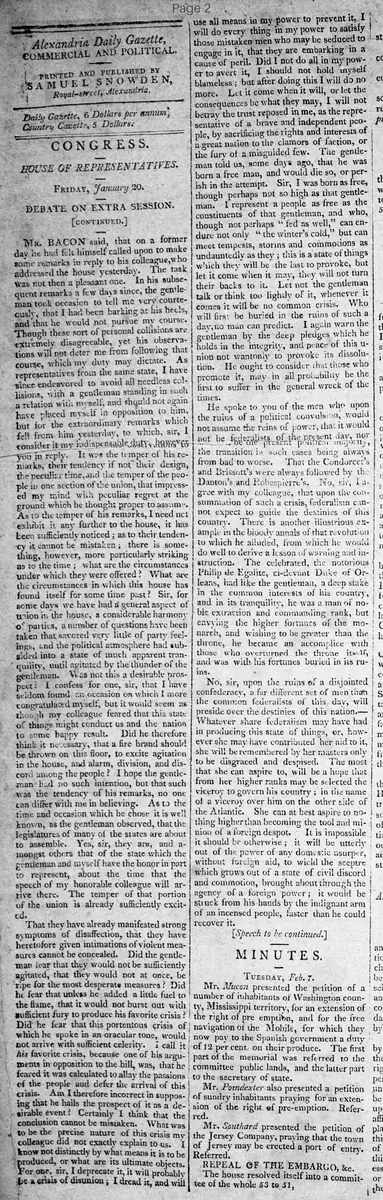
MR. BACON said, that on a former day he had felt himself called upon to make some remarks in reply to his colleague, who addressed the house yesterday. The task was not then a pleasant one. In his subsequent remarks a few days since, the gentleman took occasion to tell me very courteously, that I had been barking at his heels, and that he would not pursue my course. Though these sort of personal collisions are extremely disagreeable, yet his observations will not deter me from following that course, which my duty may dictate. As representatives from the same state, I have since endeavored to avoid all needless collisions, with a gentleman standing in such a relation with myself, and should not again have placed myself in opposition to him, but for the extraordinary remarks which fell from him yesterday, to which, sir, I consider it my indispensable duty—however you in reply. It was the temper of his remarks, their tendency if not their design, the peculiar time, and the temper of the people in one section of the union, that impressed my mind with peculiar regret at the ground which he thought proper to assume. As to the temper of his remarks, I need not exhibit it any further to the house, it has been sufficiently noticed; as to their tendency it cannot be mistaken; there is something, however, more particularly striking as to the time; what are the circumstances under which they were offered? What are the circumstances in which this house has found itself for some time past? Sir, for some days we have had a general aspect of union in the house, a considerable harmony of parties, a number of questions have been taken that savored very little of party feelings, and the political atmosphere had subsided into a state of much apparent tranquility, until agitated by the thunder of the gentleman. Was not this a desirable prospect? I confess for one, sir, that I have seldom found an occasion on which I more congratulated myself, but it would seem as though my colleague feared that this state of things might conduct us and the nation to some happy result. Did he therefore think it necessary, that a fire brand should be thrown on this floor, to excite agitation in the house, and alarm, division, and discord among the people? I hope the gentleman had no such intention, but that such was the tendency of his remarks, no one can differ with me in believing. As to the time and occasion which he chose it is well known, as the gentleman observed, that the legislatures of many of the states are about to assemble. Yes, sir, they are, and amongst others that of the state which the gentleman and myself have the honor in part to represent, about the time that the speech of my honorable colleague will arrive there. The temper of that portion of the union is already sufficiently excited. That they have already manifested strong symptoms of disaffection, that they have heretofore given intimations of violent measures cannot be concealed. Did the gentleman fear that they would not be sufficiently agitated, that they would not at once, be ripe for the most desperate measures? Did he fear that unless he added a little fuel to the flame, that it would not burst out with sufficient fury to produce his favorite crisis? Did he fear that this portentous crisis of which he spoke in an oracular tone, would not arrive with sufficient celerity. I call it his favorite crisis, because one of his arguments in opposition to the bill, was, that he feared it was calculated to allay the passions of the people and defer the arrival of this crisis. Am I therefore incorrect in supposing that he hails the prospect of it as a desirable event? Certainly I think that the conclusion cannot be mistaken. What was to be the precise nature of this crisis my colleague did not exactly explain to us. I know not distinctly by what means it is to be produced, or what are its ultimate objects. For one, sir, I deprecate it, it will probably be a crisis of disunion; I dread it, and will use all means in my power to prevent it, I will do every thing in my power to satisfy those mistaken men who may be seduced to engage in it, that they are embarking in a cause of peril. Did I not do all in my power to avert it, I should not hold myself blameless; but after doing this I will do no more. Let it come when it will, or let the consequences be what they may, I will not betray the trust reposed in me, as the representative of a brave and independent people, by sacrificing the rights and interests of a great nation to the clamors of faction, or the fury of a misguided few. The gentleman told us, some days ago, that he was born a free man, and would die so, or perish in the attempt. Sir, I was born as free, though perhaps not so high as that gentleman. I represent a people as free as the constituents of that gentleman, and who, though not perhaps "fed as well," can endure not only "the winter's cold," but can meet tempests, storms and commotions as undauntedly as they; this is a state of things which they will be the last to provoke, but let it come when it may, they will not turn their backs to it. Let not the gentleman talk or think too lightly of it, whenever it comes it will be no common crisis. Who will first be buried in the ruins of such a day, no man can predict. I again warn the gentleman by the deep pledges which he holds in the integrity, and peace of this union not wantonly to provoke its dissolution. He ought to consider that those who promote it, may in all probability be the first to suffer in the general wreck of the times. He spoke to you of the men who upon the ruins of a political convulsion, would not assume the reins of power, that it would not be federalists of the present day, nor be the present political majority the transition in such cases being always from bad to worse. That the Condorcet's and Brissot's were always followed by the Danton's and Robespierre's. No, sir, I agree with my colleague, that upon the consummation of such a crisis, federalism cannot expect to guide the destinies of this country. There is another illustrious example in the bloody annals of that revolution to which he alluded, from which he would do well to derive a lesson of warning and instruction. The celebrated, the notorious Philip de Egalite, ci-devant Duke of Orleans, had like the gentleman, a deep stake in the common interests of his country, and in its tranquility, he was a man of noble extraction and commanding rank, but envying the higher fortunes of the monarch, and wishing to be greater than the throne, he became an accomplice with those who overturned the throne itself, and was with his fortunes buried in its ruins. No, sir, upon the ruins of a disjointed confederacy, a far different set of men than the common federalists of this day, will preside over the destinies of this nation.-- Whatever share federalism may have had in producing this state of things, or, however she may have contributed her aid to it, she will be remembered by her masters only to be disgraced and despised. The most that she can aspire to, will be a hope that from her higher ranks may be selected the viceroy to govern his country; in the name of a viceroy over him on the other side of the Atlantic. She can at best aspire to nothing higher than becoming the tool and minion of a foreign despot. It is impossible it should be otherwise; it will be utterly out of the power of any domestic usurper, without foreign aid, to wield the sceptre which grows out of a state of civil discord and commotion, brought about through the agency of a foreign power; it would be struck from his hands by the indignant arm of an incensed people, faster than he could recover it.
[Speech to be continued.]
HOUSE OF REPRESENTATIVES.
FRIDAY, January 20.
DEBATE ON EXTRA SESSION.
[CONTINUED.]
MR. BACON said, that on a former day he had felt himself called upon to make some remarks in reply to his colleague, who addressed the house yesterday. The task was not then a pleasant one. In his subsequent remarks a few days since, the gentleman took occasion to tell me very courteously, that I had been barking at his heels, and that he would not pursue my course. Though these sort of personal collisions are extremely disagreeable, yet his observations will not deter me from following that course, which my duty may dictate. As representatives from the same state, I have since endeavored to avoid all needless collisions, with a gentleman standing in such a relation with myself, and should not again have placed myself in opposition to him, but for the extraordinary remarks which fell from him yesterday, to which, sir, I consider it my indispensable duty—however you in reply. It was the temper of his remarks, their tendency if not their design, the peculiar time, and the temper of the people in one section of the union, that impressed my mind with peculiar regret at the ground which he thought proper to assume. As to the temper of his remarks, I need not exhibit it any further to the house, it has been sufficiently noticed; as to their tendency it cannot be mistaken; there is something, however, more particularly striking as to the time; what are the circumstances under which they were offered? What are the circumstances in which this house has found itself for some time past? Sir, for some days we have had a general aspect of union in the house, a considerable harmony of parties, a number of questions have been taken that savored very little of party feelings, and the political atmosphere had subsided into a state of much apparent tranquility, until agitated by the thunder of the gentleman. Was not this a desirable prospect? I confess for one, sir, that I have seldom found an occasion on which I more congratulated myself, but it would seem as though my colleague feared that this state of things might conduct us and the nation to some happy result. Did he therefore think it necessary, that a fire brand should be thrown on this floor, to excite agitation in the house, and alarm, division, and discord among the people? I hope the gentleman had no such intention, but that such was the tendency of his remarks, no one can differ with me in believing. As to the time and occasion which he chose it is well known, as the gentleman observed, that the legislatures of many of the states are about to assemble. Yes, sir, they are, and amongst others that of the state which the gentleman and myself have the honor in part to represent, about the time that the speech of my honorable colleague will arrive there. The temper of that portion of the union is already sufficiently excited. That they have already manifested strong symptoms of disaffection, that they have heretofore given intimations of violent measures cannot be concealed. Did the gentleman fear that they would not be sufficiently agitated, that they would not at once, be ripe for the most desperate measures? Did he fear that unless he added a little fuel to the flame, that it would not burst out with sufficient fury to produce his favorite crisis? Did he fear that this portentous crisis of which he spoke in an oracular tone, would not arrive with sufficient celerity. I call it his favorite crisis, because one of his arguments in opposition to the bill, was, that he feared it was calculated to allay the passions of the people and defer the arrival of this crisis. Am I therefore incorrect in supposing that he hails the prospect of it as a desirable event? Certainly I think that the conclusion cannot be mistaken. What was to be the precise nature of this crisis my colleague did not exactly explain to us. I know not distinctly by what means it is to be produced, or what are its ultimate objects. For one, sir, I deprecate it, it will probably be a crisis of disunion; I dread it, and will use all means in my power to prevent it, I will do every thing in my power to satisfy those mistaken men who may be seduced to engage in it, that they are embarking in a cause of peril. Did I not do all in my power to avert it, I should not hold myself blameless; but after doing this I will do no more. Let it come when it will, or let the consequences be what they may, I will not betray the trust reposed in me, as the representative of a brave and independent people, by sacrificing the rights and interests of a great nation to the clamors of faction, or the fury of a misguided few. The gentleman told us, some days ago, that he was born a free man, and would die so, or perish in the attempt. Sir, I was born as free, though perhaps not so high as that gentleman. I represent a people as free as the constituents of that gentleman, and who, though not perhaps "fed as well," can endure not only "the winter's cold," but can meet tempests, storms and commotions as undauntedly as they; this is a state of things which they will be the last to provoke, but let it come when it may, they will not turn their backs to it. Let not the gentleman talk or think too lightly of it, whenever it comes it will be no common crisis. Who will first be buried in the ruins of such a day, no man can predict. I again warn the gentleman by the deep pledges which he holds in the integrity, and peace of this union not wantonly to provoke its dissolution. He ought to consider that those who promote it, may in all probability be the first to suffer in the general wreck of the times. He spoke to you of the men who upon the ruins of a political convulsion, would not assume the reins of power, that it would not be federalists of the present day, nor be the present political majority the transition in such cases being always from bad to worse. That the Condorcet's and Brissot's were always followed by the Danton's and Robespierre's. No, sir, I agree with my colleague, that upon the consummation of such a crisis, federalism cannot expect to guide the destinies of this country. There is another illustrious example in the bloody annals of that revolution to which he alluded, from which he would do well to derive a lesson of warning and instruction. The celebrated, the notorious Philip de Egalite, ci-devant Duke of Orleans, had like the gentleman, a deep stake in the common interests of his country, and in its tranquility, he was a man of noble extraction and commanding rank, but envying the higher fortunes of the monarch, and wishing to be greater than the throne, he became an accomplice with those who overturned the throne itself, and was with his fortunes buried in its ruins. No, sir, upon the ruins of a disjointed confederacy, a far different set of men than the common federalists of this day, will preside over the destinies of this nation.-- Whatever share federalism may have had in producing this state of things, or, however she may have contributed her aid to it, she will be remembered by her masters only to be disgraced and despised. The most that she can aspire to, will be a hope that from her higher ranks may be selected the viceroy to govern his country; in the name of a viceroy over him on the other side of the Atlantic. She can at best aspire to nothing higher than becoming the tool and minion of a foreign despot. It is impossible it should be otherwise; it will be utterly out of the power of any domestic usurper, without foreign aid, to wield the sceptre which grows out of a state of civil discord and commotion, brought about through the agency of a foreign power; it would be struck from his hands by the indignant arm of an incensed people, faster than he could recover it.
[Speech to be continued.]
What sub-type of article is it?
Politics
What keywords are associated?
Congress Debate
Extra Session
Union Crisis
Mr Bacon Speech
Sectional Tensions
Federalism
What entities or persons were involved?
Mr. Bacon
Domestic News Details
Event Date
Friday, January 20.
Key Persons
Mr. Bacon
Event Details
MR. BACON delivers a speech in reply to his colleague's remarks from the previous day during the debate on an extra session, criticizing the inflammatory tone and timing that could exacerbate sectional tensions and provoke a crisis of disunion, drawing historical parallels to the French Revolution to warn against such outcomes.