Thank you for visiting SNEWPapers!
Sign up free
Norfolk Gazette And Publick Ledger
Norfolk, Virginia
What is this article about?
In a legislative body sitting on December 31, 1804, Minister Champagny presents an exposition on the French Empire's internal stability, hereditary imperial succession, religious reconciliation, economic progress, colonial holdings, military readiness, and diplomatic relations with Europe amid ongoing war with Britain.
Merged-components note: Long continuous foreign news from French papers on internal situation and politics; text flows across components.
Clippings
1 of 2
OCR Quality
Full Text
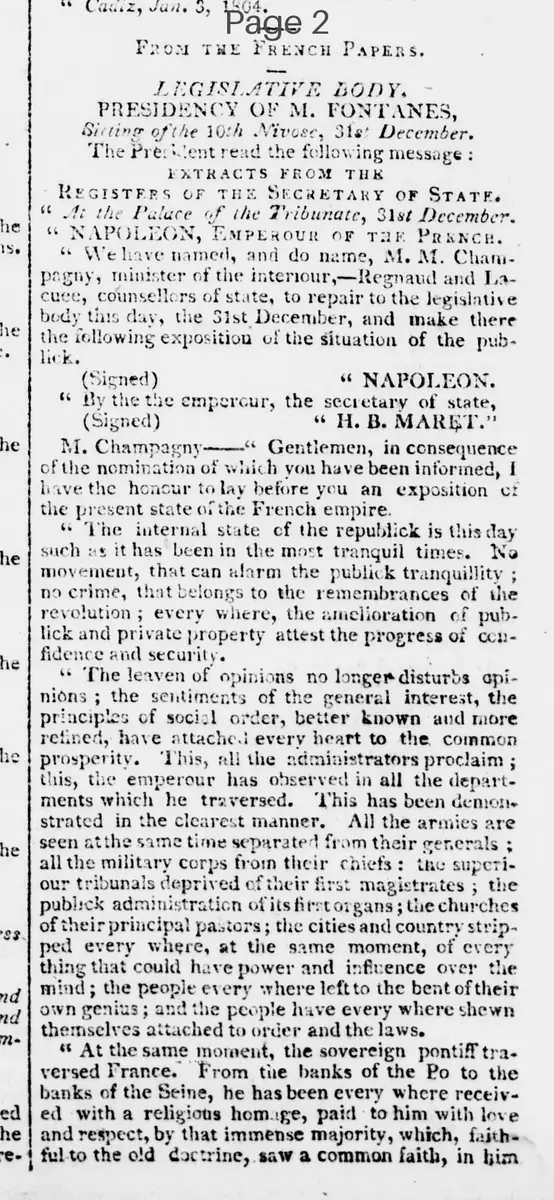
LEGISLATIVE BODY.
PRESIDENCY OF M. FONTANES,
Sitting of the 10th Nivose, 31st December.
The President read the following message:
EXTRACTS FROM THE
Registers of the Secretary of State.
"At the Palace of the Tribunate, 31st December.
"NAPOLEON, EMPEROR OF THE FRENCH.
"We have named, and do name, M. M. Champagny, minister of the interior,—Regnaud and Laplace, counsellors of state, to repair to the legislative body this day, the 31st December, and make there the following exposition of the situation of the publick.
(Signed)
"NAPOLEON."
"By the Emperor, the secretary of state,
(Signed)
"H. B. MARET."
M. Champagny—"Gentlemen, in consequence of the nomination of which you have been informed, I have the honour to lay before you an exposition of the present state of the French empire.
"The internal state of the republic is this day such as it has been in the most tranquil times. No movement, that can alarm the publick tranquillity; no crime, that belongs to the remembrances of the revolution; every where, the amelioration of publick and private property attest the progress of confidence and security.
“The leaven of opinions no longer disturbs opinions; the sentiments of the general interest, the principles of social order, better known and more refined, have attached every heart to the common prosperity. This, all the administrators proclaim; this, the emperor has observed in all the departments which he traversed. This has been demonstrated in the clearest manner. All the armies are seen at the same time separated from their generals: all the military corps from their chiefs: the superior tribunals deprived of their first magistrates; the publick administration of its first organs; the churches of their principal pastors; the cities and country stripped every where, at the same moment, of every thing that could have power and influence over the mind; the people every where left to the bent of their own genius: and the people have every where shewn themselves attached to order and the laws.
"At the same moment, the sovereign pontiff traversed France. From the banks of the Po to the banks of the Seine, he has been every where received with a religious homage, paid to him with love and respect, by that immense majority, which, faithful to the old doctrine, saw a common faith, in him whom all Europe reveres as a sovereign raised to the throne by his piety and his virtues.
"A plot, framed by an implacable government, was going to re-plunge us in the abyss of civil wars and anarchy. Upon the discovery of this horrible plot, all France was thrown into emotion: anxieties imperfectly lulled to sleep are awakened, and in every heart, at once, are found against those principles which were constantly ours, before error and weakness had alienated the mind, and guilty intrigues perverted opinion.
"It was found that the divided power was without concert, and without strength. It was felt that, entrusted for a time, it was precarious, and permitted neither long labours, nor reflections; that, entrusted for the life of a single man, it grew feeble with him, and left after him only changes of discord and anarchy. It was finally discovered that there was no safety for great nations, but in hereditary power; which alone could secure the political life and embrace ages and generations in its duration.
"The senate has been, as it ought to be, the organ of the common anxiety. This desire of inheritance, which was in all hearts, truly French, soon manifested itself; it was proclaimed by the electoral colleges, and by the armies. The council of state, the magistrates, the most enlightened of men, were consulted, and their answer has been unanimous.
"The necessity of hereditary power in a state so extensive as France, had been for a long time perceived by the first consul. In vain did he resist the force of principles--in vain did he attempt to establish a system of election, which might be able to perpetuate the authority, and transmit it without danger, and without trouble.
"The publick inquietude, the hopes of our enemies, blamed his work. His death was to be the ruin of his labours. It was at this moment the jealousy of the foreigner, and a spirit of discord and anarchy, assailed us.--Reason, sentiment, experience, alike assured all the French, there could be no certain transmission of power, but that which operated without an interval; that there could be no tranquil succession, except that which was regulated by the laws of nature.
"When such motives supported such pressing wishes, the determination of the first consul could not be doubtful. He resolved, therefore, to accept for himself, and for two of his brothers after him, the burthen which the necessity of circumstances imposed upon him.
"From his own meditations, matured by conferences with the members of the senate, by discussions in the councils, by the observations of the most enlightened men, is formed a series of dispositions which fixes the inheritance of the imperial throne;
"Which assigns to princes their right and their duties;
"Which promises to the heir of the empire an education regulated by the laws, and such as shall be worthy of his high destiny;
"Which designates those, who, in case of minority, shall be called to the regency, and marks the limits of their power;
"Which places between the throne and the citizens, dignities and offices accessible to all, encouragements and rewards of publick virtues;
"Which gives to men honoured with great distinction or invested with great authority, judges, too great to be unjust before their authority or before their distinction;
"Which give to crimes against the publick safety, an inheritance in the empire, judges, essentially attached to the safety of the empire and to its interest;
"Which places more éclat and more weight in the functions of the legislator, more development and extent in the right execution of the laws;
"Which brings back the timid and their heads. ment to their old dominations, which had often welthertetofares;
"Which, in fine, secures the rights of the nimte and of the people, by oaths, the eternal guar- di nsofalluiecls.
"These dispositions have been decreed by the se, natus constmp dithe deth cored (lsthod Mar- the I eikh muople iive mintgated tneir mree and in- doexedent vil; they have wished the unpeiil dig mity to 'be hereditary in the dircct, and tegitimste Ime of descemlence of Japh Iuomapait 3 in the cicst and le tintie lie of deaccndence or Itis Boonoparte
" rion tiat momont. Napolecn hs been, by the mosnst i ute, Pmverourofthe French. No other acrwasneroetry to prove hs title and constcrate hy anuorry.
" Ent he wihed to re tore'. France its angient forlas. to recak among us thoseinst tucions which the divinity seems to hase mst ired, and to in pres upon tthe coipmnencement of bis reign the seal of religion i oelf. Toghe tthe Fre.ch a splemlid proofof his paternal tendtruess, the he.d of the chueh, has bep pleased to sive his assist tnce to ths dugust Ceremonv.
" What deep and duiable impressions it has left in the heurt of the em eraur, and s the nenoiy of thenation ! W hat conversation for future genera- ti ns, ond whst asubject ofadniration for Eurape!
" Nopolcon prostrate at the foot of the altars which he has rai ed ; the sovereign pontiff imploring ujon Irance and ngo i him the blessings of heaven, ajd, in his wi-hes for the felicity of one nation, em- braciag the felicity of all nntions! !
" Pastors urd priests, lately divided, unitin g to his supplications thci gr. titude and thcir voices !
" The senato s, the lecislators. the tribunates, ma- gistr.ues, w. "ri urr, admunistrators of the people, and those who presi te over their assmnbhes, mixing toget her theiropiniuns, their hopes, their wishes.- Sovereigns, princes, ambassadours, struck with this gran i siecticle of France, reseated upon herancient faanlations, and by its repose assuring the repose of their country !! inspectors are appointed, who shall throw a light upon their precepts, and prevent them from degenerating into vain and useless experiments; the Lycees, the secondary schools, are filling with youth eager for instruction.
"Fontainbleau has already furnished a militia, distinguished in our armies for its high state, its attainments, and regard to discipline.
"The polytechnick school is peopling our arsenals, our ports, and our establishments, with useful hands.
"At Compeigne, the school of arts and trades daily obtains new success. That which is forming on the limits of La Vendee, is expected with impatience, and will soon be in full activity.
"Prizes have been decreed to the sciences, to literature, and the arts: and, during a period of ten years, devoted to works which his majesty is determined to recompence, he has a right to expect that the genius of the French shall produce master-pieces.
"In the department of bridges and roads, the works already commenced have been prosecuted with vigour, others have been planned, and each year prepares new projects for the prosperity of the state, to be executed in the succeeding ones. But the untowardness of the seasons has opposed the foresight and the zeal of the administration; rains descending in torrents have broken up the roads with greater rapidity than their ravages could be repaired--some works have been destroyed:--others have been for a moment suspended:--great calamities have overwhelmed some of the departments, and particularly that of the Rhine and Moselle. A judicious prefect anticipating the intentions of the Emperor, has given assistance to the unfortunate persons who fell victims to it. His Majesty has raised their courage by his presence, and has consoled them by his favours.
"The scourge of contagious disease has afflicted the neighbouring countries: but the vigilance of the administration has preserved our territory from its effects; it is now abating in these parts where it extended its ravages. By persisting in measures required by prudence and the publick welfare, the attacks of this evil will be prevented, without interrupting the communication necessary for the supply of our commerce and manufactures.
"In the midst of La Vendee a new city is erecting, which is intended to be the seat of the administration. It will thence extend its active and steady superintendence over every quarter; thence information will be propagated throughout this whole department, in which ignorance and the want of instruction have so often involved simple and honest minds in the intrigues of the malevolent.
"The decrees of the Emperor have recalled commerce to the left bank of the Rhine, and given to Mertz and Cologne all the advantages of actual entrepots, without the danger of introducing contraband commodities into the interior of France.
"Improvements are made in the manufactures, and, while in their vain declamation, the mercenaries hired by the British government boast of their distant and precarious resources, dispersed on the seas and in the Indies; while they represent our workshops as deserted, and our artizans dying of misery; our industry, extending its roots in our own soil, drives the manufactures of England far from our frontiers, has equalled them in what constituted their glory; and their success, the perfection of their machines, and will soon dispute with them the consumption in every quarter to which they can be conveyed.
"Agriculture, our principal manufacture, is daily acquiring greater extent, and receiving new improvements. "A system of exportation, so well planned, that it can be extended or contracted, according to our wants, ensures to the cultivator the price of his labour, and the plentiful supply of our markets.
"New encouragements are paving the way to the improvements of the breed of our horses;--our wools have attained to greater perfection--our fields are covered with cattle, and real wealth covers every part of our empire with opulence--reviving security is given more ample scope to active benevolence excited by religion, and the recollection of our misfortunes, is no longer confined to temporary charities, it extends to the future, and confides its treasures to the government, by which they are employed conformably to its wishes. Never were so many legacies and pious donations bequeathed to the hospitals, and charitable establishments. Some of these institutions have been created and restored by private individuals; never did suffering humanity find more friends, nor indigence more relief. They are distributed with equal judgment and zeal, and the hospitals, managed with an intelligence which increases their advantages by economizing the funds, afford relief to every want, a cure for the multitude of diseases, and are no longer those abodes of destruction which devoured their numerous and wretched inhabitants. Thus the number of the indigent in the capital is less, by 32,000 than it was in 1799; and, by 25,000 in the year 10.
"Religion has resumed its empire, which it exercises only for the good of humanity; it is accompanied with a wise toleration, and the ministers of different persuasions, who adore the same God, honour each other with testimonies of reciprocal respect, and know no other rivalship than that of virtue.
"Such is our internal situation. Abroad, French courage seconded by Spanish faith, preserves to us Santo Domingo; Martinique defies the menaces of the enemy, and under a paternal government, more durable and stronger ties of attachment to the mother country are established.
"Guadaloupe has enriched itself by the spoils of British commerce; and Guiana continues to prosper under an active and vigorous administration.
"The Isles of France and Reunion would now be the depot of the riches of Asia: London would be in convulsions and despair, if inexperience or weakness had not defeated a plan most ably concerted. Those islands at least, are enriched by prizes taken from our enemies.
"Our armies still continue to deserve the reputation they enjoy. With the same valour and the same discipline, they have acquired that patience which waits without murmuring for opportunities, and confides in the prudence and designs of the chief who conducts them. Our soldiers and our officers learn to master the element which separates them from that island which is the object of their resentment. Their audacity and address astonish the oldest and most experienced seamen.
"Our fleets by their continual manoeuvres, prepare for combat, and while those of our enemies are battered by winds and tempests, ours without injury learn to cope with them.
"Lastly, since the commencement of the war, we have gained Hanover, we are, more than ever, in a situation for striking a decisive blow against our enemies. Our marine is in a better state than it has been these ten years; by land, our army is more numerous, in higher condition, and better provided with every requisite to insure victory than ever it was.
"In the department of the finances have prevailed the same activity in the receipts, the same regularity in the administration, the same order in the expenditure of the publick treasure, and almost without fluctuation the same valuable state of the publick debt.
"War has produced a necessity for extraordinary expenses: but the sums thus applied have been retained within our territory; they have given us ports, vessels, and all that is necessary for the development of our force against our enemies.
"These extraordinary expenses now cease--and those which our warlike attitude requires will hence forth be directed with an economy, which the urgency of the preparations necessary both for attack and defence did not permit.
"The revenues of the crown will defray all the expenses of the Emperor's coronation, and those which the splendour of his throne will continue to demand. The pomp by which he is surrounded will never be a burden to the nation.
"The situation of Europe has experienced only one important change.
"Spain reposed in a neutrality to which France had consented, and to which the British cabinet had agreed.--Her vessels were suddenly attacked, and the treaty of Amiens was violated with regard to her, as it had before been with regard to France. His Catholic Majesty has taken those measures required by the dignity of his throne, the violation of publick faith, and the honour of a generous nation, whose destiny he directs.
"The Emperor of Austria devotes to the improvement of his finances, to the prosperity of his provinces, to the progress of their commerce, the repose which the loyalty of his character and the interest of his subjects recommend.
"The Italian republick, administered and governed by the same principles as France, demands, like her a definitive organization, which shall secure to the present and future generations all the advantages of the social compact united to this republick, by the duties imposed upon him, as president and founder of that state, the emperor will justify the confidence reposed in him, and secure its treaties and independence, in serving the interests of the French people, to whom it also owes its existence, and in reconciling the interests of the two friendly nations with the real interests of the neighbouring powers. By these changes, which the will of one nation, and the interests of all demand, will at length, fall to the ground all absurd calumnies, and France having herself marked the spot where she had placed her limits, will no more be accused of a wish to trespass beyond them.
"Helvetia enjoys, in peace, the blessings of her constitution, of the wisdom of her citizens, and of our alliance.
"Batavia still groans under an oligarchical government, without union in her views, without patriotism, and without vigour.
"Her colonies have been sold a second time, and surrendered, without firing a gun, to England; but that nation has energy, morals, and economy. She wants only a firm, patriotick and enlightened government.
"The King of Prussia upon all occasions has shewn himself the friend of France, and the Emperor has seized every opportunity that presented itself to consolidate this happy harmony.
"The electors and all the members of the Germanick Body, faithful to maintain the relations of friendship and good will, which unite them to France.
"Denmark follows the councils of a policy always wise, moderate, and judicious.
"The spirit of Catharine the Great will watch over the councils of Alexander the First. He will remember, that the friendship of France is for him a necessary counterpoise, in the balance of Europe; that placed at a distance from her, he can neither attack her, nor disturb her repose, and, that his chief interest is to seek in his relations with her the market necessary for the productions of his empire.
"Turkey wavers in her politicks, and follows through fear, a system which her interests disavows. May she not learn, at the expence of her existence, that fear and uncertainty accelerate the fall of empires, and that they are a thousand times more fatal than the dangers and losses of an unsuccessful war.
"Whatever may be the movements of England, the destinies of France are fixed; strong in her union, strong in her riches and the courage of her defenders, she will assiduously cultivate the alliance of friendly nations, and will neither make enemies nor fear them.
"When England shall be convinced of the insufficiency of her efforts to disturb the continent; when she shall be sensible that she can only lose in a war undertaken without object, and without motives, when she shall be convinced that France will never agree to any other conditions than those of Amiens, and will never consent to allow her the right of breaking treaties, at pleasure, by keeping possession of Malta; England will then be actuated by pacifick sentiments; hatred and envy are the passions of the day.
M. le President—"Messieurs, the minister of the interior, the counsellors of state, and the legislative body, give you thanks for the act of the exposition which you have just presented to it--it will form a general committee to consider of this communication, and will adopt a deliberation worthy of itself and the government which sends you."
The paper of the 2d contains the addresses from the tribunate and legislative body to the Emperor, returning thanks for this statement.
What sub-type of article is it?
What keywords are associated?
What entities or persons were involved?
Where did it happen?
Foreign News Details
Primary Location
France
Event Date
10th Nivose, 31st December
Key Persons
Outcome
establishment of hereditary imperial succession for napoleon and his brothers; internal stability and prosperity; preservation of colonies; military and naval preparations for war; diplomatic neutrality or alliance with european powers; ongoing conflict with britain.
Event Details
Minister Champagny delivers an exposition to the Legislative Body on the French Empire's internal tranquility, rejection of revolutionary remnants, establishment of hereditary power following a plot discovery, religious reconciliation with the Pope's visit and coronation, educational and infrastructural improvements, economic and agricultural progress, containment of disease, colonial successes in the Americas and Indian Ocean, military readiness, financial stability, and European diplomatic overview including violations of the Treaty of Amiens by Britain against Spain.