Thank you for visiting SNEWPapers!
Sign up free
The National Intelligencer And Washington Advertiser
Washington, District Of Columbia
What is this article about?
Translations of French letters from Cadiz detail the aftermath of the Battle of Trafalgar in October 1805, reporting heavy losses for the combined French-Spanish fleet, including sunk ships like Indomptable and Aigle, deaths of Nelson and others, and preservation of only a few vessels under Villeneuve and Dumanoir.
Clipping
OCR Quality
Full Text
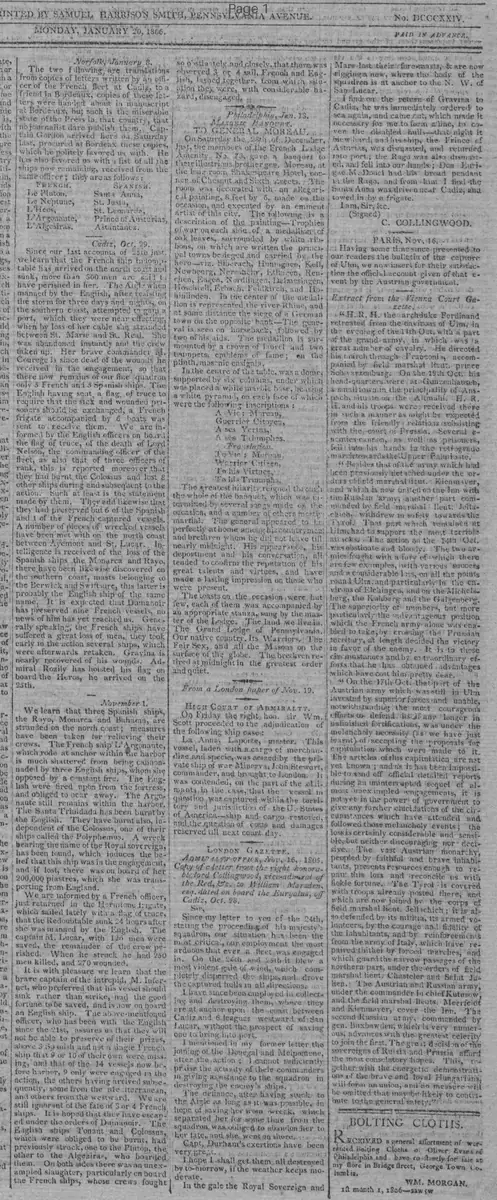
Norfolk, January 8.
The two following are translations from copies of letters written by an officer of the French fleet at Cadiz, to a friend in Bordeaux, copies of these letters were handed about in manuscript at Bordeaux, but such is the miserable state of the Press in that country, that no journalist dare publish them. Captain Gordon arrived here last Saturday procured at Bordeaux these copies, which he politely favored us with. He has also favored us with a list of all the ships now remaining, received from the same officer; they are as follows:
FRENCH.
Le Pluton.
Le Neptune.
L'Heros.
L'Argonaute.
L'Algesiras.
SPANISH.
Santa Anna.
St. Justa.
St. Leonarde.
Prince of Asturias.
Astantanez.
Since our last accounts of 8th inst. we learn that the French ship Indomptable has arrived on the north coast and sunk, more than 300 men are said to have perished in her. The Aigle, when manned by the English, after resisting the storm for three days and nights, on the southern coast, attempted to gain a port, which they were near effecting, when by loss of her cable she stranded between St. Marie and St. Real. She was abandoned instantly and the crew taken up. Her brave commander M. Courage is since dead of the wounds he received in the engagement, so that there now remains of our fine squadron only 5 French and 5 Spanish ships. The English having sent a flag of truce to require that the sick and wounded prisoners should be exchanged, a French frigate accompanied by 6 boats was sent to receive them. We are informed by the English officers on board the flag of truce, of the death of Lord Nelson, the commanding officer of the fleet, as also that of three officers of rank, this is reported moreover that they had burnt the Colossus and lost 8 other ships during and subsequent to the action. Such at least is the statement made by them. They added likewise that they had preserved but 6 of the Spanish and 1 of the French captured vessels. A number of pieces of wrecked vessels have been met with on the north coast between Ayamonte and St. Lucar. Intelligence is received of the loss of the Spanish ships the Monarca and Rayo, there have been likewise discovered on the southern coast, masts belonging to the Berwick and Swiftsure, this latter is probably the English ship of the same name. It is expected that Dumanoir has preserved nine French vessels, no news of him has yet reached us. Generally speaking, the French ships have suffered a great loss of men, they took early in the action several ships, which were afterwards retaken. Gravina is nearly recovered of his wounds. Admiral Villeneuve has hoisted his flag on board the Heros, he arrived on the 25th.
November 1.
We learn that three Spanish ships, the Rayo, Monarca and Bahama, are stranded on the north coast; measures have been taken for relieving their crews. The French ship L'Argonaute, which rode at anchor within the harbor is much shattered from being cannonaded by three English ships, whom she opposed by a constant fire. The English were fired upon from the fortress, and obliged to bear away. The Argonaute still remains within the harbor. The Santa Trinidad has been burnt by the English. They have burnt also, independent of the Colossus, one of their ships called the Polyphemus. A wreck bearing the name of the Royal Sovereign, has been found, which induces the belief that this ship was in the engagement, and if lost, there was on board of her 200,000 piastres, which she was transporting from England.
We are informed by a French officer, just returned in the Hermione frigate, which sailed lately with a flag of truce, that the Redoubtable sunk 24 hours after she was manned by the English. The captain M. Lucas, with 121 men were saved, the remainder of the crew perished. When he struck he had 250 men killed, and 270 wounded.
It is with pleasure we learn that the brave captain of the Intrepid, M. Infernet, who preferred that his vessel should sink rather than strike, had the good fortune to be saved, and is now on board an English ship. The above-mentioned officer, who has been with the English since the 21st, assures us that they will not be able to preserve of their prizes, above 3 Spanish and not a single French ship that 9 or 10 of their own were missing, and that of the 14 vessels now before harbor, 9 only were engaged in the action, the others having arrived subsequently, some from the Mediterranean, and others from the westward. We are still ignorant of the fate of 5 or 4 French ships. It is hoped that they have escaped under the orders of Dumanoir. The English ships Tonnant and Colossus, which were obliged to be burnt, had previously struck, one to the Pluton, the other to the Algesiras, who boarded them. On both sides there was an unprecedented slaughter, particularly on board the French ships, whose crews fought so obstinately and closely, that there was observed 3 or 4 sail, French and English, lashed together, from which situation they were, with considerable hazard, disengaged.
What sub-type of article is it?
What keywords are associated?
What entities or persons were involved?
Where did it happen?
Foreign News Details
Primary Location
Cadiz
Event Date
November 1805
Key Persons
Outcome
heavy losses including sinking of indomptable (300+ perished), aigle stranded, redoubtable sunk (250 killed, 270 wounded on french side), monarca and rayo lost; english reported to have lost 8-10 ships including colossus and tonnant burnt; only 5 french and 5 spanish ships remain; nelson and three officers dead; french preserved few prizes.
Event Details
French officer's letters from Cadiz report post-battle losses after Trafalgar engagement: ships sunk or stranded due to storm and battle damage; exchanges via flag of truce reveal English claims of burning Colossus, losing other vessels, and Nelson's death; lists remaining ships; details on specific wrecks like Santa Trinidad burnt, Argonaute damaged but safe; hopes for Dumanoir's escaped vessels; intense close-quarters fighting noted.