Thank you for visiting SNEWPapers!
Sign up free
Story
March 18, 1886
People And Patriot
Concord, Merrimack County, New Hampshire
What is this article about?
Detailed report on Mr. Goodell's Antrim farm, highlighting his durable 1881-built silo for ensilage storage, successful cattle feeding and dairy operations with 30 milking cows, prized imported Holstein herd, fruit cultivation, and his career balancing farming with manufacturing leadership.
Clipping
OCR Quality
98%
Excellent
Full Text
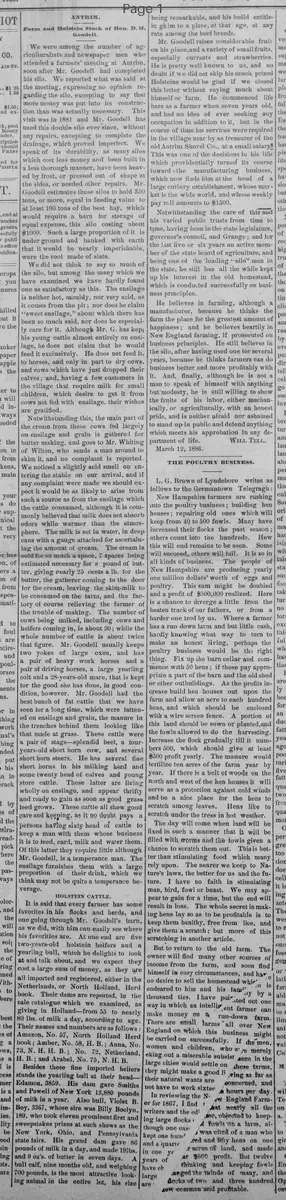
We were among the number of agriculturalists and newspaper men who attended a farmers' meeting at Antrim, soon after Mr. Goodell had completed his silo. We reported what was said at the meeting, expressing no opinion regarding the silo, excepting to say that more money was put into its construction than was actually necessary. This visit was in 1881 and Mr. Goodell has used this double silo ever since, without any repairs, excepting to complete the drainage, which proved imperfect. We speak of its durability, as many silos which cost less money and been built in a less thorough manner, have been heaved by frost, or pressed out of shape at the sides, or needed other repairs. Mr. Goodell estimates these silos to hold 350 tons, or more, equal in feeding value to at least 100 tons of the best hay, which would require a barn for storage of equal expense, this silo costing about $1000. Such a large proportion of it is under ground and banked with earth that it would be nearly imperishable, were the roof made of slate.
We did not think to say so much of the silo, but among the many which we have examined we have hardly found one as satisfactory as this. The ensilage is neither hot, mouldy, nor very acid, as it comes from the pit; nor does he claim "sweet ensilage," about which there has been so much said, nor does he especially care for it. Although Mr. G. has kept his young cattle almost entirely on ensilage, he does not claim that he would feed it exclusively. He does not feed it to horses, and only in part to dry cows, and cows which have just dropped their calves; and, having a few customers in the village that require milk for small children, which desire to get it from cows not fed with ensilage, their wishes are gratified.
Notwithstanding this, the main part of the cream from these cows fed largely on ensilage and grain is gathered for butter making, and goes to Mr. Whiting of Wilton, who sends a man around to skim it, and no complaint is reported. We noticed a slightly acid smell on entering the stable on our arrival, and if any complaint were made we should expect it would be as likely to arise from such a source as from the ensilage which the cattle consumed, although it is commonly believed that milk does not absorb odors while warmer than the atmosphere. The milk is set in water, in deep cans with a gauge attached for ascertaining the amount of cream. The cream is sold for so much a space, 7 spaces being estimated necessary for a pound of butter, giving nearly 25 cents a lb. for the butter, the gatherer coming to the door for the cream, leaving the skim-milk to be consumed on the farm, and the factory of course relieving the farmer of the trouble of making. The number of cows being milked, including cows and heifers coming in, is about 30; while the whole number of cattle is about twice that figure. Mr. Goodell usually keeps two yokes of large oxen, and has a pair of heavy work horses and a pair of driving horses, a large yearling colt and a 28-years-old mare, that is kept for the good she has done, in good condition, however. Mr. Goodell had the best bunch of fat cattle that we have seen for a long time, which were fattened on ensilage and grain, the manure in the trenches behind them looking like that made at grass. These cattle were a pair of stags—splendid beef, a four-years-old short horn cow, and several short horn steers. He has several fine short horns in his milking herd and some twenty head of calves and young store cattle. These latter are living wholly on ensilage, and appear thrifty and ready to gain as soon as good grass feed grows. These cattle all show good care and keeping, as it no doubt pays a person having sixty head of cattle to keep a man with them whose business it is to feed, care, milk and water them. Of this latter they require little although Mr. Goodell is a temperance man. The ensilage furnishes them with a large proportion of their drink, which we think may not be quite a temperance beverage.
It is said that every farmer has some favorites in his flocks and herds, and one going through Mr. Goodell's barn, as we did, with him can easily see where his favorites are. At one end are five two-years-old Holstein heifers and a yearling bull, which he delights to look at and talk about, and we expect they cost a large sum of money, as they are all imported and registered, either in the Netherlands, or North Holland, Herd book. Their dams are reported, in the sale catalogue which we examined, as giving in Holland—from 55 to nearly 80 lbs. of milk a day, according to age. Their names and numbers are as follows: Amazon, No. 57, North Holland Herd book; Amber, No. 58, H. B.; Anna, No. 73, N. H. H. B.; No. 72, Netherland, H. B.; and Arabel, No. 75. N. H. B.
Besides these fine imported heifers stands the yearling bull at their head—Edamon, 3859. His dam gave Smith and Powell of New York 13,880 pounds of milk in a year. Also bull, Violet B. Boy, 3367, whose sire was Billy Boclyn, 189, who took eleven prominent first and sweepstakes prizes at such shows as the New York, Ohio, and Pennsylvania state fairs. His grand dam gave 86 pounds of milk in a day, and made 19 lbs. and 9 oz's. of butter in seven days. A bull calf, nine months old, and weighing 700 pounds, is the most attractive looking animal in the entire lot, his size being remarkable, and his build entitling him to a place, at that age, at any rate among the beef breeds.
Mr. Goodell raises considerable fruit on his place, and a variety of small fruits, especially currants and strawberries. He is pretty well known to us, and no doubt if we did not skip his much prized Holsteins would be glad if we closed this letter without saying much about himself or farm. He commenced life here as a farmer when seven years old, and had no idea of ever seeking any occupation in addition to it, but in the course of time his services were required in the village near by as treasurer of the old Antrim Shovel Co., at a small salary. This was one of the decisions in his life which providentially turned its course toward the manufacturing business, which now finds him at the head of a large cutlery establishment, whose market is the wide world, and whose weekly pay roll amounts to $1500.
Notwithstanding the care of this and his varied public trusts from time to time, having been in the state legislature, governor's council, and Grange; and for the last five or six years an active member of the state board of agriculture, and being one of the leading "silo" men in the state, he still has all the while kept up his interest in the old homestead, which is conducted successfully on business principles.
He believes in farming, although a manufacturer, because he thinks the farm the place for the greatest amount of happiness; and he believes heartily in New England farming, if prosecuted on business principles. He still believes in the silo, after having used one for several years, because he thinks farmers can do business better and more profitably with it. And, finally, although he is not a man to speak of himself with anything but modesty, he is still willing to show the fruits of his labor, either mechanically, or agriculturally, with an honest pride, and is neither afraid nor ashamed to stand up in public and defend anything which meets his approbation in any department of life.
WILL TELL.
March 12, 1886.
We did not think to say so much of the silo, but among the many which we have examined we have hardly found one as satisfactory as this. The ensilage is neither hot, mouldy, nor very acid, as it comes from the pit; nor does he claim "sweet ensilage," about which there has been so much said, nor does he especially care for it. Although Mr. G. has kept his young cattle almost entirely on ensilage, he does not claim that he would feed it exclusively. He does not feed it to horses, and only in part to dry cows, and cows which have just dropped their calves; and, having a few customers in the village that require milk for small children, which desire to get it from cows not fed with ensilage, their wishes are gratified.
Notwithstanding this, the main part of the cream from these cows fed largely on ensilage and grain is gathered for butter making, and goes to Mr. Whiting of Wilton, who sends a man around to skim it, and no complaint is reported. We noticed a slightly acid smell on entering the stable on our arrival, and if any complaint were made we should expect it would be as likely to arise from such a source as from the ensilage which the cattle consumed, although it is commonly believed that milk does not absorb odors while warmer than the atmosphere. The milk is set in water, in deep cans with a gauge attached for ascertaining the amount of cream. The cream is sold for so much a space, 7 spaces being estimated necessary for a pound of butter, giving nearly 25 cents a lb. for the butter, the gatherer coming to the door for the cream, leaving the skim-milk to be consumed on the farm, and the factory of course relieving the farmer of the trouble of making. The number of cows being milked, including cows and heifers coming in, is about 30; while the whole number of cattle is about twice that figure. Mr. Goodell usually keeps two yokes of large oxen, and has a pair of heavy work horses and a pair of driving horses, a large yearling colt and a 28-years-old mare, that is kept for the good she has done, in good condition, however. Mr. Goodell had the best bunch of fat cattle that we have seen for a long time, which were fattened on ensilage and grain, the manure in the trenches behind them looking like that made at grass. These cattle were a pair of stags—splendid beef, a four-years-old short horn cow, and several short horn steers. He has several fine short horns in his milking herd and some twenty head of calves and young store cattle. These latter are living wholly on ensilage, and appear thrifty and ready to gain as soon as good grass feed grows. These cattle all show good care and keeping, as it no doubt pays a person having sixty head of cattle to keep a man with them whose business it is to feed, care, milk and water them. Of this latter they require little although Mr. Goodell is a temperance man. The ensilage furnishes them with a large proportion of their drink, which we think may not be quite a temperance beverage.
It is said that every farmer has some favorites in his flocks and herds, and one going through Mr. Goodell's barn, as we did, with him can easily see where his favorites are. At one end are five two-years-old Holstein heifers and a yearling bull, which he delights to look at and talk about, and we expect they cost a large sum of money, as they are all imported and registered, either in the Netherlands, or North Holland, Herd book. Their dams are reported, in the sale catalogue which we examined, as giving in Holland—from 55 to nearly 80 lbs. of milk a day, according to age. Their names and numbers are as follows: Amazon, No. 57, North Holland Herd book; Amber, No. 58, H. B.; Anna, No. 73, N. H. H. B.; No. 72, Netherland, H. B.; and Arabel, No. 75. N. H. B.
Besides these fine imported heifers stands the yearling bull at their head—Edamon, 3859. His dam gave Smith and Powell of New York 13,880 pounds of milk in a year. Also bull, Violet B. Boy, 3367, whose sire was Billy Boclyn, 189, who took eleven prominent first and sweepstakes prizes at such shows as the New York, Ohio, and Pennsylvania state fairs. His grand dam gave 86 pounds of milk in a day, and made 19 lbs. and 9 oz's. of butter in seven days. A bull calf, nine months old, and weighing 700 pounds, is the most attractive looking animal in the entire lot, his size being remarkable, and his build entitling him to a place, at that age, at any rate among the beef breeds.
Mr. Goodell raises considerable fruit on his place, and a variety of small fruits, especially currants and strawberries. He is pretty well known to us, and no doubt if we did not skip his much prized Holsteins would be glad if we closed this letter without saying much about himself or farm. He commenced life here as a farmer when seven years old, and had no idea of ever seeking any occupation in addition to it, but in the course of time his services were required in the village near by as treasurer of the old Antrim Shovel Co., at a small salary. This was one of the decisions in his life which providentially turned its course toward the manufacturing business, which now finds him at the head of a large cutlery establishment, whose market is the wide world, and whose weekly pay roll amounts to $1500.
Notwithstanding the care of this and his varied public trusts from time to time, having been in the state legislature, governor's council, and Grange; and for the last five or six years an active member of the state board of agriculture, and being one of the leading "silo" men in the state, he still has all the while kept up his interest in the old homestead, which is conducted successfully on business principles.
He believes in farming, although a manufacturer, because he thinks the farm the place for the greatest amount of happiness; and he believes heartily in New England farming, if prosecuted on business principles. He still believes in the silo, after having used one for several years, because he thinks farmers can do business better and more profitably with it. And, finally, although he is not a man to speak of himself with anything but modesty, he is still willing to show the fruits of his labor, either mechanically, or agriculturally, with an honest pride, and is neither afraid nor ashamed to stand up in public and defend anything which meets his approbation in any department of life.
WILL TELL.
March 12, 1886.
What sub-type of article is it?
Biography
Personal Triumph
What themes does it cover?
Triumph
Moral Virtue
What keywords are associated?
Silo Construction
Ensilage Feeding
Cattle Farming
Dairy Production
Holstein Heifers
Antrim Farm
Manufacturing Career
What entities or persons were involved?
Mr. Goodell
Mr. Whiting
Where did it happen?
Antrim
Story Details
Key Persons
Mr. Goodell
Mr. Whiting
Location
Antrim
Event Date
1881
Story Details
Reporter visits Mr. Goodell's Antrim farm in 1881, praises durable silo for ensilage, successful cattle and dairy operations with Holstein herd, fruit growing, and his career from boy farmer to manufacturer while maintaining prosperous homestead on business principles.