Thank you for visiting SNEWPapers!
Sign up free
Domestic News
May 29, 1816
Daily National Intelligencer
Washington, District Of Columbia
What is this article about?
A gentleman from Salem shares observations from his passage up the Mississippi to New Orleans, explaining the formation of river banks through mud deposition over salt water, supported by experiments on current velocity, water salinity, and sediment quantity calculations.
Clipping
OCR Quality
95%
Excellent
Full Text
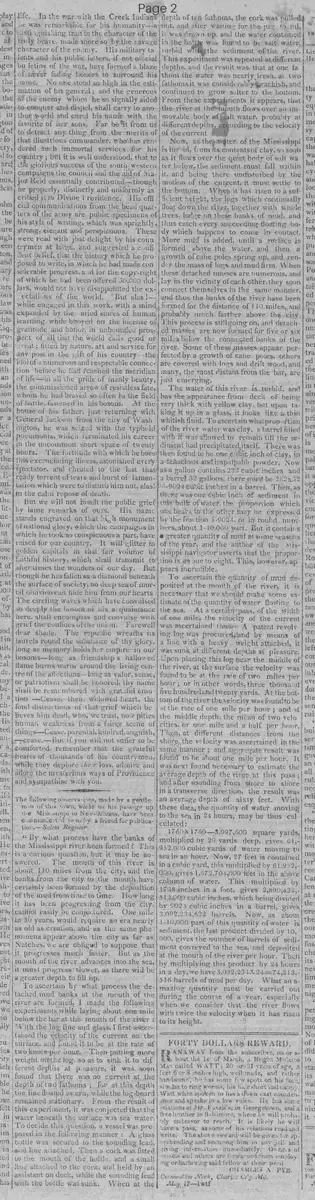
The following observations, made by a gentleman of this town, while on his passage up the Mississippi to New-Orleans, have been communicated to us by a friend for publication.-Salem Register.
"By what process have the banks of the Mississippi river been formed? This is a curious question, but it may be answered. The mouth of this river is about 110 miles from the city, and the banks from the city to the mouth have certainly been formed by the deposition of the mud from time to time. How long it has been progressing from the city. cannot easily be conjectured. One mile in 5000 years, would require an era nearly as old as creation, and as the same phenomena appear above the city as far as Natchez, we are obliged to suppose that it progresses much faster. But as the mouth of the river advances into the sea, it must progress slower, as there will be a greater depth to fill up.
To ascertain by what process the detached mud banks at the mouth of the river are formed, I made the following experiments while having about one mile below the bar at the mouth of the river : With the log line and glass, I first ascertained the velocity of the current on the surface, and found it to be at the rate of two knots per hour. Then putting more weight on the log, so as to sink it to different depths at pleasure, it was soon found that there was no current at the depth of two fathoms ; or at this depth the line floated astern, while the log-board remained stationary. From the result of this experiment, it was conjectured that the water beneath the surface was sea water. To decide this question. a vessel was prepared in the following manner : A glass bottle was secured to the sounding lead. and line attached. Then a cork was fitted to the mouth of the bottle, and a small line attached to the cork, and held by an assistant on deck, while the sounding lead with the bottle was sunk. When at the depth of ten fathoms, the cork was pulled out, and after waiting for the jug to fill, it was drawn up, and the water contained in the bottle was found to be salt water, turbid with the sediment of the river. This experiment was repeated at different depths, and the result was that at one fathom the water was nearly fresh, at two fathoms it was considerably brackish, and continued to grow salter to the bottom.
From these experiments it appears, that the river at the mouth flows over an immovable body of salt water, probably at different depths, according to the velocity of the current.
Now, as the water of the Mississippi is turbid, from its contents of clay, so soon as it flows over the quiet body of salt water below, the sediment must fall within it, and being there undisturbed by the motion of the current, it must settle to the bottom. When it has risen to a sufficient height, the logs which continually float down the river, together with whole trees, lodge on these banks of mud, and thus catch every succeeding floating body which happens to come in contact. More mud is added, until a surface is formed above the water, and then a growth of cane poles spring up, and render the mass of logs and mud firm. When these detached masses are numerous, and lay in the vicinity of each other, they soon connect themselves in the same manner, and thus the banks of the river have been formed for the distance of 110 miles, and probably much farther above the city. This process is still going on, and detached masses are now formed for five or six miles below the connected banks of the river. Some of these masses appear perfected by a growth of cane poles, others are covered with logs and drift wood, and many, the most distant from the bar, are just emerging.
The water of this river is turbid, and has the appearance from deck of being very thick with yellow clay, but upon taking it up in a glass, it looks like a thin whitish fluid. To ascertain what proportion of the river water was clay, a barrel filled with it was allowed to remain till the sediment had precipitated, itself. There was then found to be one cubic inch of clay, in a tenacious and impalpable powder. Now as a gallon contains 282 cubic inches and a barrel 32 gallons. there must be 282x32=9024 cubic inches in a barrel. Then, as there was one cubic inch of sediment in this bulk of water, the proportion which one bears to the other may be expressed by the fraction 1/9024, or in round numbers, about 1/10,000 part. But it contains greater quantity of mud at some seasons of the year, and the author of the Mississippi navigator asserts that the proportion is as one to eight. This, however, appears incredible.
To ascertain the quantity of mud deposited at the mouth of the river, it is necessary that we should make some estimate of the quantity of water flowing to the sea, At a certain pass, of the width of one mile, the velocity of the current was ascertained thus: A patent revolving log was procured, and by means of a line with a heavy weight attached, it was sunk at different depths at pleasure. Upon placing this log near the middle of the river, at the surface the velocity was found to be at the rate of two miles per hour; or in other words, three thousand five hundred and twenty yards. At the bottom of the river the velocity was found to be at the rate of one mile per hour ; and at the middle depth, the mean of two velocities, or one mile and a half per hour. Then, at different distances from the shore, the velocity was ascertained in the same manner ; and aggregate result was found to be about one mile per hour. It was next found necessary to estimate the average depth of the river at this pass ; and after sounding from shore to shore in a transverse direction, the result was an average depth of sixty feet. With these data, the quantity of water moving to the sea in 24 hours, may be thus calculated:
1760x 1760=3,097,600 square yards, multiplied by 60 yards deep, gives 185,856,000 cubic yards of water moving to sea in an hour. Now, 27 feet is contained in a cubic yard, this multiplied by 185,856,000, gives 5,018,112,000 feet in the above column of water. This multiplied by 1728 inches in a foot, gives 8,671,409,536,000 cubic inches, which being divided by 9024 cubic inches in a barrel, gives 960,742,622 barrels. Now, as about 1/10,000 part of this quantity of water is sediment, the last product divided by 10,000, gives the number of barrels of sediment conveyed to the sea, and deposited at the mouth of the river per hour. Then by multiplying this product by 24 hours in a day, we have 960,742,622x24=23,057,822,928 barrels of mud per day. What an amazing quantity must be carried out during the course of a year, especially when we consider that the river flows with twice the velocity when it has risen to its height."
"By what process have the banks of the Mississippi river been formed? This is a curious question, but it may be answered. The mouth of this river is about 110 miles from the city, and the banks from the city to the mouth have certainly been formed by the deposition of the mud from time to time. How long it has been progressing from the city. cannot easily be conjectured. One mile in 5000 years, would require an era nearly as old as creation, and as the same phenomena appear above the city as far as Natchez, we are obliged to suppose that it progresses much faster. But as the mouth of the river advances into the sea, it must progress slower, as there will be a greater depth to fill up.
To ascertain by what process the detached mud banks at the mouth of the river are formed, I made the following experiments while having about one mile below the bar at the mouth of the river : With the log line and glass, I first ascertained the velocity of the current on the surface, and found it to be at the rate of two knots per hour. Then putting more weight on the log, so as to sink it to different depths at pleasure, it was soon found that there was no current at the depth of two fathoms ; or at this depth the line floated astern, while the log-board remained stationary. From the result of this experiment, it was conjectured that the water beneath the surface was sea water. To decide this question. a vessel was prepared in the following manner : A glass bottle was secured to the sounding lead. and line attached. Then a cork was fitted to the mouth of the bottle, and a small line attached to the cork, and held by an assistant on deck, while the sounding lead with the bottle was sunk. When at the depth of ten fathoms, the cork was pulled out, and after waiting for the jug to fill, it was drawn up, and the water contained in the bottle was found to be salt water, turbid with the sediment of the river. This experiment was repeated at different depths, and the result was that at one fathom the water was nearly fresh, at two fathoms it was considerably brackish, and continued to grow salter to the bottom.
From these experiments it appears, that the river at the mouth flows over an immovable body of salt water, probably at different depths, according to the velocity of the current.
Now, as the water of the Mississippi is turbid, from its contents of clay, so soon as it flows over the quiet body of salt water below, the sediment must fall within it, and being there undisturbed by the motion of the current, it must settle to the bottom. When it has risen to a sufficient height, the logs which continually float down the river, together with whole trees, lodge on these banks of mud, and thus catch every succeeding floating body which happens to come in contact. More mud is added, until a surface is formed above the water, and then a growth of cane poles spring up, and render the mass of logs and mud firm. When these detached masses are numerous, and lay in the vicinity of each other, they soon connect themselves in the same manner, and thus the banks of the river have been formed for the distance of 110 miles, and probably much farther above the city. This process is still going on, and detached masses are now formed for five or six miles below the connected banks of the river. Some of these masses appear perfected by a growth of cane poles, others are covered with logs and drift wood, and many, the most distant from the bar, are just emerging.
The water of this river is turbid, and has the appearance from deck of being very thick with yellow clay, but upon taking it up in a glass, it looks like a thin whitish fluid. To ascertain what proportion of the river water was clay, a barrel filled with it was allowed to remain till the sediment had precipitated, itself. There was then found to be one cubic inch of clay, in a tenacious and impalpable powder. Now as a gallon contains 282 cubic inches and a barrel 32 gallons. there must be 282x32=9024 cubic inches in a barrel. Then, as there was one cubic inch of sediment in this bulk of water, the proportion which one bears to the other may be expressed by the fraction 1/9024, or in round numbers, about 1/10,000 part. But it contains greater quantity of mud at some seasons of the year, and the author of the Mississippi navigator asserts that the proportion is as one to eight. This, however, appears incredible.
To ascertain the quantity of mud deposited at the mouth of the river, it is necessary that we should make some estimate of the quantity of water flowing to the sea, At a certain pass, of the width of one mile, the velocity of the current was ascertained thus: A patent revolving log was procured, and by means of a line with a heavy weight attached, it was sunk at different depths at pleasure. Upon placing this log near the middle of the river, at the surface the velocity was found to be at the rate of two miles per hour; or in other words, three thousand five hundred and twenty yards. At the bottom of the river the velocity was found to be at the rate of one mile per hour ; and at the middle depth, the mean of two velocities, or one mile and a half per hour. Then, at different distances from the shore, the velocity was ascertained in the same manner ; and aggregate result was found to be about one mile per hour. It was next found necessary to estimate the average depth of the river at this pass ; and after sounding from shore to shore in a transverse direction, the result was an average depth of sixty feet. With these data, the quantity of water moving to the sea in 24 hours, may be thus calculated:
1760x 1760=3,097,600 square yards, multiplied by 60 yards deep, gives 185,856,000 cubic yards of water moving to sea in an hour. Now, 27 feet is contained in a cubic yard, this multiplied by 185,856,000, gives 5,018,112,000 feet in the above column of water. This multiplied by 1728 inches in a foot, gives 8,671,409,536,000 cubic inches, which being divided by 9024 cubic inches in a barrel, gives 960,742,622 barrels. Now, as about 1/10,000 part of this quantity of water is sediment, the last product divided by 10,000, gives the number of barrels of sediment conveyed to the sea, and deposited at the mouth of the river per hour. Then by multiplying this product by 24 hours in a day, we have 960,742,622x24=23,057,822,928 barrels of mud per day. What an amazing quantity must be carried out during the course of a year, especially when we consider that the river flows with twice the velocity when it has risen to its height."
What sub-type of article is it?
Scientific Observation
River Geology
What keywords are associated?
Mississippi River
Mud Deposition
Bank Formation
Current Velocity
Salinity Experiment
Sediment Calculation
Where did it happen?
Mississippi River Near New Orleans
Domestic News Details
Primary Location
Mississippi River Near New Orleans
Event Details
Observations and experiments on the formation of Mississippi River banks through mud deposition over salt water, including measurements of current velocity, water salinity at depths, sediment proportions, and calculations of daily mud deposition quantity.