Thank you for visiting SNEWPapers!
Sign up free
The Virginian
Lynchburg, Virginia
What is this article about?
A traveler describes the Welsh custom of tenderly maintaining family graves with flowers and cleanliness every Saturday, highlighting a conversation with a Pembrokeshire widow who decorates her husband and child's graves, emphasizing piety, forgiveness, and contrast to neglect in England.
Merged-components note: Seamless continuation of the story 'Veneration for the Dead' across sequential reading orders.
Clipping
OCR Quality
Full Text
From Pratt's Gleanings thro' Wales
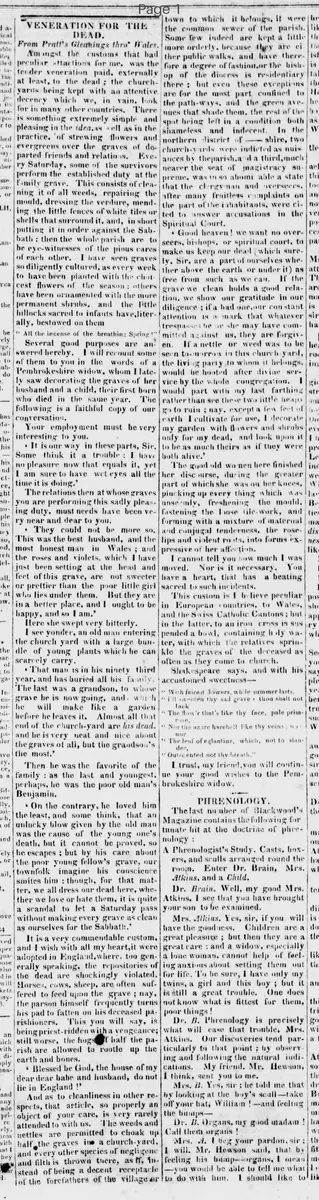
Amongst the customs that had peculiar attractions for me, was the tender veneration paid, externally at least, to the dead : the church-yards being kept with an attentive decency which we, in vain, look for in many other countries. There is something extremely simple and pleasing in the idea, as well as in the practice, of strewing flowers and evergreens over the graves of departed friends and relations. Every Saturday, some of the survivors perform the established duty at the family grave. This consists of cleaning it of all weeds, repairing the mould, dressing the verdure, mending the little fences of white tiles or shells that surround it, and, in short, putting it in order against the Sabbath : then the whole parish are to be eye-witnesses of the pious cares of each other. I have seen graves so diligently cultured, as every week to have been planted with the choicest flowers of the season : others have been ornamented with the more permanent shrubs, and the little hillocks sacred to infants have, literally, bestowed on them
"All the incense of the breathing Spring!"
Several good purposes are answered hereby. I will recount some of them to you in the words of a Pembrokeshire widow, whom I lately saw decorating the graves of her husband and a child, their first born who died in the same year. The following is a faithful copy of our conversation.
Your employment must be very interesting to you.
It is our way in these parts, Sir. Some think it a trouble : I have no pleasure now that equals it, yet I am sure to have wet eyes all the time it is doing.'
The relations then at whose graves you are performing this sadly pleasing duty, must needs have been very near and dear to you.
They could not be more so. This was the best husband, and the most honest man in Wales : and the roses and violets, which I have just been setting at the head and feet of this grave, are not sweeter or prettier than the poor little girl who lies under them. But they are in a better place, and I ought to be happy, and so I am.
Here she swept very bitterly.
I see yonder, an old man entering the church yard with a large bundle of young plants which he can scarcely carry.
That man is in his ninety third year, and has buried all his family. The last was a grandson, to whose grave he is now going, and which he will make like a garden before he leaves it. Almost all that end of the church-yard are his dead, and he is very neat and nice about the graves of all, but the grandson's the most.'
Then he was the favorite of the family : as the last and youngest, perhaps, he was the poor old man's Benjamin.
On the contrary, he loved him the least, and some think, that an unlucky blow given by the old man was the cause of the young one's death, but it cannot be proved, so he escapes ; but by his care about the poor young fellow's grave, our townfolk imagine his conscience smites him : though, for that matter, we all dress our dead here, whether we love or hate them, it is quite a scandal to let a Saturday pass without making every grave as clean as ourselves for the Sabbath.'
It is a very commendable custom, and I wish with all my heart, it were adopted in England, where, too generally speaking, the repositories of the dead are shockingly violated. Horses, cows, sheep, are often suffered to feed upon the grave; nay, the parson himself frequently turns his pad to fatten on his deceased parishioners. This you will say, is being priest-ridden with a vengeance; still worse, the hogs of half the parish are allowed to rootle up the earth and bones.
Blessed be God, the house of my dear dear babe and husband, do not lie in England!'
And as to cleanliness in other respects, that article, so properly an object of your care, is very rarely attended to with us. The weeds and nettles are permitted to choak up half the graves in a church-yard, and every other species of negligence and filth is thrown there, as if, instead of being a decent receptacle of the forefathers of the village or town to which it belongs, it were the common sewer of the parish.
Some few indeed are kept a little more orderly, because they are either public walks, and have therefore a degree of fashion, or the bishop of the diocese is residentiary there ; but even these exceptions are for the most part confined to the path-ways, and the green avenues that shade them, the rest of the spot being left in a condition both shameless and indecent. In the northern district of -- shire, two church-yards were indicted as nuisances by the parish, and a third, much nearer the seat of magistracy supreme, was in so abominable a state that the clergyman and overseers, after many fruitless complaints on the part of the inhabitants, were cited to answer accusations in the Spiritual Court.
Good heaven! we want no overseers, bishops, or spiritual court, to make us keep our dead (which surely, Sir, are a part of ourselves whether above the earth or under it) as free from such as we can. If the grave we clean holds a good relation, we show our gratitude in our diligence ; if a bad one, our constant attention is a mark that whatever trespasses he or she may have committed against us, they are forgiven. If a nettle or weed was to be seen to-morrow in this church-yard, the living party to whom it belongs, would be hooted after divine service by the whole congregation. I would part with my last farthing rather than see these two little heaps go to ruin ; nay, except a few feet of earth I cultivate for use, I decorate my garden with flowers and shrubs only for my dead, and look upon it to be as much theirs as if they were both alive.'
The good old woman here finished her discourse, during the greater part of which she was on her knees, plucking up every thing which way unseemly, freshening the mould, fastening the loose tile-work, and forming with a mixture of maternal and conjugal tenderness, the rose-lips and violets roots, into forms expressive of her affection.
I cannot tell you how much I was moved. Nor is it necessary. You have a heart, that has a beating sacred to such incidents.
This custom is, I believe, peculiar in European countries, to Wales, and the Swiss Catholic Cantons; but in the latter, to an iron cross is suspended a bowl, containing holy water, with which the relatives sprinkle the graves of the deceased as often as they come to church.
Shakespeare says, and with his accustomed sweetness--
"With fairest flowers, while summer lasts.
I sweeten thy sad grave: thou shalt not lack
The flow'r that's like thy face, pale primrose,
Nor the azured harebell like thy veins, no
The leaf of eglantine, which, not to slander,
Out-sweeten'd not thy breath."
I trust, my friend, you will continue your good wishes to the Pembrokeshire widow.
What sub-type of article is it?
What themes does it cover?
What keywords are associated?
What entities or persons were involved?
Where did it happen?
Story Details
Key Persons
Location
Wales, Pembrokeshire Church Yard
Story Details
A traveler observes the Welsh custom of weekly grave maintenance with flowers and cleanliness, converses with a widow decorating her husband and child's graves, notes an old man's care for his grandson's grave amid rumors of guilt, contrasts with English neglect, and praises the practice's promotion of piety and forgiveness.