Thank you for visiting SNEWPapers!
Sign up free
Virginia Argus
Richmond, Virginia
What is this article about?
U.S. House of Representatives proceedings from April 4-7: Adam Boyd seated replacing deceased Ezra Darby; leaves of absence granted; debates on bills to arm militia and raise 6000 additional regular troops, which passed 95-16; memorials on embargo losses; discussions on public buildings funding and adjournment.
Clipping
OCR Quality
Full Text
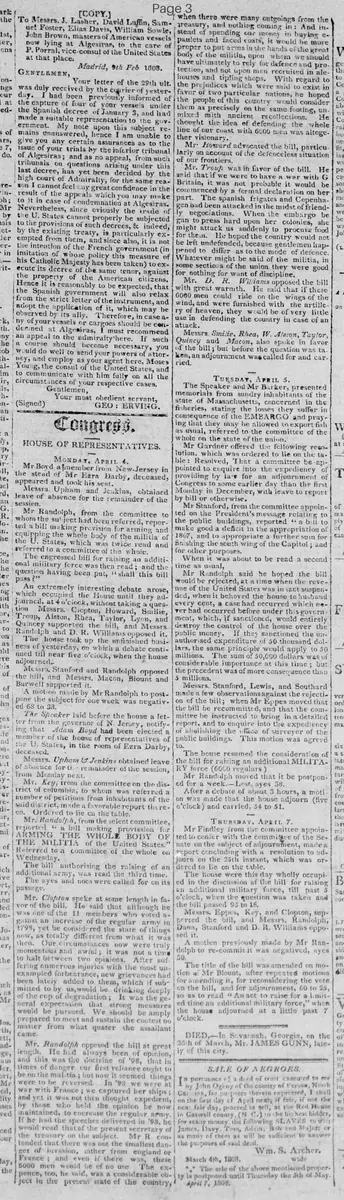
HOUSE OF REPRESENTATIVES.
MONDAY, April 4.
Mr. Boyd a member from New-Jersey in the stead of Mr. Ezra Darby, deceased, appeared and took his seat.
Messrs. Upham and Jenkins, obtained leave of absence for the remainder of the session.
Mr. Randolph, from the committee to whom the subject had been referred, reported a bill making provision for arming and equipping the whole body of the militia of the U. States, which was twice read and referred to a committee of the whole.
The engrossed bill for raising an additional military force was then read; and the question having been put, "shall this bill pass?"
An extremely interesting debate arose, which occupied the House until they adjourned, at 4 o'clock, without taking a question. Messrs. Clopton, Howard, Smilie, Troup, Alston, Rhea, Taylor, Lyon, and Quincy supported the bill, and Messrs. Randolph and D. R. Williams opposed it.
The house took up the unfinished business of yesterday, on which a debate continued till near five o'clock, when the house adjourned.
Messrs. Stanford and Randolph opposed the bill, and Messrs. Macon, Blount and Burwell supported it.
A motion made by Mr. Randolph to postpone the subject for one week was negatived 68 to 38.
The Speaker laid before the house a letter from the governor of N. Jersey, notifying that Adam Boyd had been elected a member of the house of representatives of the U. States, in the room of Ezra Darby, deceased.
Messrs. Upham & Jenkins obtained leave of absence for the remainder of the session, from Monday next.
Mr. Key, from the committee on the district of columbia, to whom was referred a number of petitions from inhabitants of the said district, made a favorable report thereon. Ordered to lie on the table.
Mr. Randolph, from the select committee, reported "a bill making provision for ARMING THE WHOLE BODY OF THE MILITIA of the United States."
Referred to a committee of the whole on Wednesday.
The bill authorising the raising of an additional army, was read the third time. The ayes and nocs were called for on its passage.
Mr. Clopton spoke at some length in favor of the bill. He said that although he was one of the 11 members who voted against an increase of the regular army in '98, yet he considered the state of things now, as totally different from what it was then. Our circumstances now were truly momentous and awful; it was not a time to halt between two opinions. After suffering numerous injuries with the most unexampled forbearance, new grievances had been lately added to them, which if submitted to by us, would be drinking deeply of the cup of degradation; It was the general expectation that strong measures would be pursued. We should be amply prepared to meet and sustain the contest no matter from what quarter the assailant came.
Mr. Randolph opposed the bill at great length. He had always been of opinion, and this was the doctrine of '98, that in times of danger our first reliance ought to be on the militia; but now it seemed things were to be reversed. In '98 we were at war with France; we captured her ships; and yet it was not then thought expedient, by those who held the opinion he now maintained, to increase the regular army. If he had the speeches delivered in '98, he would read that of the present secretary of the treasury on the subject. Mr. R. contended that there was not the smallest danger of invasion, either from England or France; and even if there was, these 6000 men would be of no use. The expense, too, he said, was a considerable object in the present state of the country, when there were many outgoings from the treasury, and nothing coming in: And instead of spending our money in buying epaulets and faced coats, it would be more proper to put arms in the hands of the great body of the militia, upon whom we should have ultimately to rely for defence and protection, and not upon men recruited in alehouses and tipling shops. With regard to the prejudices which were said to exist in favor of two particular nations, he hoped the people of this country would consider them as precisely on the same footing, unmixed with ancient recollections. He thought the idea of defending the whole line of our coast with 6000 men was altogether visionary.
Mr. Howard advocated the bill, particularly on account of the defenceless situation of our frontiers.
Mr. Troup was in favor of the bill. He said that if we were to have a war with Great Britain, it was not probable it would be commenced by a formal declaration on her part. The Spanish frigates and Copenhagen had been attacked in the midst of friendly negociations. When the embargo began to press hard upon her colonies, she might attack us suddenly to procure food for them. He hoped the country would not be left undefended, because gentlemen happened to differ as to the mode of defence. Whatever might be said of the militia, in some sections of the union they were good for nothing for want of discipline.
Mr. D. R. Williams opposed the bill with great warmth. He said that if these 6000 men could ride on the wings of the wind, and were furnished with the artillery of heaven, they would be of very little use in defending the country in case of an attack.
Messrs. Smilie, Rhea, W. Alston, Taylor, Quincy and Macon, also spoke in favor of the bill: but before the question was taken, an adjournment was called for and carried.
TUESDAY, April 5.
The Speaker and Mr. Barker, presented memorials from sundry inhabitants of the state of Massachusetts, concerned in the fisheries, stating the losses they suffer in consequence of the EMBARGO and praying that they may be allowed to export fish as usual, referred to the committee of the whole on the state of the union.
Mr. Gardner offered the following resolution, which was ordered to lie on the table: Resolved, That a committee be appointed to enquire into the expediency of providing by law for an adjournment of Congress to some earlier day than the first Monday in December, with leave to report by bill or otherwise.
Mr. Stanford, from the committee appointed on the President's message relating to the public buildings, reported a bill to make good a deficit in the appropriation of 1807, and to appropriate a further sum for finishing the south wing of the Capitol; and for other purposes.
When it was about to be read a second time as usual,
Mr. Randolph said he hoped the bill would be rejected, at a time when the revenue of the United States was in fact suspended, when it behoved the house to husband every cent, a case had occurred which never had occurred before under this government, which, if sanctioned, would entirely destroy the control of the house over the public money. If they sanctioned the unauthorised expenditure of 50 thousand dollars, the same principle would apply to 50 millions. The sum of 50,000 dollars was of considerable importance at this time; but the precedent was of more consequence than 5 millions.
Messrs. Stanford, Lewis, and Southard made a few observations against the rejection of the bill; when Mr. Eppes moved that the bill be recommitted, and that the committee be instructed to bring in a detailed report, and to enquire into the expediency of abolishing the office of surveyor of the public buildings. This motion was agreed to.
The house resumed the consideration of the bill for raising an additional MILITARY force (6000 regulars)
Mr. Randolph moved that it be postponed for a week.—Lost, ayes 38.
After a debate of about 3 hours, a motion was made that the house adjourn (five o'clock) and carried, 54 to 51.
THURSDAY, April 7.
Mr. Findley from the Committee appointed to confer with the committee of the Senate on the subject of adjournment, made a report concluding with a resolution to adjourn on the 25th instant, which was ordered to lie on the table.
The house were this day wholly occupied in the discussion of the bill for raising an additional military force, till past 5 o'clock, when the question was taken and the bill passed 95 to 16.
Messrs. Eppes, Key, and Clopton, supported the bill, and Messrs. Randolph, Dana, Stanford and D. R. Williams opposed it.
A motion previously made by Mr. Randolph to re-commit it was negatived, ayes 30
The title of the bill was amended on motion Mr. Blount, after repeated motions for amending it, for reconsidering the vote on the bill, and for adjournment, 60 to 25, so as to read "An act to raise for a limited time an additional military force," when the house adjourned at a little past 7 o'clock.
What sub-type of article is it?
What keywords are associated?
What entities or persons were involved?
Where did it happen?
Domestic News Details
Primary Location
United States House Of Representatives
Event Date
April 4 7
Key Persons
Outcome
bill to raise additional military force of 6000 passed 95 to 16; motion to recommit negatived; title amended; other motions on postponement and adjournment negatived; bill on public buildings recommitted; adjournment resolution reported.
Event Details
Proceedings included seating of new member Adam Boyd; grants of leave of absence; reporting and debate on bill to arm militia referred to committee; extended debates on bill to raise additional military force with speeches for and against; memorials from Massachusetts fisheries on embargo losses referred; resolution on earlier Congress adjournment; bill on public buildings deficit reported and recommitted with instructions; conference report on adjournment to April 25.