Thank you for visiting SNEWPapers!
Sign up free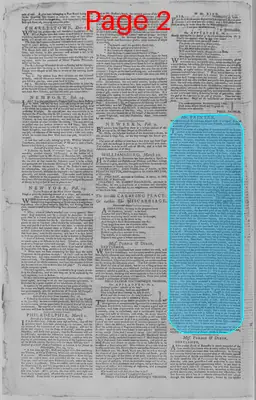
The Virginia Gazette
Richmond, Williamsburg, Richmond County, Virginia
What is this article about?
A colonial letter argues for enhancing Virginia's commerce by promoting grain and flax trade through inland towns near rivers, criticizes the duty on spirituous liquors for diverting trade to Baltimore and Philadelphia, and warns of long-term economic harm if unaddressed. References 1769 Philadelphia exports as example.
Clipping
OCR Quality
Full Text
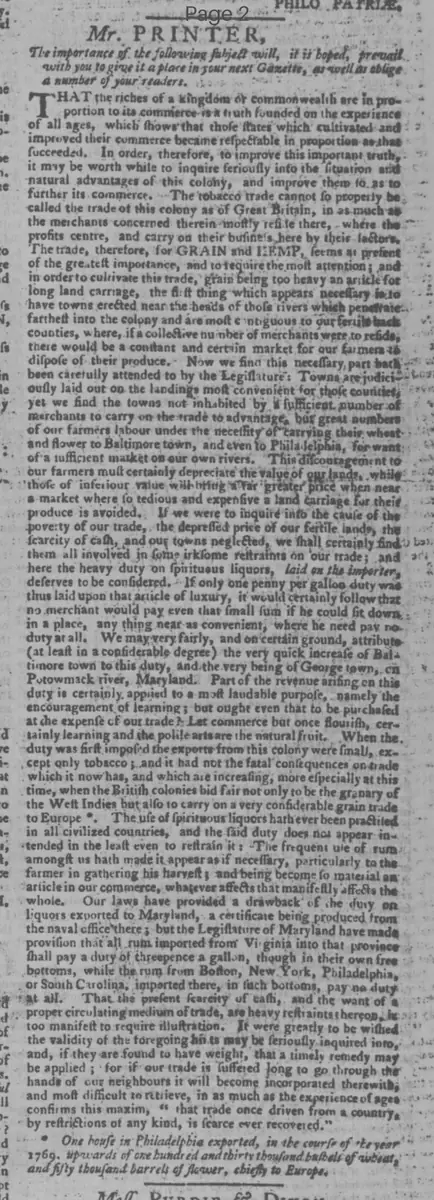
The importance of the following subject will, it is hoped, prevail with you to give it a place in your next Gazette, as well as oblige a number of your readers.
That the riches of a kingdom or commonweal are in proportion to its commerce—is a truth founded on the experience of all ages, which shows that those states which cultivated and improved their commerce became respectable in proportion—as they succeeded. In order, therefore, to improve this important truth, it may be worth while to inquire seriously into the situation and natural advantages of this colony, and improve them so as to further its commerce. The tobacco trade cannot so properly be called the trade of this colony as of Great Britain, in as much—as the merchants concerned therein mostly reside there, —where the profits centre, and carry on their business here by their factors.
The trade, therefore, for GRAIN and FLAX, seems a present of the greatest importance. and to require the most attention; and in order to cultivate this trade, ' grain being too heavy an article for long land carriage, the first thing which appears necessary is to have towns erected near the heads of those rivers which penetrate farthest into the colony and are most contiguous to our fertile back counties, where, if a collective number of merchants were to reside, there would be a constant and certain market for our farmers to dispose of their produce. Now we find this necessary part has been carefully attended to by the Legislature : Towns are judiciously laid out on the landings most convenient for those counties yet we find the towns not inhabited by sufficient. number: of merchants to carry on the trade to advantage. but great numbers of our farmers labour under the necessity of carrying their wheat and flour to Baltimore town, and even to Philadelphia, For want: of a sufficient market on our own rivers. This discouragement to our farmers must certainly depreciate the value of our lands, whil those of inferior value will bring a far greater price when near a market where so tedious and expensive a land carriage for their produce is avoided. If we were to inquire into the cause of the poverty of our trade, the depressed price of our fertile lands, the scarcity of cash, and our towns neglected, we shall certainly find them all involved in some irksome restraints on our trade; and here the heavy duty on spirituous liquors, laid on the importer, deserves to be considered. If only one penny per gallon duty was thus laid upon that article of luxury, it would certainly follow that no merchant would pay even that small sum if he could set it down. in a place, any thing near as convenient, where he need pay no. duty at all. We may very fairly, and on certain ground, attribute (at least in a considerable degree) the very quick increase of Bal timore town to this duty, and the very being of George town,. on Potowmack river, Maryland. Part of the revenue arising on this duty is certainly. applied to a most laudable purpose, namely the encouragement of learning; but ought even that to be purchased at the expense of our trade Let commerce but once flourish, cer- tainly learning and the polite arts are the natural fruit. When the. duty was first imposed the exports from this colony were small, ex- , cept only tobacco ; .and it had not the fatal' consequences on trade which it now has, and which are increasing, more especially at this time, when the British colonies bid fair not only to be the granary of the West Indies but also to carry on a very considerable grain trade to Europe . The use of spirituous liquors has ever been practised in all civilized countries, and the said duty does not appear in- tended in the least even to restrain it : -The frequent use of rum amongst us has made it appear as if necessary, particularly to the farmer in gathering his harvest; and being become so material an article in our commerce, whatever affects that manifestly affects the whole. Our laws have provided a drawback' of the duty on liquors exported to Maryland, a certificate being produced from the naval office there; but the Legislature of Maryland have made provision that all rum imported from Virginia into that province Shall pay a duty of threepence a gallon, though in their own free bottoms, while the rum from Boston, New York, Philadelphia, or South Carolina, imported there, in such bottoms, pay no duty at all. That the present scarcity of cash, and the want of a proper circulating medium of trade, are heavy restraints hereon is. too manifest to require illustration. It were greatly to be wished the validity of the foregoing hints may be seriously inquired into, and, if they are found to have weight, that a timely remedy may be applied ; · for if our trade is suffered long to go through the hands of our neighbours it will become incorporated therewith; and most difficult to retrieve, in as much as the experience of ages confirms this maxim,"that trade once driven from a country by restrictions of any kind, is scarce ever recovered."
One house in Philadelphia exported, in the course of the year 1769, upwards of one hundred and thirty thousand bushels of wheat, and fifty thousand barrels of flour, chiefly to Europe.
What sub-type of article is it?
What themes does it cover?
What keywords are associated?
What entities or persons were involved?
Letter to Editor Details
Recipient
Mr. Printer
Main Argument
to enhance virginia's commerce and wealth, focus on grain and flax trade by populating inland towns with merchants for local markets, and reduce or reconsider the duty on spirituous liquors which drives trade to neighboring colonies like maryland and pennsylvania, harming local economy and land values.
Notable Details