Thank you for visiting SNEWPapers!
Sign up free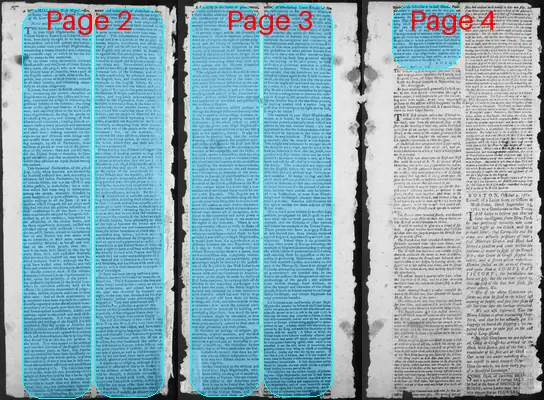
The New Hampshire Gazette And General Advertiser
Portsmouth, Exeter, Rockingham County, New Hampshire
What is this article about?
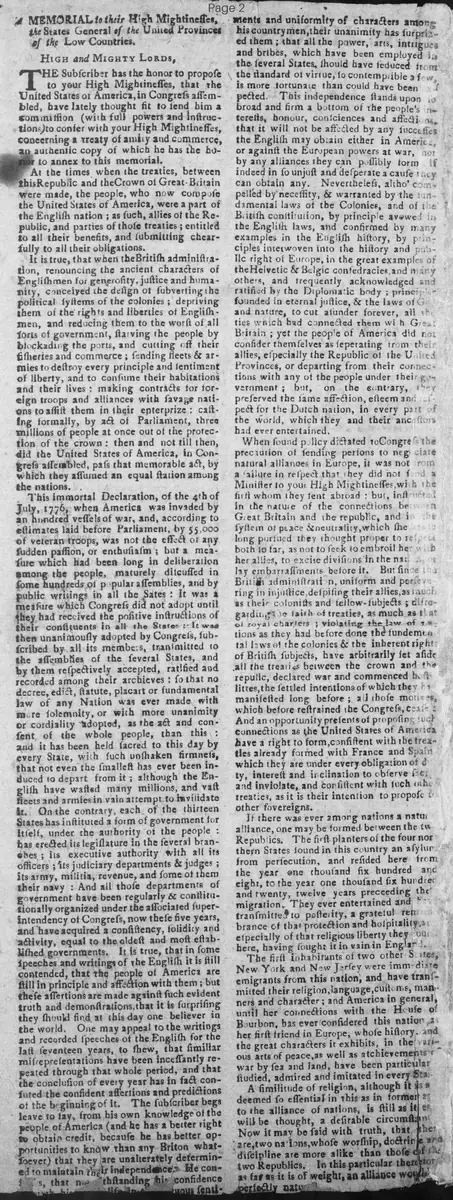
John Adams presents a memorial to the States General of the United Provinces on April 9, 1781, in Leyden, proposing a treaty of amity and commerce between the United States and the Dutch Republic, emphasizing historical ties, shared values, and mutual commercial interests amid the American Revolution.
Merged-components note: These components form a single continuous diplomatic memorial by J. Adams to the States General of the United Provinces regarding a treaty of amity and commerce, spanning pages 2-4 with sequential reading orders. The label for the third component was changed from 'story' to 'foreign_news' to match the overall content.
Clippings
1 of 3
OCR Quality
Full Text
the States General of the United Provinces
of the Low Countries.
HIGH and MIGHTY LORDS,
The subscriber has the honor to inform your High Mightinesses, that the
United States of America, in Congress assembled, have lately thought fit to send him a
commission (with full powers and instructions) to confer with your High Mightinesses
concerning a treaty of amity and commerce,
an authentic copy of which he has the honor to annex to this memorial.
At the times when the treaties, between
this Republic and the Crown of Great-Britain
were made, the people, who now compose
the United States of America, were a part of
the English nation: as such, allies of the Re-
public, and parties of those treaties; entitled
to all their benefits, and submitting cheerfully
to all their obligations.
It is true, that when the British administra-
tion, renouncing the ancient characters of
Englishmen for generosity, justice and huma-
ity, conceived the design of subverting the
political systems of the colonies; depriving
them of the rights and liberties of English-
men, and reducing them to the worst of all
forms of government, starving the people by
blockading the ports, and cutting off their
fisheries and commerce; sending fleets & ar-
mies to destroy every principle and sentiment
of liberty, and to consume their habitations
and their lives: making contracts for for-
eign troops and alliances with savage nati-
ons to aid them in their enterprize: cast-
ing formally, by act of Parliament, three
millions of people at once out of the protec-
tion of the crown: then and not till then,
did the United States of America, in Con-
gress assembled, pass that memorable act, by
which they assumed an equal station among
the nations.
This immortal Declaration, of the 4th of
July, 1776, when America was invaded by
an hundred vessels of war, and, according to
estimates laid before Parliament, by 55,000
of veteran troops, was not the effect of any
sudden passion or enthusiasm; but a mea-
sure which had been long in deliberation
among the people, maturely discussed in
some hundreds of popular assemblies, and by
public writings in all the States: It was a
measure which Congress did not adopt until
they had received the positive instructions of
their constituents in all the States:--It was
then unanimously adopted by Congress, sub-
scribed by all its members, transmitted to
the assemblies of the several States, and
by them respectively accepted, ratified and
recorded among their archives: so that no
decree, edict, statute, placart or fundamental
law of any Nation was ever made with
more solemnity, or with more unanimity
or cordiality adopted, as the act and con-
sent of the whole people, than this:
and it has been held sacred to this day by
every State, with such unshaken firmness,
that not even the smallest has ever been in-
duced to depart from it; although the En-
glish have wasted many millions, and vast
fleets and armies in vain attempt to invalidate
it. On the contrary, each of the thirteen
States has instituted a form of government for
itself, under the authority of the people:
has erected its legislature in the several bran-
ches: its executive authority with all its
officers: its judiciary departments & judges;
its army, militia, revenue, and some of them
their navy: And all those departments of
government have been regularly & constitu-
tionally organized under the associated super-
intendency of Congress, now these five years,
and have acquired a consistency, solidity and
activity, equal to the oldest and most estab-
lished governments. It is true, that in some
speeches and writings of the English it is still
contended, that the people of America are
still in principle and affection with them; but
these assertions are made against such evident
truth and demonstrations, that it is surprising
they should find at this day one believer in
the world. One may appeal to the writings
and recorded speeches of the English for the
last seventeen years, to shew, that similar
misrepresentations have been incessantly re-
peated through that whole period, and that
the conclusion of every year has in fact con-
futed the confident assertions and predictions
of the beginning of it. The subscriber begs
leave to say, from his own knowledge of the
people of America (and he has a better right
to obtain credit, because he has better op-
portunities to know than any Briton what-
soever) that they are unalterably determin-
ed to maintain their independence He con-
siders, that notwithstanding his confidence
uous entiments and uniformity of characters among
his countrymen, their unanimity has surprised
them; that all the power, arts, intrigues
and bribes, which have been employed in
the several States, should have seduced from
the standard of virtue, so contemptible a few
is more fortunate than could have been ex-
pected. This independence stands upon so
broad and firm a bottom of the people's in-
terests, honour, consciences and affections.
that it will not be affected by any success
the English may obtain either in America,
or against the European powers at war, nor
by any alliances they can possibly form if
indeed in so unjust and desperate a cause they
can obtain any. Nevertheless, altho' com-
pelled by necessity, & warranted by the fun-
damental laws of the Colonies, and of the
British constitution, by principle avowed in
the English laws, and confirmed by many
examples in the English history, by prin-
ciples interwoven into the history and pub-
lic right of Europe, in the great examples of
the Helvetic & Belgic confederacies, and many
others, and frequently acknowledged and
ratified by the Diplomatic body: principles
founded in eternal justice, & the laws of God
and nature, to cut asunder forever, all the
ties which had connected them with Great
Britain: yet the people of America did not
consider themselves as separating from their
allies, especially the Republic of the United
Provinces, or departing from their connec-
tions with any of the people under their go-
vernment; but, on the contrary, they
preserved the same affection, esteem and re-
spect for the Dutch nation, in every part of
the world, which they and their ancestors
had ever entertained.
When sound policy dictated to Congress the
precaution of sending persons to negotiate
natural alliances in Europe, it was not from
a failure in respect that they did not send a
Minister to your High Mightinesses with the
first whom they sent abroad: but, instructed
in the nature of the connections between
Great Britain and the republic, and in the
system of peace & neutrality, which she
long pursued they thought proper to respect
both so far, as not to seek to embroil her in it
her allies, to excite divisions in the nation,
or lay embarrassments before it. But since the
British administration, uniform and perse-
vering in injustice, despising their allies, as much
as their colonies and fellow-subjects; disre-
garding the faith of treaties, as much as that
of royal charters; violating the law of na-
tions as they had before done the fundamen-
tal laws of the colonies & the inherent rights
of British subjects, have arbitrarily set aside
all the treaties between the crown and the
republic, declared war and commenced hos-
tilities, the avowed intentions of which they have
manifested long before; all those motives.
which before restrained the Congress, cease:
And an opportunity presents of proposing such
connections as the United States of America
have a right to form, consistent with the trea-
ties already formed with France and Spain
which they are under every obligation of du-
ty, interest and inclination to observe strictly
and inviolate, and consistent with such other
treaties, as it is their intention to propose
to other sovereigns.
If there was ever among nations a natural
alliance, one may be formed between the two
Republics. The first planters of the four northern
States found in this country an asylum
from persecution, and resided here from
the year one thousand six hundred and
eight, to the year one thousand six hundred
and twenty, twelve years preceding the
migration. They ever entertained and
transmitted to posterity, a grateful remem-
brance of that protection and hospitality, as
especially of that religious liberty they enjoyed
here, having sought it in vain in England.
The first inhabitants of two other States,
New York and New Jersey were immediate
emigrants from this nation, and have trans-
mitted their religion, language, customs, man-
ners and character; and America in general
until her connections with the House of
Bourbon, has ever considered this nation as
her first friend in Europe, whose history, and
the great characters it exhibits, in the vari-
ous arts of peace, as well as achievements in
war by sea and land, have been particularly
studied, admired and imitated in every State.
A similitude of religion, although it is
deemed so essential in this as in former ages
to the alliance of nations, is still as it ever
will be thought, a desirable circumstance.
Now it may be said with truth, that the
are two nations, whose worship, doctrines and
discipline are more alike than those of the
two Republics. In this particular therefore
as far as it is of weight, an alliance would be
perfectly natural.
A similarity in the forms of government.
is usually considered as another circumstance.
which renders alliances natural: And altho
the constitutions of the two Republicks
are not perfectly alike, there is yet analogy
enough between them, to make a connection
so in this respect.
In general usages, and in the liberality of
sentiments in those momentous points, the
freedom of inquiry, the right of private judg-
ment and the liberty of conscience, of so
much importance to be supported in the
world, and imparted to all mankind, -and
which at this hour are in more danger from
Great Britain and that intolerant spirit which
is secretly fomenting there than from any
other quarter, the two Nations resembled
each other more than any others.
The originals of the two Republicks are so
much alike, that the history of one seems
but a transcript from that of the other: So
that every Dutchman instructed in the sub-
ject, must pronounce the American revolu-
tion just and necessary, or pass a severe cen-
sure upon the greatest actions of his immortal an-
cestors: Actions, which have been approved
and applauded by mankind, and justified by
the decision of Heaven.
But the circumstance, which perhaps in
this age has stronger influence than any other
in the formation of friendships between na-
tions, is the great and growing interest of
commerce: of the whole system of which
through the globe, your High Mightinesses
are too perfect masters for me to say any thing
that is not familiarly known. It may not
however be amiss to hint, that the central
situation of this country, her extensive navi-
gation, her possessions in the East and West
Indies, the intelligence of her merchants, the
number of her capitalists, and the riches of
her funds, render a connection with her very
desirable to America: And on the other hand,
the abundance and variety of the productions
of America, the materials of manufactures.
navigation and commerce: the vast demand
and consumption in America of the manu-
factures in Europe, of merchandises from the
Baltic, and from the East Indies, and the
situation of the Dutch possessions in the West
Indies, cannot admit of a doubt that a con-
nection with the United States would be use-
ful to this Republic. The English are so
sensible of this that notwithstanding all their
protestations of friendship, they have ever consi-
dered this nation as their rival in the Ameri-
can trade; a sentiment which dictated & main-
tained their severe act of navigation, as in-
jurious to the commerce and naval power of
this country, as it was both to the trade and
the rights of the Colonies. There is now
an opportunity offered to both, to shake off
this shackle forever. If any consideration
whatever could have induced them to have
avoided a war with your High Mightinesses,
it would have been the apprehension of an
Alliance between the two Republics: and
it is easy to foresee, that nothing will con-
tribute more to oblige them to a peace, than
such a connection once completely formed.
It is needless to point out particularly, what
advantages might be derived to the posses-
sions of the Republic in the West Indies from
a trade opened, protected and encouraged be-
tween them and the Continent of America;
or what profits might be made by the Dutch
East India company, by carrying their effects
directly to the American market, or how
much even the trade of the Baltic might be
secured and extended by a free intercourse
with America, which has ever had so large
a demand, and will have more for hemp,
cordage, sail cloth, and other articles of that
commerce: how much the national navi-
gation would be benefited by building and
purchasing ships there: how much the num-
ber of seamen might be increased, or how
much advantages to both countries, to have
their ports mutually opened to their men of
war and privateers and their prizes.
If therefore an analogy of religion, go-
vernment, original manners, and the most
extensive and lasting commercial interests,
can form a ground and an invitation to po-
litical connections, the subscriber flatters
himself, that in all these particulars the Uni-
on so obviously natural, that there has sel-
dom been a more distinct designation of Pro-
vidence to any two distant nations to unite
them selves together.
It is further submitted to the wisdom and
Style of your High Mightinesses, whether
it is not visibly for the good of mankind.
That the powers of Europe, who are convin-
ced of the justice of the American cause
there is one to be found that is not? Make haste to acknowledge the Inde-
pendence of the United States, and form
treaties with them as the
means of convincing Great-Britain of the
impracticability of her pursuits? Whether
the late Marine treaty concerning the rights
of neutral vessels, noble and useful as it is.
can be established against Great Britain who
will never adopt it, nor submit to it, but from
necessity, without the Independence of Ame-
rica? whether the return of America, with
her nurseries of seamen and magazines of
materials for navigation and commerce, to
the domination and monopoly of Great Bri-
tain, if that were practicable would not put
the possessions of other nations beyond seas
wholly in the power of that enormous Em-
pire, which has been long governed wholly
by the feeling of its own power, at least
without a proportional attention to justice,
humanity or decency. When it is obvious
and certain, that the Americans are not in-
clined to submit again to the British Govern-
ment, on the one hand, and that the powers
of Europe ought not and could not with safe-
ty consent to it, if they were on the other,
why should a course of contention be left open
for future contingencies to involve the nati-
ons of Europe in still more bloodshed, when,
by one decisive step of the maritime powers.
in making treaties with a nation long in
possession of sovereignty by right and in fact,
it might be closed?
The example of your High Mightinesses
would, it is hoped, be followed by all the
maritime powers, especially those which are
parties to the late marine treaty: nor can
apprehension, that the Independence of Ame-
rica would be injurious to the trade of the
Baltic, be any objection. This jealousy is so
groundless, that the reverse would happen.
The freight and insurance in voyages across
the Atlantic are so high, and the price of la-
bour in America so dear, that tar, pitch, tur-
pentine and ship timber never can be trans-
ported to Europe at so cheap a rate, as it has
been and will be afforded by countries round
the Baltic. This commerce was supported
by the English before the revolution with
difficulty, and not without large Parliamen-
tary bounties. Of hemp, cordage and sail-
cloth there will not probably be a sufficiency
raised in America for her own consumption
in many centuries, for the plainest of all rea-
sons, because these articles may be import-
ed from Amsterdam, or even from Peter-
burgh and Archangel, cheaper than can be
raised at home. America will therefore be
for ages a market for these articles of the
Baltic trade,
Nor is there more solidity in another sup-
position, propagated by the English to pre-
vent other nations from pursuing their true
interest, that the Colonies of other nations
will follow the example of the United States.
Those powers who have as large possessions
as any beyond seas, have already declared
against England, apprehending no such con-
sequences. Indeed there is no probability
of any other power of Europe following the
example of England, in attempting to change
the whole system of government of Colonies,
and reducing them by oppression to the ne-
cessity of governing themselves; and with-
out such manifest injustice and cruelty on the
part of the Metropolis, there is no danger of
Colonies attempting innovations. Establish-
ed governments are founded deep in the
hearts, the passions, the imaginations and un-
derstandings of the people; and without
some violent change from without, to
alter the temper and character of the whole
people, it is not in human nature to exchange
safety for danger, and certain happiness for
very precarious benefits.
It is submitted to the consideration of your High-
Mightinesses, whether the system of the United States,
which was minutely considered and discussed, and unani-
mously agreed on in Congress in the year 1776, in
planning the treaty they proposed to France, to form
equitable commercial treaties with all the maritime
powers of Europe, without being governed or mono-
polized by any: a system which was afterwards ap-
proved by the King, and made the foundation of the
treaties with his majesty: A system to which the
United-States have hitherto constantly adhered, and
from which they never will depart, unless compelled
by some powers declaring against them, which is not
expected, is not the only means of preventing this
growing country from being an object of everlasting
jealousies, rivalries and wars among the nations. If
this idea is just, it follows, that it is the interest of
every State in Europe to acknowledge American In-
dependence immediately. If such benevolent policy
should be adopted, the new world will be a propor-
tional blessing to every part of the old.
The subscriber has the further honour of inform-
ing your High-Mightinesses, that the United States
of America, in Congress assembled, impressed with a
high sense of the wisdom and magnanimity of your
High-Mightinesses, and of your inviolable attach-
ment to the rights and liberties of mankind, and be-
ing desirous of cultivating the friendship of that nation,
eminent for its wisdom, justice and w
have
Appointed the Subscriber to be their Minister Plenipotentiary to reside near you, that he may give you more particular assurances of the great respect they entertain for your High Mightinesses, beseeching your High Mightinesses to give credit to every thing which their said Minister shall deliver on their part, especially when he shall assure you of the sincerity of their friendship and regard.
The original letter of credence, under the seal of Congress, the Subscriber is ready to deliver to your High Mightinesses, or to such persons as you shall direct to receive it. He has also a similar letter of credence to his most Serene Highness the Prince Stadtholder.
All which is respectfully submitted to the consideration of your High-Mightinesses, together with the propriety of appointing some person, or persons, to treat on the subject of this mission, by
J. ADAMS.
Leyden, April 9, 1781.
What sub-type of article is it?
What keywords are associated?
What entities or persons were involved?
Where did it happen?
Foreign News Details
Primary Location
Leyden
Event Date
April 9, 1781
Key Persons
Outcome
proposal submitted for treaty of amity and commerce; appointment of john adams as minister plenipotentiary
Event Details
John Adams submits a memorial to the States General, detailing the American Declaration of Independence, historical ties with the Dutch Republic, shared religious and governmental similarities, mutual commercial benefits, and urging recognition of American independence and formation of a treaty, while providing his commission and letters of credence.