Thank you for visiting SNEWPapers!
Sign up free
Literary
July 6, 1911
The Citizen
Berea, Madison County, Kentucky
What is this article about?
Synopsis of a detective story involving international plot and a shooting at a diplomatic ball. Continuation: Mr. Grimm questions wounded Senor Alvarez, a maid witnesses Miss Thorne fleeing with a pistol, and Grimm investigates her ties to the Italian ambassador amid suspicions of espionage.
Merged-components note: Serial story with sequential illustrations; images near in reading order and spatially related
Clipping
OCR Quality
85%
Good
Full Text
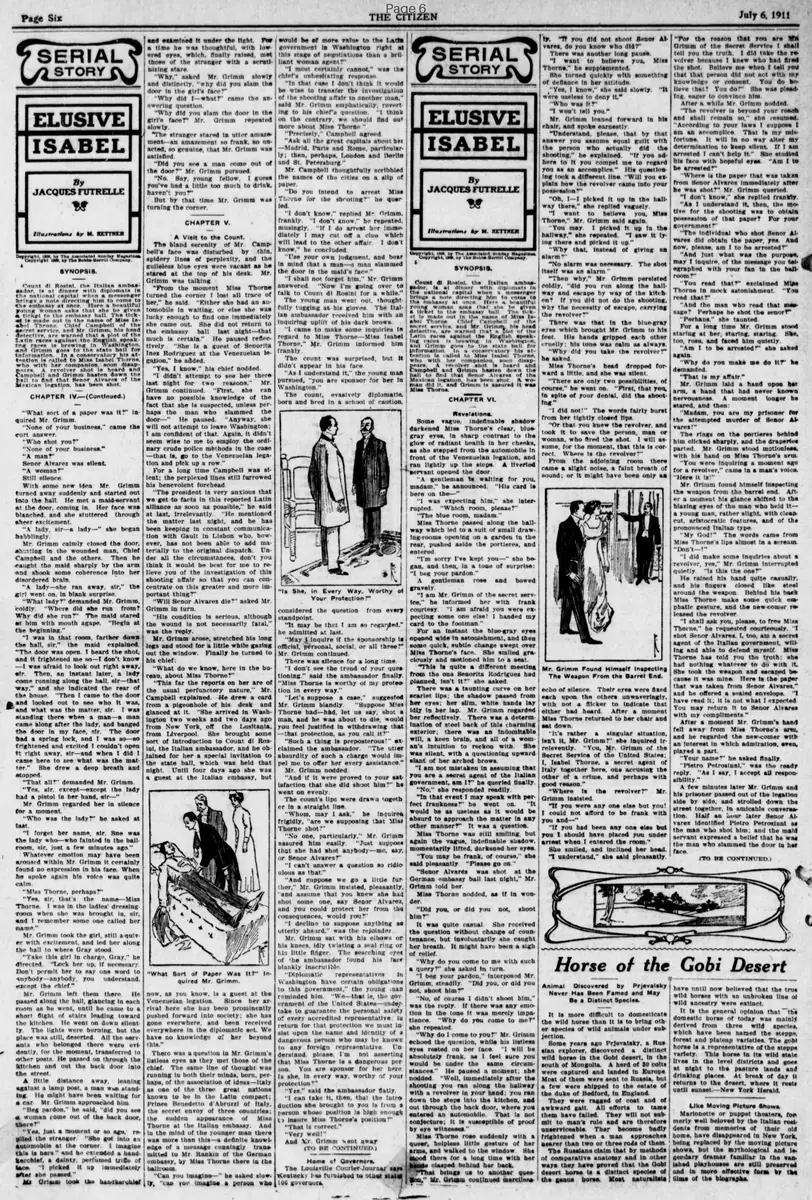
Page Six
Synopsis.
Count di Rosini, the Italian ambassador, is at dinner with diplomats in the national capital when a messenger brings a note directing him to come to the embassy at once. Here a beautiful young woman asks that she be given a ticket to the embassy ball. The ticket is made out in the name of Miss Isabel Thorne. Chief Campbell of the secret service, and Mr. Grimm, his head detective, are warned that a plot of the Latin races against the English speaking races is brewing in Washington, and Grimm goes to the state ball for information. In a conservatory his attention is called to Miss Isabel Thorne, who with her companion, soon disappears. A revolver shot is heard and Campbell and Grimm hasten down the hall to find that Senor Alvarez of the Mexican legation, has been shot.
CHAPTER IV (Continued.)
"What sort of a paper was it?" inquired Mr. Grimm.
"None of your business," came the curt answer.
"Who shot you?"
"None of your business."
"Man?"
Senor Alvarez was silent.
"A woman?"
Still silence.
With some new idea Mr. Grimm turned away suddenly and started out into the hall. He met a maid-servant at the door, coming in. Her face was blanched, and she stuttered through sheer excitement.
"A lady, sir—a lady—" she began babblingly.
Mr. Grimm calmly closed the door, shutting in the wounded man, Chief Campbell and the others. Then he caught the maid sharply by the arm and shook some coherence into her disordered brain.
"A lady—she ran away, sir," the girl went on, in blank surprise.
"What lady?" demanded Mr. Grimm, coldly.
"Where did she run from? Why did she run?" The maid stared at him with mouth agape. "Begin at the beginning."
"I was in that room, farther down the hall, sir," the maid explained. "The door was open. I heard the shot, and it frightened me so—I don't know—I was afraid to look out right away, sir. Then, an instant later, a lady came running along the hall, sir—that way," and she indicated the rear of the house. "Then I came to the door and looked out to see who it was, and what was the matter, sir. I was standing there when a man—a man came along after the lady, and banged the door in my face, sir. The door had a spring lock, and I was so—so frightened and excited I couldn't open it right away, sir—and when I did I came here to see what was the matter."
She drew a deep breath and stopped.
"That all?" demanded Mr. Grimm.
"Yes, sir, except—except the lady had a pistol in her hand, sir—"
Mr. Grimm regarded her in silence for a moment.
"Who was the lady?" he asked at last.
"I forget her name, sir. She was the lady who—who fainted in the ball room, sir, just a few minutes ago."
Whatever emotion may have been aroused within Mr. Grimm it certainly found no expression in his face. When he spoke again his voice was quite calm.
"Miss Thorne, perhaps?"
"Yes, sir, that's the name—Miss Thorne. I was in the ladies' dressing room when she was brought in, sir, and I remember some one called her name."
Mr. Grimm took the girl, still a-quiver with excitement, and led her along the hall to where Gray stood.
"Take this girl in charge, Gray," he directed. "Lock her up, if necessary. Don't permit her to say one word to anybody—anybody, you understand, except the chief."
Mr. Grimm left them there. He passed along the hall, glancing in each room as he went, until he came to a short flight of stairs leading toward the kitchen. He went on down silently. The lights were burning, but the place was still, deserted. All the servants who belonged there were evidently, for the moment, transferred to other posts. He passed on through the kitchen and out the back door into the street.
A little distance away, leaning against a lamp post, a man was standing. He might have been waiting for a car.
Mr. Grimm approached him.
"Beg pardon," he said, "did you see a woman come out of the back door, there?"
"Yes, just a moment or so ago," replied the stranger.
"She got into an automobile at the corner, I imagine this is hers" and he extended a handkerchief, a dainty, perfumed trifle of lace.
"I picked it up immediately after she passed."
Mr. Grimm took the handkerchief and examined it under the light. For a time he was thoughtful, with lowered eyes, which, finally raised, met those of the stranger with a scrutinizing stare.
"Why," asked Mr. Grimm slowly and distinctly, "why did you slam the door in the girl's face?"
"Why did I—what?" came the answering question.
"Why did you slam the door in the girl's face?" Mr. Grimm repeated slowly.
The stranger stared in utter amazement—an amazement so frank, so unacted, so genuine, that Mr. Grimm was satisfied.
"Did you see a man come out of the door?" Mr. Grimm pursued.
"No. Say, young fellow, I guess you've had a little too much to drink, haven't you?"
But by that time Mr. Grimm was turning the corner.
CHAPTER V.
A Visit to the Count.
The bland serenity of Mr. Campbell's face was disturbed by thin, spidery lines of perplexity, and the guileless blue eyes were vacant as he stared at the top of his desk. Mr. Grimm was talking.
"From the moment Miss Thorne turned the corner I lost all trace of her," he said. "Either she had an automobile in waiting, or else she was lucky enough to find one immediately she came out. She did not return to the embassy ball last night—that much is certain." He paused reflectively. "She is a guest of Senorita Inez Rodriguez at the Venezuelan legation," he added.
"Yes, I know," his chief nodded.
"I didn't attempt to see her there last night for two reasons," Mr. Grimm continued. "First, she can have no possible knowledge of the fact that she is suspected, unless perhaps the man who slammed the door—"
He paused. "Anyway, she will not attempt to leave Washington; I am confident of that. Again, it didn't seem wise to me to employ the ordinary crude police methods in the case—that is, go to the Venezuelan legation and pick up a row."
For a long time Campbell was silent; the perplexed lines still furrowed his benevolent forehead.
"The president is very anxious that we get to facts in this reported Latin alliance as soon as possible," he said at last, irrelevantly. "He mentioned the matter last night, and he has been keeping in constant communication with Gault in Lisbon who, however, has not been able to add materially to the original dispatch. Under all the circumstances, don't you think it would be best for me to relieve you of the investigation of this shooting affair so that you can concentrate on this greater and more important thing?"
"Will Senor Alvarez die?" asked Mr. Grimm in turn.
"His condition is serious, although the wound is not necessarily fatal," was the reply.
Mr. Grimm arose, stretched his long legs and stood for a little while gazing out the window. Finally he turned to his chief:
"What do we know, here in the bureau, about Miss Thorne?"
"This far the reports on her are of the usual perfunctory nature," Mr. Campbell explained. He drew a card from a pigeonhole of his desk and glanced at it. "She arrived in Washington two weeks and two days ago from New York, off the Lusitania, from Liverpool. She brought some sort of introduction to Count di Rosini, the Italian ambassador, and he obtained for her a special invitation to the state ball, which was held that night. Until four days ago she was a guest at the Italian embassy, but now, as you know, is a guest at the Venezuelan legation. Since her arrival here she has been prominently pushed forward into society; she has gone everywhere, and been received everywhere in the diplomatic set. We have no knowledge of her beyond this."
There was a question in Mr. Grimm's listless eyes as they met those of the chief. The same line of thought was running in both their minds, born, perhaps, of the association of ideas—Italy as one of the three great nations known to be in the Latin compact; Prince Benedetto d'Abruzzi of Italy, the secret envoy of three countries; the sudden appearance of Miss Thorne at the Italian embassy. And in the mind of the younger man there was more than this—a definite knowledge of a message cunningly transmitted to Mr. Rankin of the German embassy, by Miss Thorne there in the ballroom.
"Can you imagine—" he asked slowly, "can you imagine a person who would be of more value to the Latin government in Washington right at this stage of negotiations than a brilliant woman agent?"
"I most certainly cannot," was the chief's unhesitating response.
"In that case I don't think it would be wise to transfer the investigation of the shooting affair to another man," said Mr. Grimm emphatically, reverting to his chief's question. "I think on the contrary, we should find out more about Miss Thorne."
"Precisely," Campbell agreed. "Ask all the great capitals about her—Madrid, Paris and Rome, particularly; then, perhaps, London and Berlin and St. Petersburg."
Mr. Campbell thoughtfully scribbled the names of the cities on a slip of paper.
"Do you intend to arrest Miss Thorne for the shooting?" he queried.
"I don't know," replied Mr. Grimm, frankly. "I don't know," he repeated, musingly. "If I do arrest her immediately I may cut off a clue which will lead to the other affair. I don't know," he concluded.
"Use your own judgment, and bear in mind that a man—a man slammed the door in the maid's face."
"I shall not forget him." Mr. Grimm answered. "Now I'm going over to talk to Count di Rosini for a while."
The young man went out, thoughtfully tugging at his gloves. The Italian ambassador received him with an inquiring uplift of his dark brows.
"I came to make some inquiries in regard to Miss Thorne—Miss Isabel Thorne," Mr. Grimm informed him frankly.
The count was surprised, but it didn't appear in his face.
"As I understand it," the young man pursued, "you are sponsor for her in Washington."
The count, evasively diplomatic, born and bred in a school of caution, considered the question from every standpoint.
"It may be that I am so regarded," he admitted at last.
"May I inquire if the sponsorship is official, personal, social, or all three?" Mr. Grimm continued.
There was silence for a long time.
"I don't see the trend of your questioning," said the ambassador finally. "Miss Thorne is worthy of my protection in every way."
"Let's suppose a case," suggested Mr. Grimm blandly. "Suppose Miss Thorne had—had, let us say, shot a man, and he was about to die, would you feel justified in withdrawing that—that protection, as you call it?"
"Such a thing is preposterous!" exclaimed the ambassador. "The utter absurdity of such a charge would impel me to offer her every assistance."
Mr. Grimm nodded.
"And if it were proved to your satisfaction that she did shoot him?" he went on evenly.
The count's lips were drawn together in a straight line.
"Whom, may I ask," he inquired frigidly, "are we supposing that Miss Thorne shot?"
"No one, particularly," Mr. Grimm assured him easily. "Just suppose that she had shot anybody—me, say, or Senor Alvarez?"
"I can't answer a question so ridiculous as that."
"And suppose we go a little further," Mr. Grimm insisted, pleasantly, "and assume that you knew she had shot some one, say Senor Alvarez, and you could protect her from the consequences, would you?"
"I decline to suppose anything so utterly absurd," was the rejoinder.
Mr. Grimm sat with his elbows on his knees, idly twisting a seal ring on his little finger. The searching eyes of the ambassador found his face blankly inscrutable.
"Diplomatic representatives in Washington have certain obligations to this government," the young man reminded him. "We—that is, the government of the United States—undertake to guarantee the personal safety of every accredited representative; in return for that protection we must insist upon the name and identity of a dangerous person who may be known to any foreign representative. Understand, please, I'm not asserting that Miss Thorne is a dangerous person. You are sponsor for her here. Is she, in every way, worthy of your protection?"
"Yes," said the ambassador flatly.
"I can take it, then, that the introduction she brought to you is from a person whose position is high enough to insure Miss Thorne's position?"
"That is correct."
"Very well!"
And Mr. Grimm went away.
(TO BE CONTINUED.)
Synopsis.
Count di Rosini, the Italian ambassador, is at dinner with diplomats in the national capital when a messenger brings a note directing him to come to the embassy at once. Here a beautiful young woman asks that she be given a ticket to the embassy ball. The ticket is made out in the name of Miss Isabel Thorne. Chief Campbell of the secret service, and Mr. Grimm, his head detective, are warned that a plot of the Latin races against the English speaking races is brewing in Washington, and Grimm goes to the state ball for information. In a conservatory his attention is called to Miss Isabel Thorne, who with her companion, soon disappears. A revolver shot is heard and Campbell and Grimm hasten down the hall to find that Senor Alvarez of the Mexican legation, has been shot.
CHAPTER IV (Continued.)
"What sort of a paper was it?" inquired Mr. Grimm.
"None of your business," came the curt answer.
"Who shot you?"
"None of your business."
"Man?"
Senor Alvarez was silent.
"A woman?"
Still silence.
With some new idea Mr. Grimm turned away suddenly and started out into the hall. He met a maid-servant at the door, coming in. Her face was blanched, and she stuttered through sheer excitement.
"A lady, sir—a lady—" she began babblingly.
Mr. Grimm calmly closed the door, shutting in the wounded man, Chief Campbell and the others. Then he caught the maid sharply by the arm and shook some coherence into her disordered brain.
"A lady—she ran away, sir," the girl went on, in blank surprise.
"What lady?" demanded Mr. Grimm, coldly.
"Where did she run from? Why did she run?" The maid stared at him with mouth agape. "Begin at the beginning."
"I was in that room, farther down the hall, sir," the maid explained. "The door was open. I heard the shot, and it frightened me so—I don't know—I was afraid to look out right away, sir. Then, an instant later, a lady came running along the hall, sir—that way," and she indicated the rear of the house. "Then I came to the door and looked out to see who it was, and what was the matter, sir. I was standing there when a man—a man came along after the lady, and banged the door in my face, sir. The door had a spring lock, and I was so—so frightened and excited I couldn't open it right away, sir—and when I did I came here to see what was the matter."
She drew a deep breath and stopped.
"That all?" demanded Mr. Grimm.
"Yes, sir, except—except the lady had a pistol in her hand, sir—"
Mr. Grimm regarded her in silence for a moment.
"Who was the lady?" he asked at last.
"I forget her name, sir. She was the lady who—who fainted in the ball room, sir, just a few minutes ago."
Whatever emotion may have been aroused within Mr. Grimm it certainly found no expression in his face. When he spoke again his voice was quite calm.
"Miss Thorne, perhaps?"
"Yes, sir, that's the name—Miss Thorne. I was in the ladies' dressing room when she was brought in, sir, and I remember some one called her name."
Mr. Grimm took the girl, still a-quiver with excitement, and led her along the hall to where Gray stood.
"Take this girl in charge, Gray," he directed. "Lock her up, if necessary. Don't permit her to say one word to anybody—anybody, you understand, except the chief."
Mr. Grimm left them there. He passed along the hall, glancing in each room as he went, until he came to a short flight of stairs leading toward the kitchen. He went on down silently. The lights were burning, but the place was still, deserted. All the servants who belonged there were evidently, for the moment, transferred to other posts. He passed on through the kitchen and out the back door into the street.
A little distance away, leaning against a lamp post, a man was standing. He might have been waiting for a car.
Mr. Grimm approached him.
"Beg pardon," he said, "did you see a woman come out of the back door, there?"
"Yes, just a moment or so ago," replied the stranger.
"She got into an automobile at the corner, I imagine this is hers" and he extended a handkerchief, a dainty, perfumed trifle of lace.
"I picked it up immediately after she passed."
Mr. Grimm took the handkerchief and examined it under the light. For a time he was thoughtful, with lowered eyes, which, finally raised, met those of the stranger with a scrutinizing stare.
"Why," asked Mr. Grimm slowly and distinctly, "why did you slam the door in the girl's face?"
"Why did I—what?" came the answering question.
"Why did you slam the door in the girl's face?" Mr. Grimm repeated slowly.
The stranger stared in utter amazement—an amazement so frank, so unacted, so genuine, that Mr. Grimm was satisfied.
"Did you see a man come out of the door?" Mr. Grimm pursued.
"No. Say, young fellow, I guess you've had a little too much to drink, haven't you?"
But by that time Mr. Grimm was turning the corner.
CHAPTER V.
A Visit to the Count.
The bland serenity of Mr. Campbell's face was disturbed by thin, spidery lines of perplexity, and the guileless blue eyes were vacant as he stared at the top of his desk. Mr. Grimm was talking.
"From the moment Miss Thorne turned the corner I lost all trace of her," he said. "Either she had an automobile in waiting, or else she was lucky enough to find one immediately she came out. She did not return to the embassy ball last night—that much is certain." He paused reflectively. "She is a guest of Senorita Inez Rodriguez at the Venezuelan legation," he added.
"Yes, I know," his chief nodded.
"I didn't attempt to see her there last night for two reasons," Mr. Grimm continued. "First, she can have no possible knowledge of the fact that she is suspected, unless perhaps the man who slammed the door—"
He paused. "Anyway, she will not attempt to leave Washington; I am confident of that. Again, it didn't seem wise to me to employ the ordinary crude police methods in the case—that is, go to the Venezuelan legation and pick up a row."
For a long time Campbell was silent; the perplexed lines still furrowed his benevolent forehead.
"The president is very anxious that we get to facts in this reported Latin alliance as soon as possible," he said at last, irrelevantly. "He mentioned the matter last night, and he has been keeping in constant communication with Gault in Lisbon who, however, has not been able to add materially to the original dispatch. Under all the circumstances, don't you think it would be best for me to relieve you of the investigation of this shooting affair so that you can concentrate on this greater and more important thing?"
"Will Senor Alvarez die?" asked Mr. Grimm in turn.
"His condition is serious, although the wound is not necessarily fatal," was the reply.
Mr. Grimm arose, stretched his long legs and stood for a little while gazing out the window. Finally he turned to his chief:
"What do we know, here in the bureau, about Miss Thorne?"
"This far the reports on her are of the usual perfunctory nature," Mr. Campbell explained. He drew a card from a pigeonhole of his desk and glanced at it. "She arrived in Washington two weeks and two days ago from New York, off the Lusitania, from Liverpool. She brought some sort of introduction to Count di Rosini, the Italian ambassador, and he obtained for her a special invitation to the state ball, which was held that night. Until four days ago she was a guest at the Italian embassy, but now, as you know, is a guest at the Venezuelan legation. Since her arrival here she has been prominently pushed forward into society; she has gone everywhere, and been received everywhere in the diplomatic set. We have no knowledge of her beyond this."
There was a question in Mr. Grimm's listless eyes as they met those of the chief. The same line of thought was running in both their minds, born, perhaps, of the association of ideas—Italy as one of the three great nations known to be in the Latin compact; Prince Benedetto d'Abruzzi of Italy, the secret envoy of three countries; the sudden appearance of Miss Thorne at the Italian embassy. And in the mind of the younger man there was more than this—a definite knowledge of a message cunningly transmitted to Mr. Rankin of the German embassy, by Miss Thorne there in the ballroom.
"Can you imagine—" he asked slowly, "can you imagine a person who would be of more value to the Latin government in Washington right at this stage of negotiations than a brilliant woman agent?"
"I most certainly cannot," was the chief's unhesitating response.
"In that case I don't think it would be wise to transfer the investigation of the shooting affair to another man," said Mr. Grimm emphatically, reverting to his chief's question. "I think on the contrary, we should find out more about Miss Thorne."
"Precisely," Campbell agreed. "Ask all the great capitals about her—Madrid, Paris and Rome, particularly; then, perhaps, London and Berlin and St. Petersburg."
Mr. Campbell thoughtfully scribbled the names of the cities on a slip of paper.
"Do you intend to arrest Miss Thorne for the shooting?" he queried.
"I don't know," replied Mr. Grimm, frankly. "I don't know," he repeated, musingly. "If I do arrest her immediately I may cut off a clue which will lead to the other affair. I don't know," he concluded.
"Use your own judgment, and bear in mind that a man—a man slammed the door in the maid's face."
"I shall not forget him." Mr. Grimm answered. "Now I'm going over to talk to Count di Rosini for a while."
The young man went out, thoughtfully tugging at his gloves. The Italian ambassador received him with an inquiring uplift of his dark brows.
"I came to make some inquiries in regard to Miss Thorne—Miss Isabel Thorne," Mr. Grimm informed him frankly.
The count was surprised, but it didn't appear in his face.
"As I understand it," the young man pursued, "you are sponsor for her in Washington."
The count, evasively diplomatic, born and bred in a school of caution, considered the question from every standpoint.
"It may be that I am so regarded," he admitted at last.
"May I inquire if the sponsorship is official, personal, social, or all three?" Mr. Grimm continued.
There was silence for a long time.
"I don't see the trend of your questioning," said the ambassador finally. "Miss Thorne is worthy of my protection in every way."
"Let's suppose a case," suggested Mr. Grimm blandly. "Suppose Miss Thorne had—had, let us say, shot a man, and he was about to die, would you feel justified in withdrawing that—that protection, as you call it?"
"Such a thing is preposterous!" exclaimed the ambassador. "The utter absurdity of such a charge would impel me to offer her every assistance."
Mr. Grimm nodded.
"And if it were proved to your satisfaction that she did shoot him?" he went on evenly.
The count's lips were drawn together in a straight line.
"Whom, may I ask," he inquired frigidly, "are we supposing that Miss Thorne shot?"
"No one, particularly," Mr. Grimm assured him easily. "Just suppose that she had shot anybody—me, say, or Senor Alvarez?"
"I can't answer a question so ridiculous as that."
"And suppose we go a little further," Mr. Grimm insisted, pleasantly, "and assume that you knew she had shot some one, say Senor Alvarez, and you could protect her from the consequences, would you?"
"I decline to suppose anything so utterly absurd," was the rejoinder.
Mr. Grimm sat with his elbows on his knees, idly twisting a seal ring on his little finger. The searching eyes of the ambassador found his face blankly inscrutable.
"Diplomatic representatives in Washington have certain obligations to this government," the young man reminded him. "We—that is, the government of the United States—undertake to guarantee the personal safety of every accredited representative; in return for that protection we must insist upon the name and identity of a dangerous person who may be known to any foreign representative. Understand, please, I'm not asserting that Miss Thorne is a dangerous person. You are sponsor for her here. Is she, in every way, worthy of your protection?"
"Yes," said the ambassador flatly.
"I can take it, then, that the introduction she brought to you is from a person whose position is high enough to insure Miss Thorne's position?"
"That is correct."
"Very well!"
And Mr. Grimm went away.
(TO BE CONTINUED.)
What sub-type of article is it?
Prose Fiction
What themes does it cover?
Political
What keywords are associated?
Detective Investigation
Diplomatic Intrigue
Shooting Incident
Miss Thorne
Mr. Grimm