Thank you for visiting SNEWPapers!
Sign up free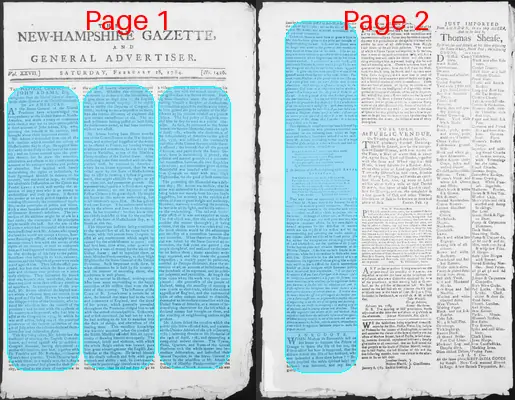
The New Hampshire Gazette And General Advertiser
Portsmouth, Exeter, Rockingham County, New Hampshire
What is this article about?
Biographical account of John Adams, U.S. Ambassador to the Netherlands, detailing his role in securing Dutch recognition of American independence and a commercial treaty in 1782, highlighting his background, principles, and diplomatic successes against British influence.
Merged-components note: This is a continuation of the biographical narrative article on John Adams' diplomatic mission and recognition by the Netherlands, which qualifies as foreign news due to its focus on international relations.
Clippings
1 of 2
OCR Quality
Full Text
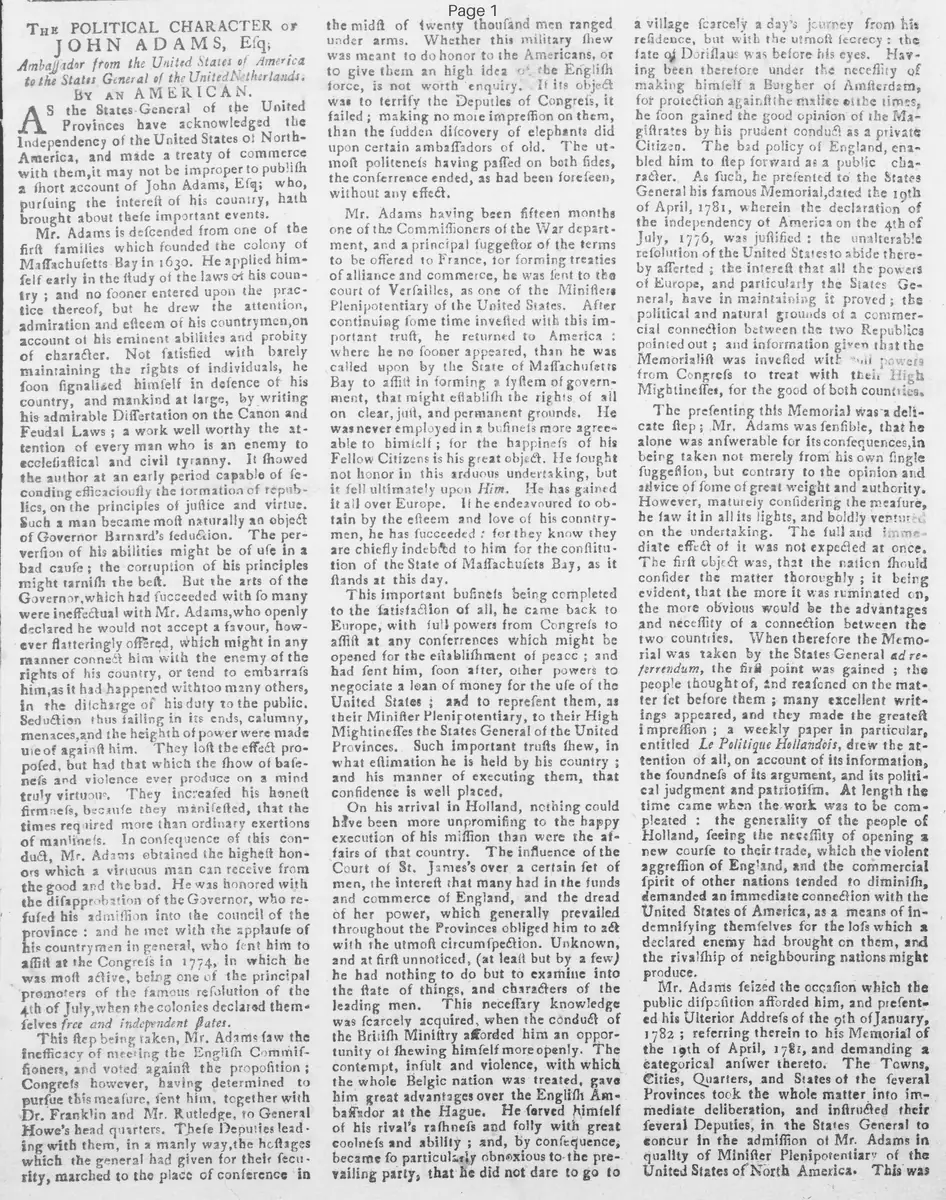
JOHN ADAMS, Esq;
Ambassador from the United States of America
to the States General of the United Netherlands.
BY AN AMERICAN.
Since the States-General of the United
Provinces have acknowledged the
Independency of the United States of North-
America, and made a treaty of commerce
with them, it may not be improper to publish
a short account of John Adams, Esq; who,
pursuing the interest of his country, hath
brought about these important events.
Mr. Adams is descended from one of the
first families which founded the colony of
Massachusetts Bay in 1630. He applied him-
self early in the study of the laws of his coun-
try ; and no sooner entered upon the prac-
tice thereof, but he drew the attention.
admiration and esteem of his countrymen, on
account of his eminent abilities and probity
of character. Not satisfied with barely
maintaining the rights of individuals, he
soon signalized himself in defence of his
country, and mankind at large, by writing
his admirable Dissertation on the Canon and
Feudal Laws : a work well worthy the at-
tention of every man who is an enemy to
eccclesiastical and civil tyranny. It showed
the author at an early period capable of se-
conding efficaciously the formation of repub-
lics, on the principles of justice and virtue.
Such a man became most naturally an object
of Governor Barnard's seduction. The per-
version of his abilities might be of use in a
bad cause : the corruption of his principles
might tarnish the best. But the arts of the
Governor, which had succeeded with so many
were ineffectual with Mr. Adams, who openly
declared he would not accept a favour, how-
ever flatteringly offered, which might in any
manner connect him with the enemy of the
rights of his country, or tend to embarrass
him, as it had happened with too many others,
in the discharge of his duty to the public.
Seduction thus failing in its ends, calumny.
menaces, and the height of power were made
use of against him. They lost the effect pro-
posed, but had that which the show of base-
ness and violence ever produce on a mind
truly virtuous. They increased his honest
firmness, because they manifested, that the
times required more than ordinary exertions
of manliness. In consequence of this con-
duct, Mr. Adams obtained the highest hon-
ors which a virtuous man can receive from
the good and the bad. He was honored with
the disapprobation of the Governor, who re-
fused his admission into the council of the
province : and he met with the applause of
his countrymen in general, who sent him to
sit at the Congress in 1774, in which he
was most active, being one of the principal
promoters of the famous resolution of the
4th of July, when the colonies declared them-
themselves free and independent states.
This step being taken, Mr. Adams saw the
inefficacy of meeting the English Commis-
sioners, and voted against the proposition :
Congress however, having determined to
pursue this measure, sent him, together with
Dr. Franklin and Mr. Rutledge, to General
Howe's head quarters. These Deputies lead-
ing with them, in a manly way, the hostages
which the general had given for their secu-
rity, marched to the place of conference in
the midst of twenty thousand men ranged
under arms. Whether this military show
was meant to do honor to the Americans, or
to give them a high idea of the English
force, is not worth enquiry. If its object
was to terrify the Deputies of Congress, it
failed: making no more impression on them.
than the sudden discovery of elephants did
upon certain ambassadors of old. The ut-
most politeness having passed on both sides.
the conference ended, as had been foreseen,
without any effect.
Mr. Adams having been fifteen months
one of the Commissioners of the War depart-
ment, and a principal suggester of the terms
to be offered to France, for forming treaties
of alliance and commerce, he was sent to that
court of Versailles, as one of the Ministers
Plenipotentiary of the United States. After
continuing some time invested with this im-
portant trust, he returned to America :
where he no sooner appeared, than he was
called upon by the State of Massachusetts
Bay to assist in forming a system of govern-
ment, that might establish the rights of all
on clear, just, and permanent grounds. He
was never employed in a business more agree-
able to himself : for the happiness of his
Fellow Citizens is his great object. He sought
not honor in this arduous undertaking, but
it fell ultimately upon Him. He has gained
it all over Europe. If he endeavored to ob-
tain by the esteem and love of his country-
men, he has succeeded : for they know they
are chiefly indebted to him for the constitu-
tion of the State of Massachusetts Bay, as it
stands at this day.
This important business being completed
to the satisfaction of all, he came back to
Europe, with full powers from Congress to
assist at any conferences which might be
opened for the establishment of peace ; and
had sent him, soon after, other powers to
negotiate a loan of money for the use of the
United States : and to represent them, as
their Minister Plenipotentiary, to their High
Mightinesses the States General of the United
Provinces. Such important trusts show, in
what estimation he is held by his country ;
and his manner of executing them, that
confidence is well placed.
On his arrival in Holland, nothing could
have been more unpromising to the happy
execution of his mission than were the af-
fairs of that country. The influence of the
Court of St. James's over a certain set of
men, the interest that many had in the funds
and commerce of England, and the dread
of her power, which generally prevailed
throughout the Provinces obliged him to act
with the utmost circumspection. Unknown,
and at first unnoticed, (at least but by a few)
he had nothing to do but to examine into
the state of things, and characters of the
leading men.
This necessary knowledge
was scarcely acquired, when the conduct of
the British Ministry afforded him an oppor-
tunity of showing himself more openly. The
contempt, insult and violence, with which
the whole Belgic nation was treated, gave
him great advantages over the English Am-
bassador at the Hague. He availed himself
of his rival's rashness and folly with great
coolness and ability ; and, by consequence,
became so particularly obnoxious to the pre-
vailing party, that he did not dare to go to
a village scarcely a day's journey from his
residence, but with the utmost secrecy : the
fate of Dorilaus was before his eyes. Hav-
ing been therefore under the necessity of
making himself a Burgher of Amsterdam,
for protection against the malice of the times,
he soon gained the good opinion of the Ma-
gistrates by his prudent conduct as a private
Citizen. The bad policy of England, ena-
bled him to step forward as a public cha-
racter. As such, he presented to the States
General his famous Memorial, dated the 19th
of April, 1781, wherein the declaration of
the independency of America on the 4th of
July, 1776, was justified : the unalterable
resolution of the United States to abide there-
by asserted : the interest that all the powers
of Europe, and particularly the States Ge-
neral, have in maintaining it proved; the
political and natural grounds of a commer-
cial connection between the two Republics
pointed out ; and information given that the
Memorialist was invested with full powers
from Congress to treat with their High
Mightinesses, for the good of both countries.
The presenting this Memorial was a deli-
icate step: Mr. Adams was sensible, that he
alone was answerable for its consequences, in
being taken not merely from his own single
suggestion, but contrary to the opinion and
advice of some of great weight and authority.
However, maturely considering the measure,
he saw it in all its lights, and boldly ventured
on the undertaking. The full and imme-
di即 effect of it was not expected at once.
The first object was, that the nation should
consider the matter thoroughly ; it being
evident, that the more it was ruminated on,
the more obvious would be the advantages
and necessity of a connection between the
two countries. When therefore the Memo-
rial was taken by the States General ad re-
ferendum, the first point was gained ; the
people thought of, and reasoned on the mat-
ter set before them ; many excellent writ-
ings appeared, and they made the greatest
impression ; a weekly paper in particular,
entitled Le Politique Hollandois, drew the at-
tention of all, on account of its information.
the soundness of its argument, and its politi-
cal judgment and patriotism. At length the
time came when the work was to be com-
pleted : the generality of the people of
Holland, seeing the necessity of opening a
new course to their trade, which the violent
aggression of England, and the commercial
spirit of other nations tended to diminish.
demanded an immediate connection with the
United States of America, as a means of in-
demnifying themselves for the loss which a
declared enemy had brought on them, and
the rivalry of neighbouring nations might
produce.
Mr. Adams seized the occasion which the
public disposition afforded him, and pre sent-
ed his Ulterior Address of the 9th of January,
1782 : referring therein to his Memorial of
the 19th of April, 1781, and demanding a
categorical answer thereto. The Towns,
Cities, Quarters, and States of the several
Provinces took the whole matter into im-
mediate deliberation, and instructed their
Several Deputies, in the States General to
concur in the admission of Mr. Adams in
quality of Minister Plenipotentiary of the
United States of North America. This was
By a resolution passed by their High Mightinesses the 8th of April, 1782; and on the 21st of the same month, Mr. Adams was admitted accordingly, with all the usual ceremonies.
This event seems to have been as great a blow as any that has been given to the pride and interests of England during the war. It showed the Dutch were no longer over awed by the power of their enemy, for they dared to brave him to his teeth. It set an example to other nations to partake of the commerce of those countries which England had lost by her incensed and confederate conduct. It concluded at once the English partisans in Holland, and proved that Sir Joseph Yorke was not the great minister he had hitherto been supposed to be. It gave occasion to an ambassador of one of the greatest monarchies of Europe to say to Mr. Adams: 'Vous avez frappe, Monsieur, le plus grand coup de tout l'Europe. C'est le plus grand coup qui a ete frappe dans le cause Americain. C'est vous qui avez effraye et terrase les Anglois. C'est vous qui avez seme cette nation d'enthousiasme.' - You have struck, Sir, the great stroke in all Europe. It is the greatest stroke that has been given in the American cause. It is you who have frightened and struck to the ground the English party. It is you who have filled this nation with enthusiasm. And then turning to another gentleman, he said, 'Ce n'est pas pour faire compliment a Monsieur Adams, que je dis cela: c'est parceque en verite je crois que c'est sa due.' - It is not to make a compliment to Mr. Adams that I say this: it is because truly I think it is his due.
This diplomatic compliment has been followed by others. I transcribe with pleasure a convivial one contained in the following lines, which an ingenious and patriotic Dutchman addressed to his excellency Mr. Adams, on drinking to him out of a large beautiful glass, which is called a bocal, and had inscribed round its brim. Aurea Libertas:
Aurea Libertas! gaude! par altera mundi
Vindice te enunt subde colla jugo
Hac tibi legatum quem chorus Belga recepit
Pectore sincero pocula plena salo.
Urnque gens deter, mox lugubrenda tyrannis,
Qua libertati vincula solva precor.
An Imitation of the Verses beginning with AUREA LIBERTAS.
Now Liberty exult! for, on thy fostering wing,
Far from the bloody despot's yoke, Columbia springs.
Come Fav'rite of the Goddess, on the Belgic shore,
To thee the rich libation shall her vota-res pour:
And may congenial States & endless Bonds unite!
Whilst the fell Tyrant trembles at the glorious Sight!
Mr. Adams.
Holland and America.
They who have an opportunity of knowing his Excellency Mr. Adams trace in his features the most unequivocal marks of probity and candor. He unites to the gravity, suitable to the character with which he is invested, an affability which prejudices you in his favour. Although of a blunt turn, as William the Prince of Orange was, and most great men are, who engage in important affairs, he has nevertheless a natural eloquence for the discussion of matters which are the objects of his mission, and for the recommending and enforcing the truths, measures, and systems, which are dictated by sound policy. He has neither the corrupted nor corrupting principles of Lord Chesterfield, nor the qualities of Sir Joseph Yorke, but the plain and virtuous demeanor of Sir William Temple. Like him too he is simple in negotiations, where he finds candour in those who treat with him. Otherwise he has the severity of a true republican, his high idea of virtue giving him a rigidness, which makes it difficult for him to accommodate himself to those intrigues which European politics have introduced into negotiation. 'Il faut que l'art de negocier ne pas l'art d'intriguer et de tromper: qu'il ne consiste pas a corrompre; a se jurer des serments et a temer les alarmes; et les divisions; qu'un negociateur habile peut parvenir a son but sans ces expediens, qui sont la triste ressource des intriguans sans avoir recours a des manoeuvres detourne: et extraordinaires. Il trouve dans la nature meme des affaires qu'il negocie des incidens propices a faire reussir tous ses projets mille fois gentille the art of negotiating is not the art of intriguing and deceiving: that it does not consist in corrupting: in making a farce of one's oath, and in forging alarms and divisions. That an able negotiator can arrive at his end without those expedients which are the miserable resources of intriguers. Without having recourse to out of the way and extraordinary manoeuvres, he finds, even in nature, circumstances from which he negotiates incidents proper to make his projects succeed.'
ANECDOTE.
When Madam de Barneveldt fell on her knees to implore the Prince of Orange to spare the life of her son, the Prince asked her how it happened, that she did not solicit the life of her husband, who was beheaded a short time before? 'Because (replied the noble-spirited lady) my husband was innocent, and my son is guilty.'
What sub-type of article is it?
What keywords are associated?
What entities or persons were involved?
Where did it happen?
Foreign News Details
Primary Location
United Netherlands
Event Date
19th April 1781 To 21st April 1782
Key Persons
Outcome
states-general acknowledged u.s. independence and made a treaty of commerce; adams admitted as minister plenipotentiary on 21st april 1782.
Event Details
John Adams, U.S. diplomat, presented a memorial to the States General on 19th April 1781 justifying American independence and proposing commercial ties; followed by an address on 9th January 1782 demanding response; resulted in resolution on 8th April 1782 and his formal admission on 21st April 1782, despite British opposition.