Thank you for visiting SNEWPapers!
Sign up free
Vermont Phœnix
Brattleboro, Bellows Falls, Ludlow, Windham County, Windsor County, Vermont
What is this article about?
A letter from Constantinople dated the 5th reports that American wrecking companies failed to raise the sunken Russian warships in Sevastopol harbor due to teredo worm damage and mud. The harbor remains blocked with 31 vessels sunk; attempts to blow them up also failed.
Clipping
OCR Quality
Full Text
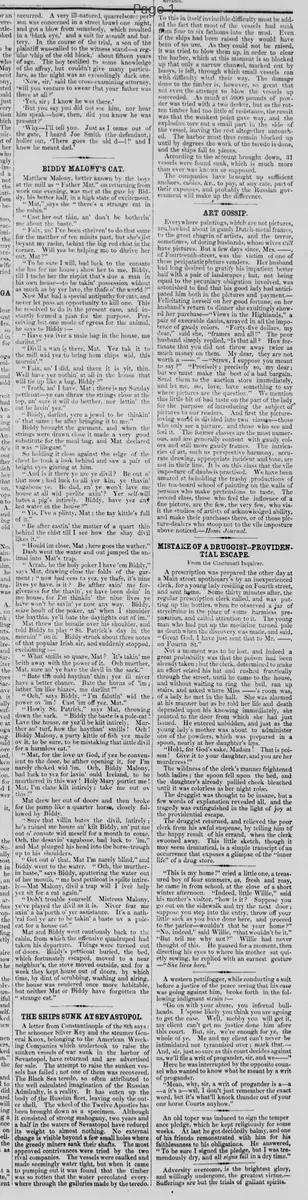
A letter from Constantinople of the 5th says :
The schooner Silver Key and the steamer General Knox, belonging to the American Wrecking Companies which undertook to raise the sunken vessels of war sunk in the harbor of Sevastopol, have returned and are advertised for sale. The attempt to raise the sunken vessels has failed; not one of them was recovered.
The Black Sea teredo, so often attributed to the well calculated imagination of the Russian Admiralty, is a reality. It has eaten up the body of the Russian Fleet, leaving only the outer shell. The wheel of the Twelve Apostles has been brought down as a specimen. Although it consisted of strong mahogany, two years and a half in the waters of Sevastopol have reduced its weight to almost nothing. No external change is visible beyond a few small holes where the greedy miners sank their shafts.
The most approved contrivances were tried by the two rival companies. The vessels were caulked and made seemingly water tight, but when it came to pumping out it was found that the timber was so rotten that the water percolated everywhere through the galleries made by the teredo. To this in itself invincible difficulty must be added the fact that most of the vessels had sunk from four to six fathoms into the mud.
Even if the ships had been raised they would have been of no use. As they could not be raised, it was tried to blow them up, in order to clear the harbor, which at this moment is so blocked up that only a narrow channel, marked out by buoys, is left, through which small vessels can with difficulty wind their way.
The damage done to the timber is, however, so great that not even the attempt to blow the vessels up succeeded. As much as 5000 pounds of powder was tried with a two decker, but as the rotten timber had too little of resistance, the result was that the weakest point gave way, and the explosion tore out a small part in the side of the vessel, leaving the rest altogether untouched.
The harbor must thus remain blocked up until by degrees the work of the teredo is done, and the ships fall to pieces.
According to the account brought down, 31 vessels were found sunk, which is much more than ever was known or supposed.
The companies have brought up sufficient anchors, cables, &c., to pay, at any rate, part of their expenses, and probably the Russian government will make up the difference.
What sub-type of article is it?
What keywords are associated?
Where did it happen?
Foreign News Details
Primary Location
Sevastopol
Event Date
As Of The 5th From Constantinople
Outcome
attempt to raise 31 sunken russian vessels failed due to teredo damage and mud; no ships recovered; harbor remains blocked; explosion attempts unsuccessful; companies recovered anchors and cables to cover partial expenses.
Event Details
American Wrecking Companies using schooner Silver Key and steamer General Knox tried to raise sunken Russian warships in Sevastopol harbor but failed because the teredo worm had rotten the timber, making vessels unseaworthy and pumping impossible; ships sank deep into mud; blowing up with 5000 pounds of powder on a two-decker only damaged a small part; harbor blocked except narrow buoyed channel; wheel from Twelve Apostles shown as example of destruction after two and a half years.