Thank you for visiting SNEWPapers!
Sign up free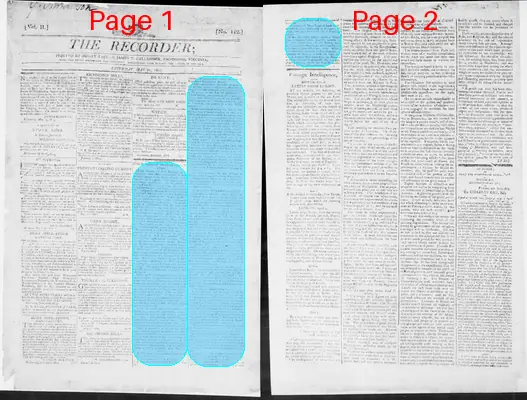
The Recorder
Richmond, Virginia
What is this article about?
This 1796 editorial critiques New England politicians' opposition to land taxes despite state precedents, questions Massachusetts' religious tolerance amid Baptist oppression, reflects on adversity fostering charity, and condemns Prof. Benjamin Waterhouse's cold treatment of foreign scholar Pherkin, leading to his suicide in Hingham, MA, as emblematic of inhospitality.
Merged-components note: Continuation of the critical opinion piece on the New England professor's treatment of the foreigner and related themes across pages 1 and 2; relabeled from 'story' to 'editorial' due to opinionated and partisan tone.
Clippings
1 of 2
OCR Quality
Full Text
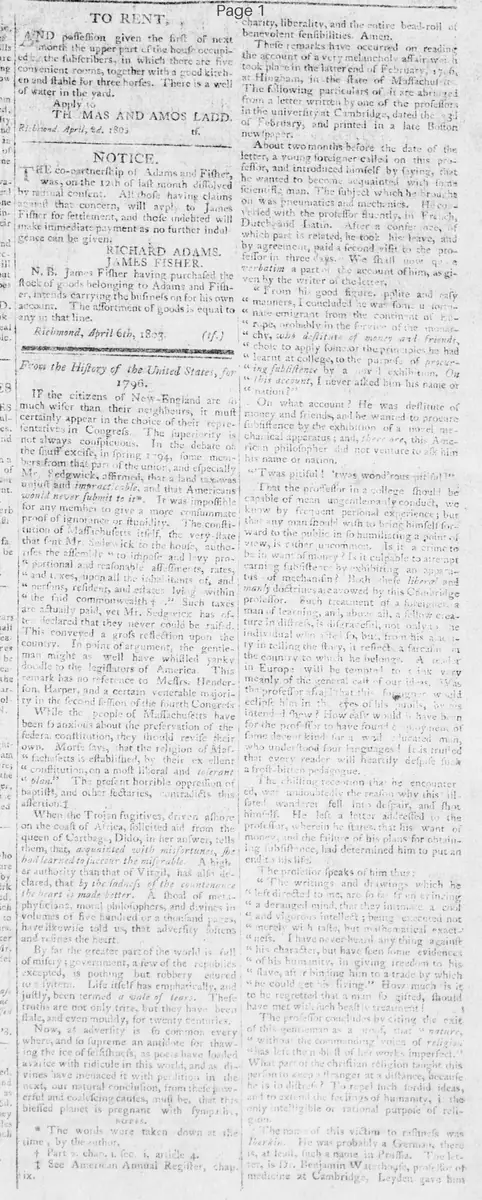
If the citizens of New-England are so much wiser than their neighbours, it must certainly appear in the choice of their representatives in Congress. The superiority is not always conspicuous. In the debate on the snuff excise, in spring 1794, some members from that part of the union, and especially Mr Sedgwick, affirmed, that a land tax was unjust and impracticable, and that Americans would never submit to it*. It was impossible for any member to give a more consummate proof of ignorance or stupidity. The constitution of Massachusetts itself, the very state that sent Mr. Sedgwick to the house, authorizes the assembly "to impose and levy proportional and reasonable assessments, rates, and taxes, upon all the inhabitants of, and persons, resident, and estates lying within the said commonwealth" Such taxes are actually paid, yet Mr. Sedgwick has often declared that they never could be raised. This conveyed a gross reflection upon the country. In point of argument, the gentleman might as well have whistled Yankee doodle to the legislators of America. This remark has no reference to Messrs. Henderson, Harper, and a certain venerable majority in the second session of the fourth Congress
While the people of Massachusetts have been anxious about the preservation of the federal constitution, they should revise their own. Morse says, that the religion of Massachusetts is established, by their excellent constitution, on a most liberal and tolerant plan. The present horrible oppression of baptists, and other sectaries, contradicts this assertion.
When the Trojan fugitives, driven ashore on the coast of Africa, solicited aid from the queen of Carthage, Dido, in her answer, tells them, that, acquainted with misfortunes, she had learned to succour the miserable. A higher authority than that of Virgil, has also declared, that by the sadness of the countenance the heart is made better. A shoal of metaphysicians, moral philosophers, and divines in volumes of five hundred or a thousand pages, have likewise told us, that adversity softens and refines the heart
By far the greater part of the world in full of misery; government, a few of the republics excepted, is nothing but robbery carried to a system. Life itself has emphatically, and justly, been termed a vale of tears. These truths are not only trite, but they have been stale, and even mouldy, for twenty centuries. Now, as adversity is so common every where, and to supreme an antidote for thawing the ice of selfishness, as poets have loaded avarice with ridicule in this world, and as divines have denounced it with perdition in the next, our natural conclusion, from these powerful and coalescing causes, must be that this blessed planet is pregnant with nymphs urie. sUrie.
* The words were taken down at the time, by the author.
³ Part a. chan. t. see i. article 4.
¹ See American Annual Register, chap. ix.
charity, liberality, and the entire bead-roll of benevolent sensibilities. Amen.
These remarks have occurred on reading the account of a very melancholy affair which took place in the latter end of February, 1796, at Hingham, in the state of Massachusetts
The following particulars of it are abridged from a letter written by one of the professors in the university at Cambridge, dated the 3d of February, and printed in a late Boston newspaper.
About two months before the date of the letter, a young foreigner called on this professor, and introduced himself by saying, that he wanted to become acquainted with some scientific man. The subject which he brought on was pneumatics and mechanics. He conversed with the professor fluently, in French, Dutch and Latin. After a conference, of which part is related, he took his leave, and by agreement, paid a second visit to the professor in three days. We shall now give verbatim a part of the account of him, as given by the writer of the letter.
"From his good figure. polite and easy manners, I concluded he was some unfortunate emigrant from the continent of Europe, probably in the prime of life delitute of money and friends, chose to apply some of the principles he had learnt at college, to the purpose of procuring subsistence by a novel exhibition. On this account, I never asked him his name or nation?"
On what account? He was destitute of money and friends, and he wanted to procure subsistence by the exhibition of a novel mechanical apparatus: and, therefore, this American philosopher did not venture to ask him his name or nation.
'Twas pitiful! 'twas wond'rous pitiful! That the professor in a college should be capable of mean ungentlemanly conduct, we know by frequent personal experience; but that any man should wish to bring himself forward to the public in so humiliating a point of view, is rather uncommon. Is it a crime to be in want of money? Is it culpable to attempt earning subsistence by exhibiting an apparatus of mechanics? Both these liberal and manly doctrines are avowed by this Cambridge professor. Such treatment of a foreigner, a man of learning, and, above all, a fellow creature in distress, is disgraceful, not only to the individual who acted so, by from his station in college, it reflects a stain on the country to which he belongs. A reader in Europe will be tempted to think very meanly of the general cast four ideas. Was the professor afraid that this foreigner would eclipse him in the eyes of his pupils, by a display of how? How easy would it have been for the professor to have found a moment of some decent kindness for a well educated man, who understood four languages! It is trusted that every reader will heartily desire so k a frost-bitten pedagogue.
The chilling reception that he encountered, undoubtedly the reason why this ill-fated wanderer fell into despair, and shot himself. He left a letter addressed to the professor, wherein he states, that his want of money and the failure of his plans for obtaining subsistence, had determined him to put an end to his life.
The professor speaks of him thus:
"The writings and drawings which he addressed directed to me, are so far from convincing a deranged mind, that they indicate a cool and vigorous, intellect; being executed not merely with taste but mathematical exactness. I have never heard any thing against his character. but have seen long evidences of his humanity, in giving freedom to his slave, after binding him to a trade by which he could get a living." How much is it to be regretted that a man so gifted, should have met with such beastly treatment!
The professor concludes by citing the exit of this gentleman as a proof, that "nature withholds the commanding voice of religion has left the noblest of her works imperfect."
What part of the Christian religion taught this professor to creep, danger at distance, because he is in distress? To repel such sordid ideas, and to extend the feelings of humanity. is the only intelligible or rational purpose of religion
The name of this victim to rashness was Pherkin, He was probably a German, there is, at least, such a name in Prussia. The letter is to Dr. Benjamin Waterhouse, professor of medicine at Cambridge, Leiden gave him Education; Rhode-Island had the dishonour of his birth.
The people of New-England boast much of their sincere hospitality to strangers. Of which this anecdote holds up a shocking sample.
Before this sorry pedant speaks a second time of religion, let him read the parable of the good Samaritan. In the Levite, who passed by on the other side, he will trace the intellectual pedigree of his own mind. When, such a character presents itself to mankind, as a paragon of piety, it is both our right and duty to wrench their visor from the features of deformity, and to administer that typographical drubbing, which has been so hardily courted, and so richly deserved.
What sub-type of article is it?
What keywords are associated?
What entities or persons were involved?
Editorial Details
Primary Topic
Criticism Of New England Hypocrisy In Politics, Religion, And Hospitality Exemplified By The Suicide Of Scholar Pherkin
Stance / Tone
Strongly Critical And Satirical
Key Figures
Key Arguments