Thank you for visiting SNEWPapers!
Sign up free
The Virginia Gazette
Richmond, Williamsburg, Richmond County, Virginia
What is this article about?
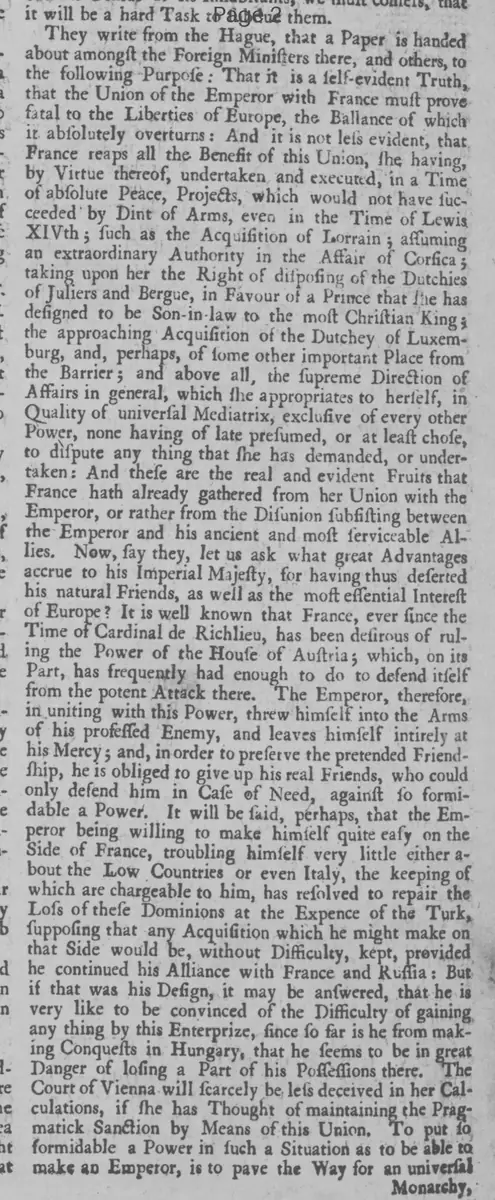
A paper circulating in The Hague criticizes the Emperor's alliance with France as detrimental to Europe's balance of power, benefiting France through acquisitions like Lorraine and influence in Corsica, Juliers, Bergue, and Luxembourg, while endangering the Emperor's interests and the Pragmatic Sanction.
Merged-components note: This is a single continuous foreign news article spanning pages 2 and 3, as indicated by the sequential reading order and the text directly continuing from one component to the next.
Clippings
1 of 2
OCR Quality
Full Text
Now, say they, let us ask what great Advantages accrue to his Imperial Majesty, for having thus deserted his natural Friends, as well as the most essential Interest of Europe? It is well known that France, ever since the Time of Cardinal de Richelieu, has been desirous of ruling the Power of the House of Austria; which, on its Part, has frequently had enough to do to defend itself from the potent Attacks thereof. The Emperor, therefore, in uniting with this Power, threw himself into the Arms of his professed Enemy, and leaves himself entirely at his Mercy; and, in order to preserve the pretended Friendship, he is obliged to give up his real Friends, who could only defend him in Case of Need, against so formidable a Power.
It will be said, perhaps, that the Emperor being willing to make himself quite easy on the Side of France, troubling himself very little either about the Low Countries or even Italy, the keeping of which are chargeable to him, has resolved to repair the Loss of these Dominions at the Expense of the Turk, supposing that any Acquisition which he might make on that Side would be, without Difficulty, kept, provided he continued his Alliance with France and Russia : But if that was his Design, it may be answered, that he is very likely to be convinced of the Difficulty of gaining any thing by this Enterprise, since so far is he from making Conquests in Hungary, that he seems to be in great Danger of losing a Part of his Possessions there.
The Court of Vienna will scarcely be less deceived in her Calculations, if she has thought of maintaining the Pragmatic Sanction by Means of this Union. To put so formidable a Power in such a Situation as to be able to make an Emperor, is to pave the Way for an universal
Monarchy of which there is Room to fear it has not entirely got the Idea. In order to justify the Conduct of the Court of Vienna, it is said, that he was forsaken by her Allies; to prove which, the Case of the late War concerning the Polish Affair, is cited: But why did this Court undertake it without first consulting, and even having the Consent of those who were only able to succour her? It is said, after all, that it will be very easy for the Emperor to renew his Friendship with his ancient Allies, whenever France shall give him Occasion to abandon her; but it would not be improper for him to consider, that in the mean time the Protestant Powers may possibly have formed a League for their common Security; and should that happen to be the Case, they would have but little Occasion to court his Imperial Majesty to enter into it: And if the Misunderstanding, which at present subsists amongst them, should still unhappily prevail, they would in that Case, be but of little Aid to the Emperor; or indeed to one another, since they would most of them, probably, be brought under the Yoke of France.
What sub-type of article is it?
What keywords are associated?
What entities or persons were involved?
Where did it happen?
Foreign News Details
Primary Location
The Hague
Key Persons
Outcome
france gains acquisitions including lorrain, authority in corsica, disposition of juliers and bergue, approaching acquisition of luxemburg; emperor risks losing possessions in hungary and support from allies; potential protestant league formation.
Event Details
A paper circulated among foreign ministers in The Hague argues that the Emperor's union with France upends Europe's balance, allowing France to achieve territorial and influential gains in peacetime that would have been impossible militarily; questions benefits to the Emperor, who allies with a historical enemy; discusses failed designs against the Turk, threats to the Pragmatic Sanction, and past Polish War; warns of possible Protestant league excluding the Emperor.