Thank you for visiting SNEWPapers!
Sign up free
Story
September 30, 1835
Morning Star
Limerick, York County, Maine
What is this article about?
Detailed account of the September 19, 1835, farewell services in Boston for 21 Baptist missionaries departing on September 22 for Asia, including speeches on devotion and challenges, and the emotional send-off at Union Wharf.
Clipping
OCR Quality
98%
Excellent
Full Text
DOVER:
Wednesday, Sept. 30, 1835.
DEPARTURE OF THE MISSIONARIES.
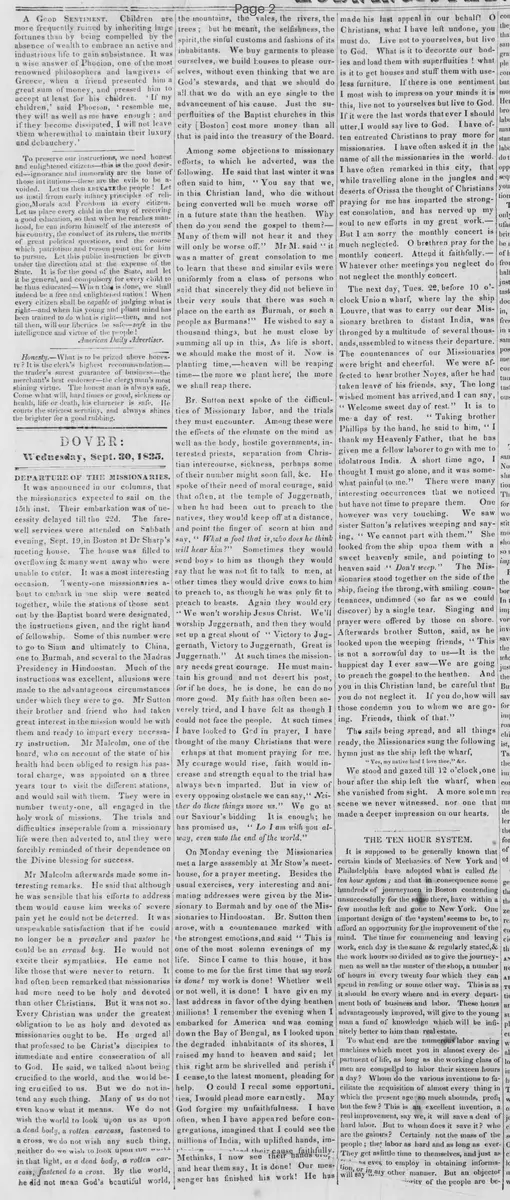
It was announced in our columns, that the missionaries expected to sail on the 15th inst. Their embarkation was of necessity delayed till the 22d. The farewell services were attended on Sabbath evening, Sept. 19, in Boston at Dr. Sharp's meeting house. The house was filled to overflowing & many went away who were unable to enter. It was a most interesting occasion. Twenty-one missionaries about to embark in one ship were seated together, while the stations of those sent out by the Baptist board were designated, the instructions given, and the right hand of fellowship. Some of this number were to go to Siam and ultimately to China, one to Burmah, and several to the Madras Presidency in Hindoostan. Much of the instructions was excellent, allusions were made to the advantageous circumstances under which they were to go. Mr. Sutton their brother and friend who had taken great interest in the mission would be with them and ready to impart every necessary instruction. Mr. Malcolm, one of the board, who on account of the state of his health had been obliged to resign his pastoral charge, was appointed on a three years tour to visit the different stations, and would sail with them. They were in number twenty-one, all engaged in the holy work of missions. The trials and difficulties inseparable from a missionary life were then adverted to, and they were forcibly reminded of their dependence on the Divine blessing for success.
Mr. Malcolm afterwards made some interesting remarks. He said that although he was sensible that his efforts to address them would cause him weeks of severe pain yet he could not be deterred. It was unspeakable satisfaction that if he could no longer be a preacher and pastor he could be an errand boy. He would not excite their sympathies. He came not like those that were never to return. It had often been remarked that missionaries had more need to be holy and devoted than other Christians. But it was not so. Every Christian was under the greatest obligation to be as holy and devoted as missionaries ought to be. He urged all that professed to be Christ's disciples to immediate and entire consecration of all to God. He said, we talked about being crucified to the world, and the world being crucified to us. But we do not intend any such thing. Many of us do not even know what it means. We do not wish the world to look upon us as upon a dead body, a rotten carcass, fastened to a cross, we do not wish any such thing, neither do we wish to look upon the world in that light, as a dead body, a rotten carcass, fastened to a cross. By the world, he did not mean God's beautiful world, the mountains, the vales, the rivers, the trees; but he meant, the selfishness, the spirit, the sinful customs and fashions of its inhabitants. We buy garments to please ourselves, we build houses to please ourselves, without even thinking that we are God's stewards, and that we should do all that we do with an eye single to the advancement of his cause. Just the superfluities of the Baptist churches in this city [Boston] cost more money than all that is paid into the treasury of the Board.
Among some objections to missionary efforts, to which he adverted, was the following. He said that last winter it was often said to him, "You say that we, in this Christian land, who die without being converted will be much worse off in a future state than the heathen. Why then do you send the gospel to them?—Many of them will not hear it and they will only be worse off." Mr. M. said "it was a matter of great consolation to me to learn that these and similar evils were uniformly from a class of persons who said that sincerely they did not believe in their very souls that there was such a place on the earth as Burmah, or such a people as Burmans!" He wished to say a thousand things, but he must close by summing all up in this, As life is short, we should make the most of it. Now is planting time,—heaven will be reaping time—the more we plant here, the more we shall reap there.
Br. Sutton next spoke of the difficulties of Missionary labor, and the trials they must encounter. Among these were the effects of the climate on the mind as well as the body, hostile governments, interested priests, separation from Christian intercourse, sickness, perhaps some of their number might soon fall, &c. He spoke of their need of moral courage, said that often, at the temple of Juggernath, when he had been out to preach to the natives, they would keep off at a distance, and point the finger of scorn at him and say, "What a fool that is, who does he think will hear him?" Sometimes they would send boys to him as though they would say that he was not fit to talk to men, at other times they would drive cows to him to preach to, as though he was only fit to preach to beasts. Again they would cry . We won't worship Jesus Christ. We'll worship Juggernath, and then they would set up a great shout of "Victory to Juggernath, Victory to Juggernath, Great is Juggernath." At such times the missionary needs great courage. He must maintain his ground and not desert his post, for if he does. he is done, he can do no more good. My faith has often been severely tried, and I have felt as though I could not face the people. At such times I have looked to God in prayer, I have thought of the many Christians that were perhaps at that moment praying for me. My courage would rise, faith would increase and strength equal to the trial has always been imparted. But in view of every opposing obstacle we can say,"Neither do these things move us." We go at our Saviour's bidding It is enough; he has promised us, "Lo I am with you always, even unto the end of the world."
On Monday evening the Missionaries met a large assembly at Mr. Stow's meeting house, for a prayer meeting. Besides the usual exercises, very interesting and animating addresses were given by the Missionary to Burmah and by one of the Missionaries to Hindoostan. Br. Sutton then arose, with a countenance marked with the strongest emotions, and said "This is one of the most solemn evenings of my life. Since I came to this house, it has come to me for the first time that my work is done! my work is done! Whether well or not well, it is done! I have given my last address in favor of the dying heathen millions! I remember the evening when I embarked for America and was coming down the Bay of Bengal, as I looked upon the degraded inhabitants of its shores, I raised my hand to heaven and said; let this right arm be shrivelled and perish if I cease, to the latest moment, pleading for help. O could I recall some opportunities, I would plead more earnestly. May God forgive my unfaithfulness. I have often, when I have appeared before congregations, imagined that I could see the millions of India, with uplifted hands, imploring me to plead their cause faithfully. Methinks, I now see their hands upraised and hear them say, It is done! Our messenger has finished his work! He has made his last appeal in our behalf! O Christians, what I have left undone, you must do. Live not to yourselves, but live to God. What is it to decorate our bodies and load them with superfluities! what is it to get houses and stuff them with useless furniture. If there is one sentiment I most wish to impress on your minds it is this, live not to yourselves but live to God. If it were the last words that ever I should utter, I would say live to God. I have often entreated Christians to pray more for missionaries. I have often asked it in the name of all the missionaries in the world. I have often remarked in this city, that while travelling alone in the jungles and deserts of Orissa the thought of Christians praying for me has imparted the strongest consolation, and has nerved up my soul to new efforts in my great work.—But I am sorry the monthly concert is much neglected. O brethren pray for the monthly concert. Attend it faithfully.—Whatever other meetings you neglect do not neglect the monthly concert.
The next day, Tues. 22, before 10 o'clock Union wharf, where lay the ship Louvre, that was to carry our dear Missionary brethren to distant India, was thronged by a multitude of several thousands, assembled to witness their departure. The countenances of our Missionaries were bright and cheerful. We were affected to hear brother Noyes, after he had taken leave of his friends, say, The long wished moment has arrived, and I can say, "Welcome sweet day of rest." It is to me a day of rest. "Taking brother Phillips by the hand, he said to him, "I thank my Heavenly Father, that he has given me a fellow laborer to go with me to idolatrous India. A short time ago, I thought I must go alone, and it was somewhat painful to me." There were many interesting occurrences that we noticed but have not time to prepare them. One however was very touching. We saw sister Sutton's relatives weeping and saying, "We cannot part with them." She looked from the ship upon them with a sweet heavenly smile, and pointing to heaven said "Don't weep." The Missionaries stood together on the side of the ship, facing the throng, with smiling countenances, undimmed (so far as we could discover) by a single tear. Singing and prayer were offered by those on shore. Afterwards brother Sutton, said, as he looked upon the weeping friends, "This is not a sorrowful day to us—It is the happiest day I ever saw—We are going to preach the gospel to the heathen. And you in this Christian land, be careful that you do not neglect it. If you do, how will those condemn you to whom we are going. Friends, think of that."
The sails being spread, and all things ready, the Missionaries sung the following hymn just as the ship left the wharf, "Yes, my native land I love thee," &c. We stood and gazed till 12 o'clock, one hour after the ship left the wharf, when she vanished from sight. A more solemn scene we never witnessed, nor one that made a deeper impression on our hearts.
Wednesday, Sept. 30, 1835.
DEPARTURE OF THE MISSIONARIES.
It was announced in our columns, that the missionaries expected to sail on the 15th inst. Their embarkation was of necessity delayed till the 22d. The farewell services were attended on Sabbath evening, Sept. 19, in Boston at Dr. Sharp's meeting house. The house was filled to overflowing & many went away who were unable to enter. It was a most interesting occasion. Twenty-one missionaries about to embark in one ship were seated together, while the stations of those sent out by the Baptist board were designated, the instructions given, and the right hand of fellowship. Some of this number were to go to Siam and ultimately to China, one to Burmah, and several to the Madras Presidency in Hindoostan. Much of the instructions was excellent, allusions were made to the advantageous circumstances under which they were to go. Mr. Sutton their brother and friend who had taken great interest in the mission would be with them and ready to impart every necessary instruction. Mr. Malcolm, one of the board, who on account of the state of his health had been obliged to resign his pastoral charge, was appointed on a three years tour to visit the different stations, and would sail with them. They were in number twenty-one, all engaged in the holy work of missions. The trials and difficulties inseparable from a missionary life were then adverted to, and they were forcibly reminded of their dependence on the Divine blessing for success.
Mr. Malcolm afterwards made some interesting remarks. He said that although he was sensible that his efforts to address them would cause him weeks of severe pain yet he could not be deterred. It was unspeakable satisfaction that if he could no longer be a preacher and pastor he could be an errand boy. He would not excite their sympathies. He came not like those that were never to return. It had often been remarked that missionaries had more need to be holy and devoted than other Christians. But it was not so. Every Christian was under the greatest obligation to be as holy and devoted as missionaries ought to be. He urged all that professed to be Christ's disciples to immediate and entire consecration of all to God. He said, we talked about being crucified to the world, and the world being crucified to us. But we do not intend any such thing. Many of us do not even know what it means. We do not wish the world to look upon us as upon a dead body, a rotten carcass, fastened to a cross, we do not wish any such thing, neither do we wish to look upon the world in that light, as a dead body, a rotten carcass, fastened to a cross. By the world, he did not mean God's beautiful world, the mountains, the vales, the rivers, the trees; but he meant, the selfishness, the spirit, the sinful customs and fashions of its inhabitants. We buy garments to please ourselves, we build houses to please ourselves, without even thinking that we are God's stewards, and that we should do all that we do with an eye single to the advancement of his cause. Just the superfluities of the Baptist churches in this city [Boston] cost more money than all that is paid into the treasury of the Board.
Among some objections to missionary efforts, to which he adverted, was the following. He said that last winter it was often said to him, "You say that we, in this Christian land, who die without being converted will be much worse off in a future state than the heathen. Why then do you send the gospel to them?—Many of them will not hear it and they will only be worse off." Mr. M. said "it was a matter of great consolation to me to learn that these and similar evils were uniformly from a class of persons who said that sincerely they did not believe in their very souls that there was such a place on the earth as Burmah, or such a people as Burmans!" He wished to say a thousand things, but he must close by summing all up in this, As life is short, we should make the most of it. Now is planting time,—heaven will be reaping time—the more we plant here, the more we shall reap there.
Br. Sutton next spoke of the difficulties of Missionary labor, and the trials they must encounter. Among these were the effects of the climate on the mind as well as the body, hostile governments, interested priests, separation from Christian intercourse, sickness, perhaps some of their number might soon fall, &c. He spoke of their need of moral courage, said that often, at the temple of Juggernath, when he had been out to preach to the natives, they would keep off at a distance, and point the finger of scorn at him and say, "What a fool that is, who does he think will hear him?" Sometimes they would send boys to him as though they would say that he was not fit to talk to men, at other times they would drive cows to him to preach to, as though he was only fit to preach to beasts. Again they would cry . We won't worship Jesus Christ. We'll worship Juggernath, and then they would set up a great shout of "Victory to Juggernath, Victory to Juggernath, Great is Juggernath." At such times the missionary needs great courage. He must maintain his ground and not desert his post, for if he does. he is done, he can do no more good. My faith has often been severely tried, and I have felt as though I could not face the people. At such times I have looked to God in prayer, I have thought of the many Christians that were perhaps at that moment praying for me. My courage would rise, faith would increase and strength equal to the trial has always been imparted. But in view of every opposing obstacle we can say,"Neither do these things move us." We go at our Saviour's bidding It is enough; he has promised us, "Lo I am with you always, even unto the end of the world."
On Monday evening the Missionaries met a large assembly at Mr. Stow's meeting house, for a prayer meeting. Besides the usual exercises, very interesting and animating addresses were given by the Missionary to Burmah and by one of the Missionaries to Hindoostan. Br. Sutton then arose, with a countenance marked with the strongest emotions, and said "This is one of the most solemn evenings of my life. Since I came to this house, it has come to me for the first time that my work is done! my work is done! Whether well or not well, it is done! I have given my last address in favor of the dying heathen millions! I remember the evening when I embarked for America and was coming down the Bay of Bengal, as I looked upon the degraded inhabitants of its shores, I raised my hand to heaven and said; let this right arm be shrivelled and perish if I cease, to the latest moment, pleading for help. O could I recall some opportunities, I would plead more earnestly. May God forgive my unfaithfulness. I have often, when I have appeared before congregations, imagined that I could see the millions of India, with uplifted hands, imploring me to plead their cause faithfully. Methinks, I now see their hands upraised and hear them say, It is done! Our messenger has finished his work! He has made his last appeal in our behalf! O Christians, what I have left undone, you must do. Live not to yourselves, but live to God. What is it to decorate our bodies and load them with superfluities! what is it to get houses and stuff them with useless furniture. If there is one sentiment I most wish to impress on your minds it is this, live not to yourselves but live to God. If it were the last words that ever I should utter, I would say live to God. I have often entreated Christians to pray more for missionaries. I have often asked it in the name of all the missionaries in the world. I have often remarked in this city, that while travelling alone in the jungles and deserts of Orissa the thought of Christians praying for me has imparted the strongest consolation, and has nerved up my soul to new efforts in my great work.—But I am sorry the monthly concert is much neglected. O brethren pray for the monthly concert. Attend it faithfully.—Whatever other meetings you neglect do not neglect the monthly concert.
The next day, Tues. 22, before 10 o'clock Union wharf, where lay the ship Louvre, that was to carry our dear Missionary brethren to distant India, was thronged by a multitude of several thousands, assembled to witness their departure. The countenances of our Missionaries were bright and cheerful. We were affected to hear brother Noyes, after he had taken leave of his friends, say, The long wished moment has arrived, and I can say, "Welcome sweet day of rest." It is to me a day of rest. "Taking brother Phillips by the hand, he said to him, "I thank my Heavenly Father, that he has given me a fellow laborer to go with me to idolatrous India. A short time ago, I thought I must go alone, and it was somewhat painful to me." There were many interesting occurrences that we noticed but have not time to prepare them. One however was very touching. We saw sister Sutton's relatives weeping and saying, "We cannot part with them." She looked from the ship upon them with a sweet heavenly smile, and pointing to heaven said "Don't weep." The Missionaries stood together on the side of the ship, facing the throng, with smiling countenances, undimmed (so far as we could discover) by a single tear. Singing and prayer were offered by those on shore. Afterwards brother Sutton, said, as he looked upon the weeping friends, "This is not a sorrowful day to us—It is the happiest day I ever saw—We are going to preach the gospel to the heathen. And you in this Christian land, be careful that you do not neglect it. If you do, how will those condemn you to whom we are going. Friends, think of that."
The sails being spread, and all things ready, the Missionaries sung the following hymn just as the ship left the wharf, "Yes, my native land I love thee," &c. We stood and gazed till 12 o'clock, one hour after the ship left the wharf, when she vanished from sight. A more solemn scene we never witnessed, nor one that made a deeper impression on our hearts.
What sub-type of article is it?
Historical Event
Journey
Heroic Act
What themes does it cover?
Moral Virtue
Bravery Heroism
Providence Divine
What keywords are associated?
Missionaries Departure
Baptist Mission
Farewell Services
Missionary Trials
India Siam Burmah
What entities or persons were involved?
Mr. Sutton
Mr. Malcolm
Missionaries
Where did it happen?
Boston, Union Wharf
Story Details
Key Persons
Mr. Sutton
Mr. Malcolm
Missionaries
Location
Boston, Union Wharf
Event Date
September 22, 1835
Story Details
Twenty-one Baptist missionaries depart from Boston on the ship Louvre for Siam, China, Burmah, and India. Farewell services on September 19 feature speeches by Mr. Malcolm and Br. Sutton on devotion, missionary trials, and the need for Christian consecration. The departure scene is solemn with singing and prayers.