Thank you for visiting SNEWPapers!
Sign up free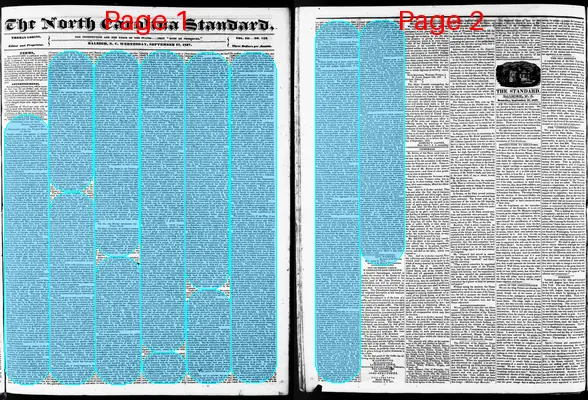
The North Carolina Standard
Raleigh, Wake County, North Carolina
What is this article about?
Report from Treasury Secretary Levi Woodbury on U.S. finances in 1837, covering settlements with former deposite banks after specie payment suspension, policy on receivable money, and causes of economic embarrassments like over-production and excessive imports.
Merged-components note: This is a continuation of the Treasury Department report across pages, forming a single narrative article.
Clippings
1 of 2
OCR Quality
Full Text
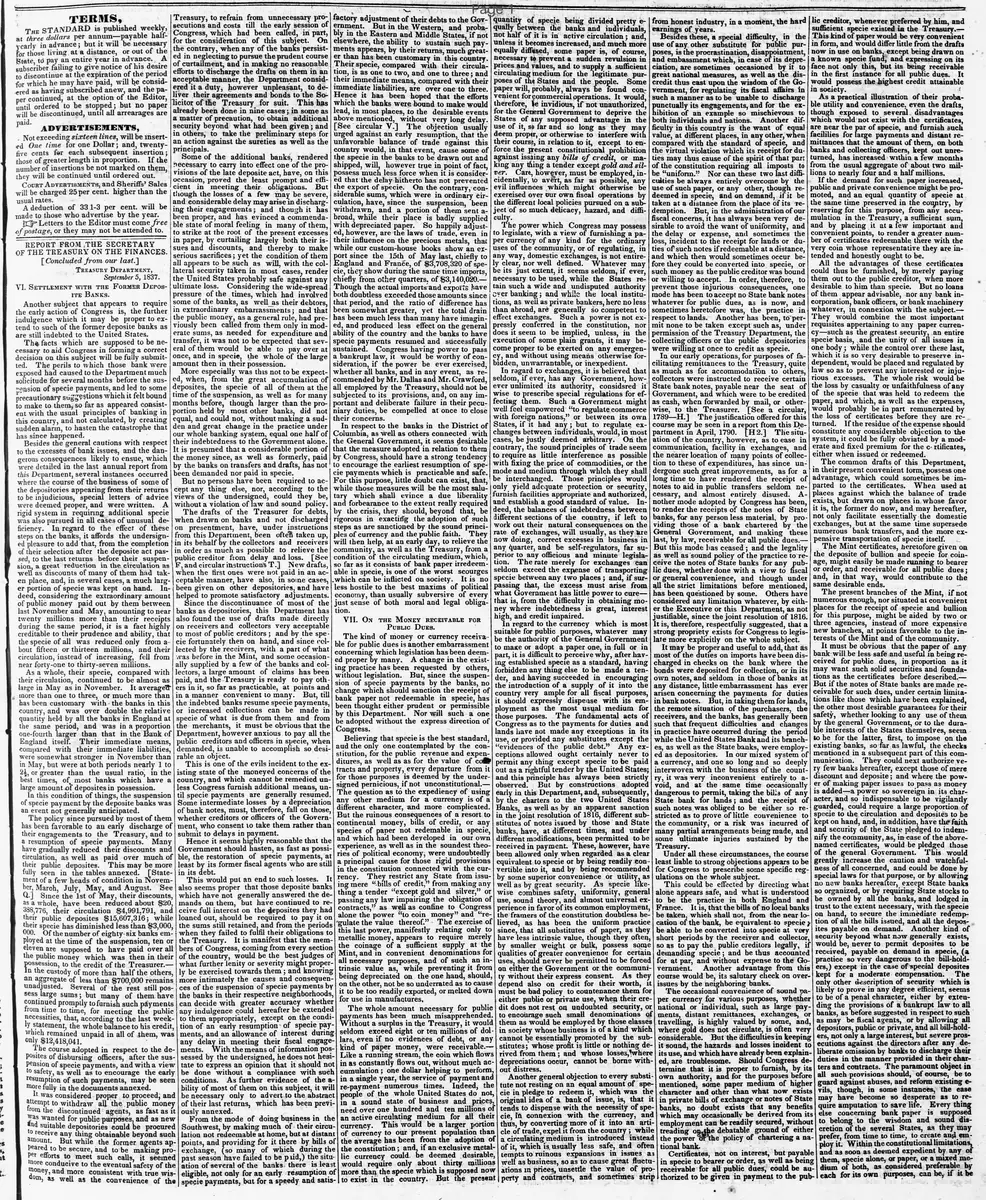
[Concluded from our last.]
Treasury Department,
September 5, 1837.
VI. SETTLEMENT WITH THE FORMER DEPOSITE BANKS.
Another subject that appears to require the early action of Congress is, the further indulgence which it may be proper to extend to such of the former deposite banks as are still indebted to the United States.
The facts which are supposed to be necessary to aid Congress in forming a correct decision on this subject will be fully submitted. The perils to which those banks were exposed had caused to the Department much solicitude for several months before the suspension of specie payments, and led to some precautionary suggestions which it felt bound to make to them, so far as appeared consistent with the usual principles of banking in this country, and not calculated, by creating sudden alarm, to hasten the catastrophe that has since happened.
Besides the general cautions with respect to the excesses of bank issues, and the dangerous consequences likely to ensue, which were detailed in the last annual report from this Department, several instances occurred where the course of the business of some of the depositories appearing from their returns to be injudicious, special letters of advice were deemed proper, and were written. A rigid system in requiring additional specie was also pursued in all cases of unusual deficiency. In regard to the effect of these steps on the banks, it affords the undersigned pleasure to add that, from the completion of their selection after the deposite act passed, to the last returns before their suspension, a great reduction in the circulation as well as discounts of many of them had taken place, and, in several cases, a much larger portion of specie was kept on hand.
Indeed, considering the extraordinary amount of public money paid out by them between last November and May, amounting to near twenty millions more than their receipts during the same period, it is a fact highly creditable to their prudence and ability, that the specie of all was reduced only from about fifteen or thirteen millions, and their circulation, instead of increasing, fell from near forty-one to thirty-seven millions.
As a whole, their specie, compared with their circulation, continued to be almost as large in May as in November. It averaged more than one to three, or much more than has been customary with the banks in this country, and was over double the relative quantity held by all the banks in England at the same period, and was in a proportion one-fourth larger than that in the Bank of England itself. Their immediate means, compared with their immediate liabilities, were somewhat stronger in November than in May, but were at both periods nearly 1 to 2½, or greater than the usual ratio, in the best times, of most banks which have a large amount of deposites in possession.
In this condition of things, the suspension of specie payment by the deposite banks was an event not generally anticipated.
The policy since pursued by most of them has been favorable to an early discharge of their engagements to the Treasury, and to a resumption of specie payments. Many have gradually reduced their discounts and circulation, as well as paid over much of their public deposites. This may be more fully seen in the tables annexed. [Statement of a few heads of condition in November, March, July, May, and August. See Q.] Since the 1st of May, their discounts, as a whole, have been reduced about $20,388,776, their circulation $4,991,791, and their public deposites $15,607,316; while their specie has diminished less than $3,000,000. Of the number of eighty-six banks employed at the time of the suspension, ten or eleven are supposed to have paid over all the public money which was then in their possession, to the credit of the Treasurer.
In the custody of more than half the others, an aggregate of less than $700,000 remains unadjusted. Several of the rest still possess large sums; but many of them have continued promptly to furnish such payments from time to time, for meeting the public necessities, that, according to the last weekly statement, the whole balance to his credit, which remained unpaid in all of them, was only $12,418,041.
The course adopted in respect to the deposites of disbursing officers, after the suspension of specie payments, and with a view to safety, as well as to encourage the early resumption of such payments, may be seen more fully in the documents annexed.
It was considered proper to proceed, and attempt to withdraw all the public money from the discontinued agents, as fast as it was wanted for public purposes, and as new and suitable depositories could be procured to receive any thing obtainable beyond such amount. But while the former agents appeared to be secure, and to be making proper efforts to meet such calls, it seemed more conducive to the eventual safety of the money, and more consistent with true wisdom, as well as the convenience of the Treasury, to refrain from unnecessary prosecutions and costs till the early session of Congress, which had been called, in part, for the consideration of this subject. On the contrary, when any of the banks persisted in neglecting to pursue the prudent course of curtailment, and in making no reasonable efforts to discharge the drafts on them in an acceptable manner, the Department considered it a duty, however unpleasant, to deliver their agreements and bonds to the Solicitor of the Treasury for suit. This has already been done in nine cases; in some as a matter of precaution, to obtain additional security beyond what had been given; and in others, to take the preliminary steps for an action against the sureties as well as the principals.
Some of the additional banks, rendered necessary to carry into effect one of the provisions of the late deposite act, have, on this occasion, proved the least prompt and efficient in meeting their obligations. But though the losses of a few may be severe, and considerable delay may arise in discharging their engagements; and though it has been proper, and has evinced a commendable state of moral feeling in many of them, to strike at the root of the present excesses in paper, by curtailing largely both their issues and discounts, and thereby to make serious sacrifices; yet the condition of them all appears to be such as will, with the collateral security taken in most cases, render the United States probably safe against any ultimate loss.
Considering the wide-spread pressure of the times, which had involved some of the banks, as well as their debtors, in extraordinary embarrassments; and that the public money, as a general rule, had previously been called from them only in moderate sums, as needed for expenditure and transfer, it was not to be expected that several of them would be able to pay over at once, and in specie, the whole of the large amount then in their possession.
More especially was this not to be expected, when, from the great accumulation of deposites, the specie of all of them at the time of the suspension, as well as for many months before, though larger than the proportion held by most other banks, did not equal, and could not, without making a sudden and great change in the practice under our whole banking system, equal one half of their indebtedness to the Government alone.
It is presumed that a considerable portion of the money since, as well as formerly, paid by the banks on transfers and drafts, has not been demanded nor paid in specie.
But no persons have been required to accept any thing else, nor, according to the views of the undersigned, could they be, without a violation of law and sound policy.
The drafts of the Treasurer for debts when drawn on banks and not discharged on presentment, have, under instructions from this Department, been often taken up, in its behalf by the collectors and receivers in order as much as possible to relieve the public creditor from delay and loss. See F, and circular instructions T.] New drafts, when the first ones were not paid in an acceptable manner, have also, in some cases, been given on other depositories, and have helped to promote satisfactory adjustments.
Since the discontinuance of most of the banks as depositories, this Department has also found the use of drafts made directly on receivers and collectors very acceptable to most of public creditors; and by the specie fortunately then on hand, and since collected by the receivers, with a part of what was before in the Mint, and some occasionally supplied by a few of the banks and collectors, a large amount of claims has been paid, and the Treasury is ready to pay others in it, so far as practicable, at points and in a manner convenient to many. But, till the indebted banks resume specie payments, or increased collections can be made in specie of what is due from them and from the merchants, it must be obvious that the Department, however anxious to pay all the public creditors and officers in specie, when demanded, is unable to accomplish so desirable an object.
This is one of the evils incident to the existing state of the moneyed concerns of the country, and which cannot be remedied unless Congress furnish additional means, until specie payments are generally resumed.
Some intermediate losses by a depreciation of bank notes, must, therefore, fall on those, whether creditors or officers of the Government, who consent to take them rather than submit to delays in payment.
Hence it seems highly reasonable that the Government should hasten, as fast as possible, the restoration of specie payments, at least by its former fiscal agents who are still in its debt.
This would put an end to such losses. It also seems proper that those deposite banks which have not generally answered the demands on them, but have continued to receive full interest on the deposites they had loaned out, should be required to pay it on the sums still retained, and from the periods when they failed to fulfil their obligations to the Treasury. It is manifest that the members of Congress, coming from every section of the country, would be the best judges of what further lenity or severity might properly be exercised towards them; and knowing more intimately the causes and consequences of the suspension of specie payments by the banks in their respective neighborhoods, can decide with greater accuracy whether any indulgence could hereafter be extended to them appropriately, except on the condition of an early resumption of specie payments, and an allowance of interest during any delay in meeting their fiscal engagements. With the means of information possessed by the undersigned, he does not hesitate to express an opinion that it should not be done without a compliance with such conditions. As further evidence of the ability of most of them on this subject, it will be necessary only to advert to the abstract of their last returns, which has been previously annexed.
From the mode of doing business in the Southwest, by making much of their circulation not redeemable at home, but at distant points, and providing for it there by bills of exchange, (so many of which during the past season have failed to be paid,) the situation of several of the banks there is least eligible, not only for an early resumption of specie payments, but for a speedy and satisfactory adjustment of their debts to the Government. But in the Western, and probably in the Eastern and Middle States, if not elsewhere, the ability to sustain such payments appears, by their returns, much greater than has been customary in this country.
Their specie, compared with their circulation, is as one to two, and one to three; and their immediate means, compared with their immediate liabilities, are over one to three.
Hence it has been hoped that the efforts which the banks were bound to make would lead, in most places, to the desirable events above mentioned, without very long delay. [See circular V.] The objection usually urged against an early resumption, that the unfavorable balance of trade against this country would, in that event, cause some of the specie in the banks to be drawn out and shipped, will, however true in point of fact, possess much less force when it is considered that the delay hitherto has not prevented the export of specie. On the contrary, considerable sums, which were in ordinary circulation, have, since the suspension, been withdrawn, and a portion of them sent abroad, while their place is badly supplied with depreciated paper. So happily adjusted, however, are the laws of trade, even in their influence on the precious metals, that while our custom-house books show an export since the 15th of May last, chiefly to England and France, of $3,708,320 of specie, they show during the same time imports, chiefly from other quarters, of $3,140,020.
Though the actual imports and exports have both doubtless exceeded those amounts since that period, and the ratio of difference has been somewhat greater, yet the total drain has been much less than many have imagined, and produced less effect on the general ability of the country and the banks to have specie payments resumed and successfully sustained. Congress having power to pass a bankrupt law, it would be worthy of consideration, if the power be ever exercised, whether all banks, and in any event, as recommended by Mr. Dallas and Mr. Crawford, all employed by the Treasury, should not be subjected to its provisions, and, on any important and deliberate failure in their pecuniary duties, be compelled at once to close their concerns.
In respect to the banks in the District of Columbia, as well as others connected with the General Government, it seems desirable that the measure adopted in relation to them by Congress, should have a strong tendency to encourage the earliest resumption of specie payments which is practicable and safe.
For this purpose, little doubt can exist, that, while those measures will be the most salutary which shall evince a due liberality and forbearance to the extent really required by the crisis, they should, beyond that, be rigorous in exacting the adoption of such steps as are sanctioned by the sound principles of currency and the public faith. They will then help, at an early day, to relieve the community, as well as the Treasury, from a condition of the circulating medium, which, so far as it consists of bank paper irredeemable in specie, is one of the worst scourges which can be inflicted on society. It is no less hostile to the best maxims of political economy, than usually subversive of every just sense of both moral and legal obligation.
VII. ON THE MONEY RECEIVABLE FOR PUBLIC DUES.
The kind of money or currency receivable for public dues is another embarrassment concerning which legislation has been deemed proper by many.
A change in the existing practice has been requested by others, without legislation. But, since the suspension of specie payments by the banks, no change which should sanction the receipt of bank paper not redeemable in specie, has been thought either prudent or permissible by this Department. Nor will such a one be adopted without the express direction of Congress.
Believing that specie is the best standard, and the only one contemplated by the constitution, for the public revenue and expenditures, as well as for the value of contracts and property, every departure from it for those purposes is deemed by the undersigned pernicious, if not unconstitutional.
The question as to the expediency of using any other medium for a currency is of a different character, and more complicated.
But the ruinous consequences of a resort to continental money, bills of credit, or any species of paper not redeemable in specie, and which had been developed in our own experience, as well as in the soundest theories of political economy, were undoubtedly a principal cause for those rigid provisions in the constitution connected with the currency. They restrict any State from issuing mere "bills of credit," from making any thing a tender "except gold and silver," or passing any law impairing the obligation of contracts," as well as confine to Congress alone the power "to coin money" and "regulate the value thereof."
The exercise of this last power, manifestly relating only to metallic money, appears to require merely the coinage of a sufficient supply at the Mint, and in convenient denominations for all necessary purposes, and of such an intrinsic value as, while preventing it from being depreciated on the one hand, should, on the other, not be so underrated as to cause it to be too readily exported, or melted down for use in manufactures.
The whole amount necessary for public payments has been much misapprehended.
Without a surplus in the Treasury, it would seldom exceed eight or ten millions of dollars, even if no evidences of debt, or any kind of paper money, were receivable.
Like a running stream, the coin which flows in as constantly flows out, without much accumulation; one dollar helping to perform, in a single year, the service of payment and re-payment numerous times. Indeed, the people of the whole United States do not, in a sound state of business and prices, need over one hundred and ten millions of an active circulating medium for all their currency. This would be a larger portion of currency to our present population than the average has been from the adoption of the constitution; and, if an exclusive metallic currency could be deemed desirable, would require only about thirty millions more than the specie which is supposed now to exist in the country. But the present quantity of specie, being divided pretty equally between the banks and individuals, not half of it is in active circulation; and, unless it becomes increased, and much more equally diffused, some paper is, of course, necessary to prevent a sudden revulsion in prices and values, and to supply a sufficient circulating medium for the legitimate purposes of the States and the people. Some paper will, probably, always be found convenient for commercial operations. It would, therefore, be invidious, if not unauthorized, for the General Government to deprive the States of any supposed advantage in the use of it, so far and so long as they may deem proper, or otherwise to interfere with their course, in relation to it, except to enforce the present constitutional prohibition against issuing any bills of credit, or making any thing a tender except gold and silver. Care, however, must be employed, incidentally, to avert, as far as possible, any evil influences which might otherwise be exercised over our own fiscal operations by the different local policies pursued on a subject of so much delicacy, hazard, and difficulty.
The power which Congress may possess to legislate, with a view of furnishing a paper currency of any kind for the ordinary uses of the community, or of regulating, in any way, domestic exchanges, is not entirely clear, nor well defined. Whatever may be its just extent, it seems seldom, if ever, necessary to be used, while the States retain such a wide and undisputed authority over banking; and while the local institutions, as well as private bankers, here no less than abroad, are generally so competent to effect exchanges. Such a power is not expressly conferred in the constitution, nor does it seem to be implied, unless, in the execution of some plain grants, it may become proper to be exerted on any emergency, and without using means otherwise forbidden, unwarrantable, or inexpedient.
In regard to exchanges, it is believed that seldom, if ever, has any Government, however unlimited its authority, considered it wise to prescribe special regulations for effecting them. Such a Government might well feel empowered "to regulate commerce with foreign nations," or between its own States, if it had any; but to regulate exchanges between individuals, would, in most cases, be justly deemed arbitrary. On the contrary, the sound principles of trade seem to require as little interference as possible with fixing the price of commodities, or the mode and medium through which they shall be interchanged. Those principles would only yield adequate protection or security, furnish facilities appropriate and authorized, and establish a good standard of value. Indeed, the balances of indebtedness between different sections of the country, if left to work out their natural consequences on the rate of exchanges, will usually, as they are now doing, correct excesses in business in any quarter, and be self-regulators, far superior to any officious and minute legislation. The rate merely for exchanges can seldom exceed the expense of transporting specie between any two places; and, if surpassing that, the excess must arise from what Government has little power to cure—that is, from the difficulty in obtaining money where indebtedness is great, interest high, and credit impaired.
In regard to the currency which is most suitable for public purposes, whatever may be the authority of the General Government to make or adopt a paper one, in full or in part, it is difficult to perceive why, after having established specie as a standard, having forbidden any thing else to be made a tender, and having succeeded in encouraging the introduction of a supply of it into the country very ample for all fiscal purposes, it should expressly dispense with its employment as the most usual medium for those purposes. The fundamental acts of Congress as to the payments for duties and lands have not made any exceptions in its use, or provided any substitutes except the "evidences of the public debt." Any exceptions allowed ought certainly never to permit any thing except specie to be paid out as a rightful tender by the United States: and this principle has always been strictly observed. But by constructions adopted early in this Department, and, subsequently, by the charters to the two United States Banks, as well as by an apparent sanction in the joint resolution of 1816, different substitutes of notes issued by those and State banks, have, at different times, and under different modifications, been permitted to be received in payment. These, however, have been allowed only when regarded as a clear equivalent to specie or by being readily convertible into it, and by being recommended by some superior convenience or utility, as well as by great security. As specie likewise combines safety, uniformity, general use, sound theory, and almost universal experience in favor of its common employment, the framers of the constitution doubtless believed, as has been the uniform practice since, that all substitutes of paper, as they have less intrinsic value, though they often, by smaller weight or bulk, possess some qualities of greater convenience for certain uses, should never be permitted to be forced on either the Government or the community without their express consent. As they depend also on credit for their worth, it must be bad policy to countenance them for either public or private use, when their credit does not rest on undoubted security, or to encourage such small denominations of them as would be employed by those classes in society whose business is of a kind which cannot be essentially promoted by the substitutes; whose profit is little or nothing derived from them; and whose losses, where depreciations occur, cannot be borne without distress.
Another general objection to every substitute not resting on an equal amount of specie in pledge to redeem it, which was the original idea of a bank of issue, is, that it tends to dispense with the necessity of specie, in connexion with the currency, and thus, by converting more of it into an article of trade, expel it from the country; while a circulating medium is introduced instead of it, which is usually less safe, and often tempts to ruinous expansions in issues as well as business, so as to cause great fluctuations in prices, unsettle the value of property and contracts, and sometimes strip from honest industry, in a moment, the hard earnings of years.
Besides these, a special difficulty, in the use of any other substitute for public purposes, is the procrastination, disappointment, and embarrassment which, in case of its depreciation, are sometimes occasioned by it to great national measures, as well as the discredit thus cast upon the wisdom of the Government, for regulating its fiscal affairs in such a manner as to be unable to discharge punctually its engagements, and for the exhibition of an example so mischievous to both individuals and nations. Another difficulty in this country is the want of equal value, at different places, in any other, when compared with the standard of specie, and the virtual violation which its receipt for duties may thus cause of the spirit of that part of the constitution requiring all imposts to be "uniform." Nor can these two last difficulties be always entirely overcome by the use of such paper, or any other, though redeemed in specie, and on demand, if it be taken at a distance from the place of its redemption. But, in the administration of our fiscal concerns, it has always been very desirable to avoid the want of uniformity, and the delay or expense, and sometimes the loss, incident to the receipt for lands or duties of such notes if redeemable at a distance, and which then would sometimes occur before they could be converted into specie, or such money as the public creditor was bound or willing to accept. In order, therefore, to prevent those injurious consequences, one mode has been to accept no State bank notes whatever for public dues, as is now, and sometimes heretofore was, the practice in respect to lands. Another has been, to permit none to be taken except such as, under permission of the Treasury Department, the collecting officers or the public depositories were willing at once to credit as specie.
In our early operations, for purposes of facilitating remittances to the Treasury, quite as much as for accommodation to others, collectors were instructed to receive certain State bank notes, payable near the seat of Government, and which were to be credited as cash, when forwarded by mail, or otherwise, to the Treasurer. See a circular, 1789—H.] The justification offered for this course may be seen in a report from this Department in April, 1790. [H.] The situation of the country, however, as to ease in communication, facility in exchanges, and the nearer location of many points of collection to these of expenditures, has since undergone such great improvements, as for a long time to have rendered the receipt of notes to aid in public transfers seldom necessary, and almost entirely disused. Another mode adopted by Congress has been, to render the receipts of the notes of State banks, for any person less material, by providing those of a bank chartered by the General Government, and making these last, by law, receivable for all public dues. But this mode has ceased; and the legality as well as sound policy of the practice to receive the notes of State banks for any public dues, whether done with a view to fiscal or general convenience, and though under all the strict limitations before mentioned, has been questioned by some. Others have considered any limitation whatever, by either the Executive or this Department, as not justifiable, since the joint resolution of 1816.
It is, therefore, respectfully suggested, that a strong propriety exists for Congress to legislate more explicitly on the whole subject.
It may be proper and useful to add, that as most of the duties on imports have been discharged in checks on the bank where the bonds were deposited for collection, or in its own notes, and seldom in those of banks at any distance, little embarrassment has ever arisen concerning the payments for duties in bank notes. But, in taking them for lands, the remote situation of the purchasers, the receivers, and the banks, has generally been such that frequent difficulties and changes in practice have occurred during the period while the United States Bank and its branches, as well as the State banks, were employed as depositories. In our mixed system of a currency, and one so long and so deeply interwoven with the business of the country, it was very inconvenient entirely to avoid, and at the same time occasionally dangerous to permit, taking the bills of any State bank for lands; and the receipt of such notes was obliged to be either so restricted as to prove of little convenience to the community, or a risk was incurred of many partial arrangements being made, and some ultimate injuries sustained by the Treasury.
Under all these circumstances, the course least liable to strong objections appears to be for Congress to prescribe some specific regulations on the whole subject.
This could be effected by directing what alone appears safe, and what is understood to be the practice in both England and France. It is, that the bills of no local banks be taken, which shall not, from the near location of the bank, be equivalent to specie; be able to be converted into specie at very short periods by the receiver and collector, so as to pay the public creditors legally, if demanding specie; and be thus accounted for at par, and without expense to the Government. Another advantage from this course would be, its salutary check on over-issues by the neighboring banks.
The occasional convenience of sound paper currency for various purposes, whether national or individual, such as large payments, distant remittances, exchanges, or travelling, is highly valued by some, and, where gold does not circulate, is often very considerable. But the difficulties in keeping it sound, the hazards and losses incident to its use, and which have already been explained, are troublesome. Should Congress determine that it is proper to furnish, by its own authority, and for the purposes before mentioned, some paper medium of higher character and other than what now exists in private bills of exchange or notes of State banks, no doubt exists that any benefits which may occasionally be derived from its employment can be readily secured, without treading on the debatable ground of either the power or the policy of chartering a national bank.
Certificates, not on interest, but payable in specie to bearer or order, as well as being receivable for all public dues, could be authorized to be given in payment to the public creditor, whenever preferred by him, and sufficient specie existed in the Treasury.
This kind of paper would be very convenient in form, and would differ little from the drafts now in use on banks, except being drawn on a known specie fund, and expressing on its face not only this, but its being receivable in the first instance for all public dues. It would possess the highest credit attainable in society.
As a practical illustration of their probable utility and convenience, even the drafts, though exposed to several disadvantages which would not exist with the certificates, are near the par of specie, and furnish such facilities for large payments and distant remittances that the amount of them, on both banks and collecting officers, kept out unreturned, has increased within a few months from the usual aggregate of about two millions to nearly four and a half millions.
If the demand for such paper increased, public and private convenience might be promoted, and an equal quantity of specie at the same time preserved in the country, by reserving for this purpose, from any accumulation in the Treasury, a sufficient sum, and by placing it at a few important and convenient points, to render a greater number of certificates redeemable there with the very coin whose representative they are intended and honestly ought to be.
All the advantages of these certificates could thus be furnished, by merely paying them out to the public creditor, when more desirable to him than specie. But no loans of them appear advisable, nor any bank incorporation, bank officers, or bank machinery whatever, in connexion with the subject.
They would combine the most important requisites appertaining to any paper currency—such as the greatest security, an entire specie basis, and the unity of all issues in one body; while the control over these last, which it is so very desirable to preserve independent, would be placed and regulated by law so as to prevent any interested or injurious excesses. The whole risk would be the loss by casualty or unfaithfulness of any of the specie that was held to redeem the paper, and which, as well as the expenses, would probably be in part remunerated by the loss of certificates before they are returned. If the residue of the expense should constitute any considerable objection to the system, it could be fully obviated by a moderate and fixed premium for the certificates, either when issued or redeemed.
The common drafts of this Department, in their present convenient form, possess one advantage, which could sometimes be imparted to the certificates. When used at places against which the balance of trade exists, but drawn on places in whose favor it is, the former do now, and may hereafter, not only facilitate essentially the domestic exchanges, but at the same time supersede numerous bank transfers, and the more expensive transportation of specie itself.
The Mint certificates, heretofore given on the deposite of bullion and specie for coinage, might easily be made running to bearer or order, and receivable for all public dues; and, in that way, would contribute to the same desirable ends.
The present branches of the Mint, if not numerous enough, nor situated at convenient places for the receipt of specie and bullion for this purpose, might be aided by two or three agencies, instead of more expensive new branches, at points favorable to the interests of the Mint and of the community.
It must be obvious that the paper of any bank will be less safe and useful in being received for public dues, in proportion as it may want such solid securities and foundations as the certificates before described. But if the notes of State banks are made receivable for such dues, under certain limitations like those which have been explained, the other most desirable guarantees for their safety, whether looking to any use of them by the general Government, or to the durable interests of the States themselves, seem to be for the latter, first, to impose on the existing banks, so far as lawful, the checks mentioned in a subsequent part of this communication. They could next authorize very few banks hereafter, except those of mere discount and deposite; and where the power of making paper issues to pass as money is added—a power so sovereign in its character, and so indispensable to be vigilantly guarded, could require a large proportion of specie to the circulation and deposites to be kept on hand, and, in addition, have the faith and security of the State pledged to indemnify the community, as, in case of the above-named certificates, would be pledged those of the general Government. This would greatly increase the caution and watchfulness of all concerned, and could be done by special laws for that purpose, or by allowing no new banks hereafter, except State banks so organized, or by requiring State stocks to be owned by all the banks, and lodged in trust to the extent necessary, with the specie on hand, to secure the immediate redemption of all the bills issued, and all the deposites payable on demand. Another kind of security beyond what now generally exists, would be, never to permit deposites to be received, payable on demand in specie, (a practice so very dangerous to the bill-holders,) except in the case of special deposites kept for a moderate compensation. The only other description of security which is likely to prove in any degree efficient, seems to be of a penal character, either by extending the provisions of a bankrupt law to all banks, as before suggested in respect to such as may be fiscal agents, or by allowing all depositors, public or private, and all bill-holders, not only a large interest, but severe prosecutions against the directors after any deliberate omission by banks to discharge their duties in the manner provided in their charters and contracts. The paramount object in all such provisions should, of course, be to guard against abuses, and reform existing evils, though, in some instances, the case may have become so desperate as to require amputation to save life. Every thing else concerning bank paper is supposed to belong to the wisdom and sound discretion of the several States, as they may prefer, from time to time, to create and employ it. Within the constitutional limitations and as soon as deemed expedient by any of them, specie alone, or paper, or a mixed medium of both, as considered preferable by each for its own purposes, can be, if it be
not now, established. At the same time, it is hoped and believed that no wish exists in any quarter to prevent, but rather a deep and general anxiety, like that evinced by Congress, the Executive, and this Department, for some years past, to encourage the same sound currency for the uses of the people and the States, as for the fiscal operations of the general Government.
VIII. Some General Causes and Remedies of the Present Embarrassments.
In conclusion, it is the intention of the undersigned not to advert to the chief causes of the recent calamities, except so far as they are connected with our financial condition, and as appears necessary to indicate briefly a few remedies by means of general legislation.
Without doubt one of these causes was the over-production of cotton, coupled with the large and sudden depreciation of its price. The whole product, though before so great, had, within three years, been increased probably more than one hundred millions of pounds, so as to exceed in a single year the enormous quantity of five hundred and forty millions of pounds. The fall of price was such as, on that quantity, would make a difference in its value of nearly forty millions of dollars. The occurrence of this fall, however, was at such a period of the year as not much to affect over half the last crop; but the violence of the shock, though thus lessened, still occasioned a loss to an appalling amount. The fall was chiefly consequent from the over-production, and the abrupt withdrawal of foreign credit, combined with some other circumstances which need not now be particularized. The over-production originated partly, like most other excesses here, from an extraordinary extension of credits and of bank issues, and partly from keeping open the sales of public lands to all persons, and at the former low prices, after other articles, including cotton and lands, had suddenly risen much in their nominal value. Under this tempting state of things those sales were exorbitantly enlarged, till they amounted to over twenty millions of acres in a year, when not more than three or four millions were probably necessary; and not so much had before been requisite, annually to meet the natural demands for new public lands for raising cotton, and for all other kinds of agricultural employment. But this excess in sales, so unexpected and ruinous, can, it is believed, be averted hereafter, whenever they are likely to go beyond a desirable amount, by passing laws which shall confine them to actual settlers, or increase the price to others. The same measures, with other remedies hereafter suggested for some other existing evils, will help to correct future excesses in the production of the great domestic staple of the Union.
Another of the causes of the present embarrassments was the unprecedented quantity of foreign goods imported. By stimulants to over-trading, such as very extended and often renewed credits abroad, as well as at home, so treacherous in appearances of prosperity, those importations were dangerously swollen to the amount of almost two hundred millions of dollars a year, and thus constituted an excess over our exports of about sixty millions, and involved the country in a foreign debt, merely commercial, whose balance against us, after all proper deductions for freights, profits, and similar considerations, probably exceeded the aggregate of thirty millions of dollars.
That excess, so little anticipated and so indiscreet, the system of credit formerly in use, and better regulated, would have seasonably prevented, by requiring an early adjustment of balances, and, thus turning the foreign exchanges against us, would have stopped many extravagances both in trade and bank issues.
But, stimulated and unrestrained, as before described, it increased the duties some millions beyond what a prudent though prosperous state of trade was likely to produce, and, combined with some other causes, has overwhelmed the mercantile interest with many of those disasters under which it has suffered so severely the past season. From many of these, no just legislation can now afford much relief. Nor could any legislation heretofore have prevented severe revulsions from this source, except by imposing checks on inordinate credit and banking, as well as on sudden and large expansions and contractions in bank issues, and by that further reduction of the tariff which has been so strenuously urged for two years past to be adopted, whenever our fiscal condition evinced that the whole of the accruing duties were not needed for public purposes. Because the great surplus, forced into the Treasury by the excesses in the sales of land and in duties on imports, not being seasonably withdrawn, either by equivalent appropriations or further reductions in the current receipts through new laws or by investments, has undoubtedly contributed, through the loan of it while in deposite, to sustain in some degree, if not produce, the spirit of over-trading. That surplus was often deprecated; and the only sound legal preventives still appear to this Department to be the measures before enumerated for preventing its accumulation. And after it had undesignedly happened, the wisest disposal of it was supposed to be, to expend it, as fast as useful, on proper objects of a public character; and, in the mean time, not to leave it in the deposite banks, but to invest it in State stocks, as a provident fund, to remain both safely and profitably till wanted to aid in meeting current expenditures or extraordinary contingencies.
The undersigned regrets that he was not so fortunate in sustaining his opinions concerning the transient and fluctuating character of the excesses in our revenue, as to have received the concurrence of Congress in relation to those cautionary provisions formerly recommended by him for meeting the revulsions, deficiencies, and contingencies, which he supposed incident to them, as well as to our financial system generally. He is, at the same time, aware that the deposite act, so far as it placed a part of the public money with the States for safe keeping, and the Treasury circular issued by the direction of the Executive, as to the kind of money receivable for public lands, were intended among other things, to obviate a portion of the evils connected with those excesses. Nor does he entertain any doubt that they both contributed, at first, to awaken caution among the more considerate, and to excite strong suspicions, if not convictions, in prudent minds, as to the great extravagancies of credit into which the community had rashly plunged. But after those measures had accomplished these and similar benefits with a portion of the community, though others still felt justified in anticipating a continuance of surpluses and distributions, the subsequent influence of either the act or the circular, in checking the threatened mischiefs, is believed, in most cases, to have been overrated. The operations of the deposite act, in supplying deficiencies of revenue, by a recall from the States, however well intended, will probably prove very deficient. In some other respects they have, by first requiring to be speedily collected and subdivided among more numerous banks from ten to fifteen millions of dollars, and then compelling, within the short period of nine months from the 1st of January last, another collection and transfer of nearly forty millions more, and much of it from the merchants, and to places not situated in the usual channels of trade or of large fiscal operations, unquestionably aggravated many of the distresses which had their principal origin in other causes. Those operations necessarily aided to produce the derangement that occurred in the domestic exchanges, and imposed a task upon the banks unprecedented for its amount and difficulty. By converting suddenly into demands for specie very large sums, most of which were before mere credits, they also hastened, if not increased, the loss of confidence in banks, that has since so widely impaired their character and usefulness.
Another, and the last general cause of the present embarrassments which will be noticed as having much connexion with our financial affairs, has been an unnecessary and injudicious increase of bank capital, discounts, and issues. A similar increase, however this may have been influenced by the large temporary deposites of public money made with banks and States, and by the causes before alluded to, has happened in some foreign countries, as well as here, during the same period, from other great commercial and monetary impulses, that are permanently connected with all paper systems not founded entirely on specie. These impulses have operated in some measure independently of several transient and local causes, whose effects have, by many, been much exaggerated. It is probable that they never can be properly controlled under such a system of expensive credit, while the individual directors of much of that credit have so little separate legislative restraint placed over their conduct, and have private interests at stake, which, in the pursuit of immediate and large profits, must usually possess a strength so superior to that of any sense of general duty to consult the public security.
The amount of circulation which existed in the early part of the last year, had increased thirty millions or forty millions of dollars in only three years. It continued to expand for some months afterwards, and in the last annual report was considered likely to prove ruinous to steady prices; to surround with danger every species of sound trade; and not to be susceptible of that reduction to proper dimensions which was necessary, and soon inevitable, without probably producing some of the wide-spread sufferings which have since happened.
The constitutional power of the General Government to check such evils, except as before indicated, and incidentally, through the kind of money it can and should permit to be employed in its revenues and expenditures, is apprehended to be limited. Through the latter, it may usefully discourage, as of late years has been attempted by Congress as well as the Executive, the dangerous issues of small bills, and indeed, paper emissions of any kind, which are not paid on demand in gold or silver coin at the place where issued, and shall not be equivalent to specie at the place where offered, and convertible into gold or silver upon the spot, at the will of the holder, and without delay or loss to him. For the like purpose, it may likewise continue inflexibly to countenance for smaller payments, and in the business of society not particularly commercial, a metallic currency; which is not liable, like bank paper, to sudden fluctuations and great losses. A further wise step would doubtless be, to refrain to make, by its own acts, any addition to the amount of bank capital, already too great; and to rely on bank paper as little as practicable, when authorized in the improvident manner which has often prevailed, and exhibited so much feebleness and insecurity, as well as produced so many inconveniences and losses.
It appears to the undersigned that, all beyond this which can be beneficially accomplished in connexion with the last cause of the present embarrassments, and without an alteration in the constitution conferring on the General Government direct authority over every kind of banking, must be effected through the State Legislatures, and commercial habits of the community. Much improvement can, doubtless, be introduced, if the Legislatures will impose those additional regulations, restraints, and securities, which have been before enumerated. Much more will also follow, and substantial relief be afforded to the people at large, if, in addition to the other measures recommended, individuals will exercise the wisdom to place a greater reliance on real capital, active industry, frugality, and well-grounded credit, than on that inflated system which of late has contemporaneously prevailed to such a ruinous extent, both in this and some other countries—a system which has been encouraged by some persons, under the delusive idea that there was no overtrading of any kind, till a revulsion has occurred almost without a parallel, and has given to commerce and credit a blow whose destructive effects it may require years fully to repair.
All which is respectfully submitted.
LEVI WOODBURY,
Secretary of the Treasury.
HON. JAMES K. POLK,
Speaker of the House of Representatives.
What sub-type of article is it?
What keywords are associated?
What entities or persons were involved?
Where did it happen?
Story Details
Key Persons
Location
United States
Event Date
September 5, 1837
Story Details
Treasury Secretary Levi Woodbury reports on settlements with former deposite banks after their suspension of specie payments, recommends congressional action on indulgences and interest, discusses acceptable money for public dues emphasizing specie, proposes certificates payable in specie, and analyzes causes of economic embarrassments including cotton over-production, excessive imports, and bank expansions.