Thank you for visiting SNEWPapers!
Sign up free
Literary
September 17, 1847
Southern Christian Advocate
Charleston, Charleston County, South Carolina
What is this article about?
Biographical sketch of Susanna Wesley, mother of John Wesley, highlighting her intellect, steadfast principles, handling of a political disagreement with her husband Samuel, her management of family prayers and sermons in his absence, and her defense of these practices in a letter to him.
Clipping
OCR Quality
98%
Excellent
Full Text
LADIES.
THE MOTHER OF JOHN WESLEY.
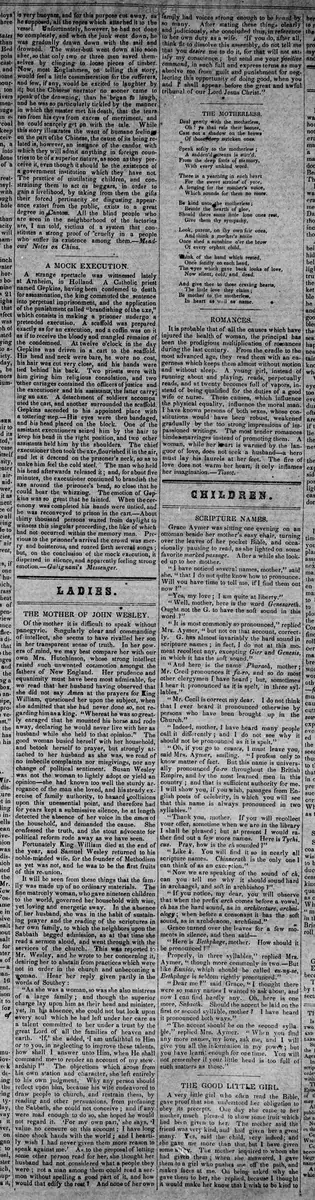
Of the mother it is difficult to speak without panegyric. Singularly clear and commanding of intellect, she seems to have rivalled her son in her transparent sense of truth. In her powers of mind, we may best compare her with our own Mrs. Hutchinson, whose strong intellect raised such unwonted commotion amongst the fathers of New England. Her prudence and equanimity must have been most admirable, for we read that her husband having observed that she did not say Amen at the prayers for King William, questioned her upon the subject, when she admitted that she had never done so, not regarding him as a king. "Whereat he was so greatly enraged that he mounted his horse and rode away, declaring he would never live with her as husband while she held to that opinion." The good woman busied herself with her household, and betook herself to prayer, but strongly attached to her husband as she was, we read of no imbecile complaints nor misgivings, nor any change of political sentiment. Susanna Wesley was not the woman to lightly adopt or yield an opinion—she had known too well the sturdy arrogance of the man she loved, and his steady exercise of family authority, to hazard collisions upon this unessential point, and therefore had for years kept a submissive silence, he at length detected the absence of her voice in the amen of the household, and demanded the cause. She confessed the truth, and the stout advocate for political reform rode away as we have seen. Fortunately King William died at the end of the year, and Samuel Wesley returned to his noble-minded wife, for the founder of Methodism as yet was not, and he was to be the first fruits of this re-union. It will be seen from these things that the family was made up of no ordinary materials. The fine matronly woman, who gave nineteen children to the world, governed her household with wise, yet loving and energetic sway. In the absence of her husband, she was in the habit of sustaining prayer and the reading of the scriptures in her own family, to which the neighbors upon the Sabbath begged admission, as at that time she read a sermon aloud, and went through with the services of the church. This was reported to Mr. Wesley, and he wrote to her concerning it, desiring her to abstain from practices which were not in order in the church and unbecoming a woman. Hear her reply given partly in the words of Southey: "As she was a woman, so was she also mistress of a large family; and though the superior charge lay upon him as their head and minister, yet, in his absence, she could not but look upon every soul which he had left under her care as a talent committed to her under a trust by the great Lord of all the families of heaven and earth. If,' she added, 'I am unfaithful to Him or to you, in neglecting to improve these talents, how shall I answer unto Him, when He shall command me to render an account of my stewardship?' The objections which arose from his own station and character, she left entirely to his own judgment. Why any person should reflect upon him, because his wife endeavored to draw people to church, and restrain them, by reading and other persuasions, from profaning the Sabbath, she could not conceive; and if any were mad enough to do so, she hoped he would not regard it. 'For my own part,' she says, 'I value no censure on this account: I have long since shook hands with the world; and I heartily wish I had never given them more reason to speak against me.' As to the proposal of letting some other person read for her, she thought her husband had not considered what a people they were; not a man among them could read a sermon without spelling a good part of it, and how would that edify the rest? And none of her own family had voices strong enough to be heard by so many. After stating these things clearly and judiciously, she concluded thus, in reference to her own duty as a wife, If you do, after all think fit to dissolve this assembly, do not tell me that you desire me to do it, for that will not satisfy my conscience; but send me your positive command, in such full and express terms as may absolve me from guilt and punishment for neglecting this opportunity of doing good, when you and I shall appear before the great and awful tribunal of our Lord Jesus Christ."
THE MOTHER OF JOHN WESLEY.
Of the mother it is difficult to speak without panegyric. Singularly clear and commanding of intellect, she seems to have rivalled her son in her transparent sense of truth. In her powers of mind, we may best compare her with our own Mrs. Hutchinson, whose strong intellect raised such unwonted commotion amongst the fathers of New England. Her prudence and equanimity must have been most admirable, for we read that her husband having observed that she did not say Amen at the prayers for King William, questioned her upon the subject, when she admitted that she had never done so, not regarding him as a king. "Whereat he was so greatly enraged that he mounted his horse and rode away, declaring he would never live with her as husband while she held to that opinion." The good woman busied herself with her household, and betook herself to prayer, but strongly attached to her husband as she was, we read of no imbecile complaints nor misgivings, nor any change of political sentiment. Susanna Wesley was not the woman to lightly adopt or yield an opinion—she had known too well the sturdy arrogance of the man she loved, and his steady exercise of family authority, to hazard collisions upon this unessential point, and therefore had for years kept a submissive silence, he at length detected the absence of her voice in the amen of the household, and demanded the cause. She confessed the truth, and the stout advocate for political reform rode away as we have seen. Fortunately King William died at the end of the year, and Samuel Wesley returned to his noble-minded wife, for the founder of Methodism as yet was not, and he was to be the first fruits of this re-union. It will be seen from these things that the family was made up of no ordinary materials. The fine matronly woman, who gave nineteen children to the world, governed her household with wise, yet loving and energetic sway. In the absence of her husband, she was in the habit of sustaining prayer and the reading of the scriptures in her own family, to which the neighbors upon the Sabbath begged admission, as at that time she read a sermon aloud, and went through with the services of the church. This was reported to Mr. Wesley, and he wrote to her concerning it, desiring her to abstain from practices which were not in order in the church and unbecoming a woman. Hear her reply given partly in the words of Southey: "As she was a woman, so was she also mistress of a large family; and though the superior charge lay upon him as their head and minister, yet, in his absence, she could not but look upon every soul which he had left under her care as a talent committed to her under a trust by the great Lord of all the families of heaven and earth. If,' she added, 'I am unfaithful to Him or to you, in neglecting to improve these talents, how shall I answer unto Him, when He shall command me to render an account of my stewardship?' The objections which arose from his own station and character, she left entirely to his own judgment. Why any person should reflect upon him, because his wife endeavored to draw people to church, and restrain them, by reading and other persuasions, from profaning the Sabbath, she could not conceive; and if any were mad enough to do so, she hoped he would not regard it. 'For my own part,' she says, 'I value no censure on this account: I have long since shook hands with the world; and I heartily wish I had never given them more reason to speak against me.' As to the proposal of letting some other person read for her, she thought her husband had not considered what a people they were; not a man among them could read a sermon without spelling a good part of it, and how would that edify the rest? And none of her own family had voices strong enough to be heard by so many. After stating these things clearly and judiciously, she concluded thus, in reference to her own duty as a wife, If you do, after all think fit to dissolve this assembly, do not tell me that you desire me to do it, for that will not satisfy my conscience; but send me your positive command, in such full and express terms as may absolve me from guilt and punishment for neglecting this opportunity of doing good, when you and I shall appear before the great and awful tribunal of our Lord Jesus Christ."
What sub-type of article is it?
Essay
What themes does it cover?
Religious
Moral Virtue
What keywords are associated?
Susanna Wesley
Samuel Wesley
John Wesley
Methodism
Family Prayer
Religious Duty
Political Opinion
King William
Literary Details
Title
The Mother Of John Wesley.
Key Lines
"As She Was A Woman, So Was She Also Mistress Of A Large Family; And Though The Superior Charge Lay Upon Him As Their Head And Minister, Yet, In His Absence, She Could Not But Look Upon Every Soul Which He Had Left Under Her Care As A Talent Committed To Her Under A Trust By The Great Lord Of All The Families Of Heaven And Earth."
"If You Do, After All Think Fit To Dissolve This Assembly, Do Not Tell Me That You Desire Me To Do It, For That Will Not Satisfy My Conscience; But Send Me Your Positive Command, In Such Full And Express Terms As May Absolve Me From Guilt And Punishment For Neglecting This Opportunity Of Doing Good, When You And I Shall Appear Before The Great And Awful Tribunal Of Our Lord Jesus Christ."