Thank you for visiting SNEWPapers!
Sign up free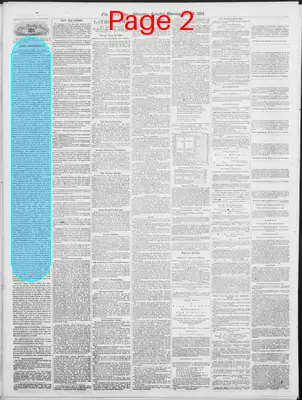
Editorial
November 10, 1866
Worcester Daily Spy
Worcester, Worcester County, Massachusetts
What is this article about?
This 1866 editorial criticizes President Andrew Johnson's post-Civil War reconstruction policy for obstructing just measures, favoring defeated rebels over loyalists, and contrasting with potential success under Hannibal Hamlin. It urges Johnson to align with national loyalty ahead of his upcoming message.
Clipping

OCR Quality
98%
Excellent
Full Text
The spy should have the eye of Argus: he is honorable if he do but look to the welfare of the commonwealth.
(WITH SUPPLEMENT.)
SATURDAY, NOV. 10, 1866.
Andrew Johnson's Policy.
At the close of the war against rebellion, after the rebel armies had surrendered, the rebels were ready to accept any terms of reconstruction that might be proposed. They were thoroughly beaten; they knew that their treason was inexcusable and deserved the severest punishment; and they expected to be held accountable for it. They did not suppose it possible to escape disfranchisement and confiscation. At that time, all the necessary guarantees for the future, including impartial suffrage, could have been secured with ease; for the rebels expected greater severities than the loyal people of the country were disposed to require. Those who had opportunity, at that time, to observe the condition of feeling at the south, among the subdued traitors, know that this was true, even beyond what we state.
If Hannibal Hamlin had been elected Vice President of the United States, instead of Andrew Johnson, reconstruction would have been completed, long ago, in the most satisfactory manner, and without serious difficulty; or, at any rate, a policy of reconstruction would have been established which nobody would now dream of setting aside. That matter would be substantially settled, and public attention would be given to other important questions. If what was so easy and so necessary has not been realized, the failure is due entirely to Andrew Johnson; it is because he has turned against his own professions and unscrupulously put himself in the way to obstruct the work and make it impossible; it is because he has undertaken to interfere with the prerogative of Congress in order to favor the rebels; it is because he has betrayed the triumphant loyalty of the country and sought to establish over it a supremacy of the copperheads and southern traitors. His speech delivered at the White House, on the twenty-second day of last February, went through the south like the scream of an evil spirit, reviving at once all the worst feelings of the defeated traitors. They were suddenly transformed, and at once assumed the tone and bearing of dictators. His "policy" had already begun to change them; but, in that speech they saw clearly that he had deserted the men who fought and put down the rebellion, and gone over to their side; and in every rebel community there was a rekindling of the fires of the pit. Easy and just reconstruction was no longer possible. His influence has been at work on that side ever since. Therefore, it has been impossible to go forward with the great work of reconstruction, which it seems impossible to finish properly until he either gives place to a better man or becomes a better man himself.
It is quite likely that Andrew Johnson has never comprehended the questions at issue between the loyal and disloyal men of the country; and that his vehemence against the secessionists was not wholly prompted by loyalty. During his whole political career he has pitted himself against men whom he has been accustomed to describe as "the aristocrats," meaning the wealthy and educated men of his section; and they, on the other hand, have charged that his whole method in politics was to "marshal the brutal elements of society against the respectable elements." His quarrel with "the aristocrats" has always been exceedingly vehement, bitter, and malignant; and when they became organizers of treason and leaders of rebellion, he very naturally flamed and roared against them like a volcano. It was possible for him to do so without any serious quarrel with their principles; and, in such a case, what was most likely to happen when he found himself in the Presidential chair with those men in his ante-room, hats in hand, humbly begging favors? It may be that "My Policy" was not developed by means of such influences; but what other explanation is so probable, or so much in accordance with the peculiar history and character of the man? At any rate, it is the explanation adopted by a great many people. How wholesome it would be for the country, and how excellent for himself, if he would dismiss all evil-minded counsellors, rise to the height of the great occasion, and seek to do, or have done, what justice and the public welfare demand! Scarcely anybody believes him capable of such elevated conduct. How admirable it would be in him to contradict the general belief, and give the country and the world an agreeable surprise! It would be a surprise, and a very great one, to see him turn from what he has seemed to be for some time past, and become in the presidential chair, a faithful representative of the earnest loyalty of the country, to which he owes his present position. We shall soon see what he will do, for his next message will tell us whether he is likely to adhere to his present policy with dogged stupidity, or listen respectfully to what the country tells him in the recent elections.
(WITH SUPPLEMENT.)
SATURDAY, NOV. 10, 1866.
Andrew Johnson's Policy.
At the close of the war against rebellion, after the rebel armies had surrendered, the rebels were ready to accept any terms of reconstruction that might be proposed. They were thoroughly beaten; they knew that their treason was inexcusable and deserved the severest punishment; and they expected to be held accountable for it. They did not suppose it possible to escape disfranchisement and confiscation. At that time, all the necessary guarantees for the future, including impartial suffrage, could have been secured with ease; for the rebels expected greater severities than the loyal people of the country were disposed to require. Those who had opportunity, at that time, to observe the condition of feeling at the south, among the subdued traitors, know that this was true, even beyond what we state.
If Hannibal Hamlin had been elected Vice President of the United States, instead of Andrew Johnson, reconstruction would have been completed, long ago, in the most satisfactory manner, and without serious difficulty; or, at any rate, a policy of reconstruction would have been established which nobody would now dream of setting aside. That matter would be substantially settled, and public attention would be given to other important questions. If what was so easy and so necessary has not been realized, the failure is due entirely to Andrew Johnson; it is because he has turned against his own professions and unscrupulously put himself in the way to obstruct the work and make it impossible; it is because he has undertaken to interfere with the prerogative of Congress in order to favor the rebels; it is because he has betrayed the triumphant loyalty of the country and sought to establish over it a supremacy of the copperheads and southern traitors. His speech delivered at the White House, on the twenty-second day of last February, went through the south like the scream of an evil spirit, reviving at once all the worst feelings of the defeated traitors. They were suddenly transformed, and at once assumed the tone and bearing of dictators. His "policy" had already begun to change them; but, in that speech they saw clearly that he had deserted the men who fought and put down the rebellion, and gone over to their side; and in every rebel community there was a rekindling of the fires of the pit. Easy and just reconstruction was no longer possible. His influence has been at work on that side ever since. Therefore, it has been impossible to go forward with the great work of reconstruction, which it seems impossible to finish properly until he either gives place to a better man or becomes a better man himself.
It is quite likely that Andrew Johnson has never comprehended the questions at issue between the loyal and disloyal men of the country; and that his vehemence against the secessionists was not wholly prompted by loyalty. During his whole political career he has pitted himself against men whom he has been accustomed to describe as "the aristocrats," meaning the wealthy and educated men of his section; and they, on the other hand, have charged that his whole method in politics was to "marshal the brutal elements of society against the respectable elements." His quarrel with "the aristocrats" has always been exceedingly vehement, bitter, and malignant; and when they became organizers of treason and leaders of rebellion, he very naturally flamed and roared against them like a volcano. It was possible for him to do so without any serious quarrel with their principles; and, in such a case, what was most likely to happen when he found himself in the Presidential chair with those men in his ante-room, hats in hand, humbly begging favors? It may be that "My Policy" was not developed by means of such influences; but what other explanation is so probable, or so much in accordance with the peculiar history and character of the man? At any rate, it is the explanation adopted by a great many people. How wholesome it would be for the country, and how excellent for himself, if he would dismiss all evil-minded counsellors, rise to the height of the great occasion, and seek to do, or have done, what justice and the public welfare demand! Scarcely anybody believes him capable of such elevated conduct. How admirable it would be in him to contradict the general belief, and give the country and the world an agreeable surprise! It would be a surprise, and a very great one, to see him turn from what he has seemed to be for some time past, and become in the presidential chair, a faithful representative of the earnest loyalty of the country, to which he owes his present position. We shall soon see what he will do, for his next message will tell us whether he is likely to adhere to his present policy with dogged stupidity, or listen respectfully to what the country tells him in the recent elections.
What sub-type of article is it?
Partisan Politics
Constitutional
War Or Peace
What keywords are associated?
Andrew Johnson
Reconstruction
Civil War
Rebels
Loyalty
Suffrage
Congress
Presidential Policy
What entities or persons were involved?
Andrew Johnson
Hannibal Hamlin
Rebels
Congress
Copperheads
Southern Traitors
Editorial Details
Primary Topic
Critique Of Andrew Johnson's Reconstruction Policy
Stance / Tone
Strongly Critical Of Andrew Johnson
Key Figures
Andrew Johnson
Hannibal Hamlin
Rebels
Congress
Copperheads
Southern Traitors
Key Arguments
Rebels Were Ready To Accept Harsh Terms Including Disfranchisement And Confiscation After Surrender
Impartial Suffrage Could Have Been Secured Easily At War's End
Johnson's Policy Obstructed Reconstruction By Favoring Rebels
Johnson's February Speech Revived Rebel Confidence And Hostility
Johnson Betrayed Loyalists By Aligning With Traitors
Johnson's Vehemence Against Secessionists Stemmed From Personal Quarrels Rather Than Loyalty
Johnson Should Rise To The Occasion For Justice And Public Welfare
Upcoming Message Will Reveal If Johnson Persists In His Policy