Thank you for visiting SNEWPapers!
Sign up free
Jenks's Portland Gazette
Portland, Cumberland County, Maine
What is this article about?
A 'Friend to Truth' submits John Jay's October 1, 1800, letter to the editor of the Pittsfield Sun, refuting exaggerated claims from the Albany Register about the expenses of Jay's 1794 mission to negotiate the Treaty of London with Great Britain, detailing actual costs of $12,000.36 against an $18,000 advance, with a balance returned to the U.S. Treasury.
Clipping
OCR Quality
Full Text
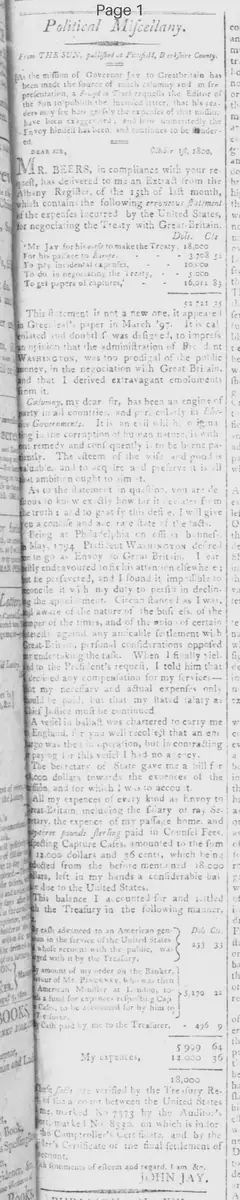
From THE SUN, published at Pittsfield, Berkshire County.
As the mission of Governor Jay to Great Britain has been made the source of much calumny and misrepresentation, a Friend to Truth requests the Editor of the Sun to publish the inclosed letter, that his readers may see how grossly the expenses of that mission have been exaggerated, and how undeservedly the Envoy himself has been and continues to be slandered.
DEAR SIR,
October 1, 1800,
R. BEERS, in compliance with your request, has delivered to me an Extract from the Albany Register, of the 15th of last month, which contains the following erroneous Statement of the expenses incurred by the United States, for negotiating the Treaty with Great Britain.
Dols. Cts.
Mr. Jay for his outfit to make the Treaty, 18,000
For his passage to Europe, 3708 50
To pay incidental expenses, 10,000
To do in negotiating the treaty, 8,000
To get papers of captures, 16,012 83
52,721 25
This statement is not a new one. It appeared in Greenleaf's paper in March '97. It is calculated and doubtless was designed, to impress an opinion that the administration of President WASHINGTON, was too prodigal of the public money, in the negotiation with Great Britain, and that I derived extravagant emoluments from it.
Calumny, my dear sir, has been an engine of party in all countries, and particularly in elective Governments. It is an evil which, originating in the corruption of human nature, is without remedy and consequently is to be borne patiently. The esteem of the wise and good is valuable, and to acquire and preserve it is all that ambition ought to aim at.
As to the statement in question, you are desirous to know exactly how far it deviates from the truth: and to gratify this desire, I will give you a concise and accurate statement.
Being at Philadelphia on official business in May, 1794, President WASHINGTON desired me to go as Envoy to Great Britain. I earnestly endeavored to fix his attention elsewhere; but he persevered, and I found it impossible to reconcile it with my duty to persist in declining the appointment. Circumstanced as I was, and aware of the nature of the business, of the temper of the times, and of the animosity of certain interests against any amicable settlement with Great Britain, personal considerations opposed my undertaking the task. When I finally yielded to the President's request, I told him that I declined any compensation for my services—but my necessary and actual expenses only, should be paid: but that my stated salary as Chief Justice must be continued.
A vessel in ballast was chartered to carry me to England. You will well recollect that an embargo was then in operation, but in contracting for paying for this vessel I had no agency.
The Secretary of State gave me a bill for 8,000 dollars towards the expenses of the mission, and for which I was to account.
All my expenses of every kind as Envoy to Great Britain, including the salary of my Secretary, the expense of my passage home, and three pounds sterling paid in Counsel Fees respecting Capture Cases, amounted to the sum of 12,000 dollars and 36 cents, which being deducted from the before mentioned 18,000 dollars, left in my hands a considerable balance due to the United States.
This balance I accounted for and settled with the Treasury in the following manner,
Dols. Cts.
Yearly advanced to an American gentleman in the service as the United States, 233 33
Store account with the public, was 233 33
Credited with it by the Treasury, amount of my order on the Banker, through Mr. Pinckney, who was then American Minister at London, to 5,270 22
If used as a fund for expenses respecting Capture Cases, to be accounted for by him to the Treasurer, 1,000
Cash paid by me to the Treasurer, 5,999 64
My expenses, 12,000 36
18,000
These facts are verified by the Treasury Records of the account between the United States and me, marked No. 373 by the Auditor's Office, No. 8880, on which is indorsed the Comptroller's Certificate, and by the Register's Certificate of the final settlement of account.
With sentiments of esteem and regard, I am &c.
JOHN JAY.
What sub-type of article is it?
What themes does it cover?
What keywords are associated?
What entities or persons were involved?
Letter to Editor Details
Author
John Jay
Recipient
Editor Of The Sun
Main Argument
john jay refutes exaggerated claims of $52,721 in mission expenses, stating actual costs were $12,000.36 from an $18,000 advance, with the balance returned to the u.s. treasury, countering partisan calumny against the washington administration.
Notable Details