Thank you for visiting SNEWPapers!
Sign up free
The Augusta Courier
Augusta, Richmond County, Georgia
What is this article about?
A 1958 Boston Herald article by Fred Wheeler argues that a 1849 Massachusetts Supreme Court ruling in Roberts vs. City of Boston upheld school segregation, justifying Southern states' positions against federal integration mandates, as seen in Little Rock, emphasizing state control over public education.
Clipping
OCR Quality
Full Text
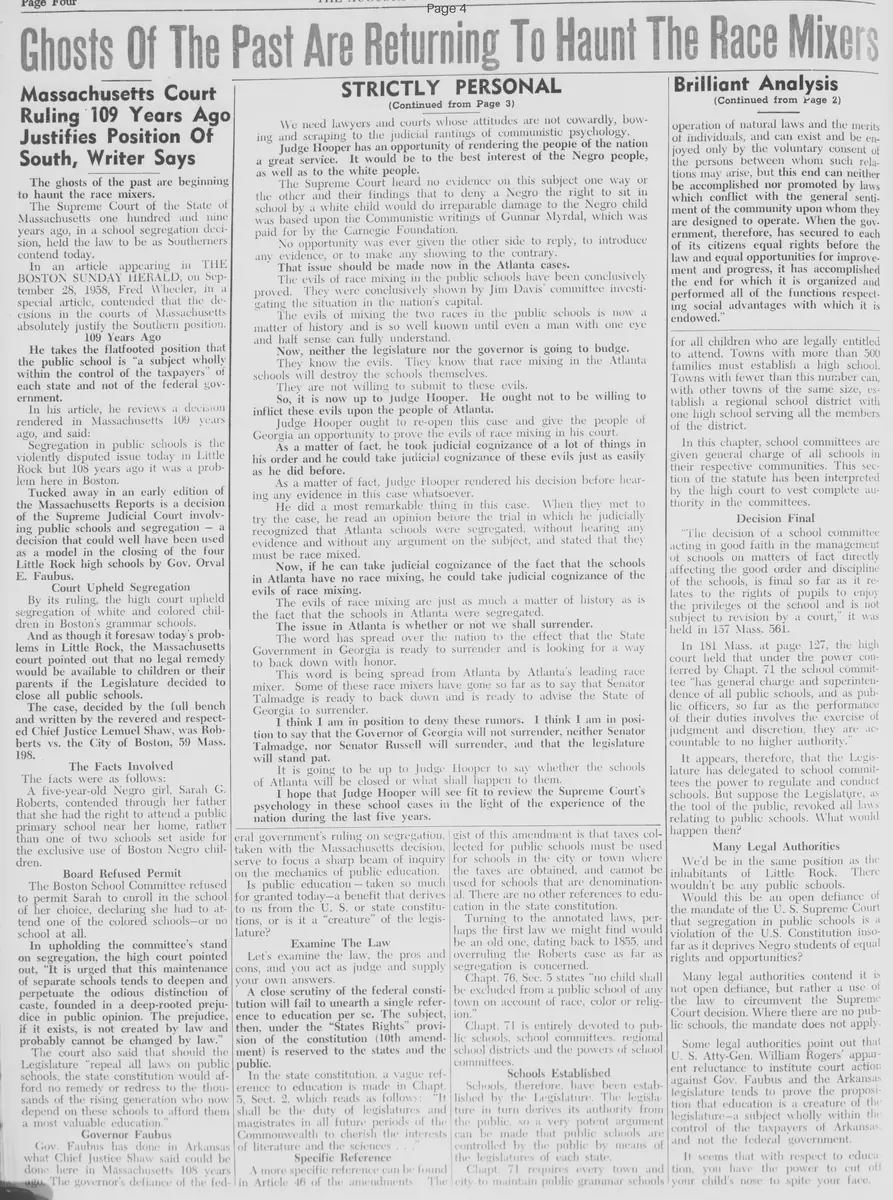
Massachusetts Court Ruling 109 Years Ago Justifies Position Of South, Writer Says
The ghosts of the past are beginning to haunt the race mixers.
The Supreme Court of the State of Massachusetts one hundred and nine years ago, in a school segregation decision, held the law to be as Southerners contend today.
In an article appearing in THE BOSTON SUNDAY HERALD, On September 28, 1958, Fred Wheeler, in a special article, contended that the decisions in the courts of Massachusetts absolutely justify the Southern position.
109 Years Ago
He takes the flatfooted position that the public school is "a subject wholly within the control of the taxpayers" of each state and not of the federal government.
In his article, he reviews a decision rendered in Massachusetts 109 years ago, and said:
Segregation in public schools is the violently disputed issue today in Little Rock but 108 years ago it was a problem here in Boston.
Tucked away in an early edition of the Massachusetts Reports is a decision of the Supreme Judicial Court involving public schools and segregation - a decision that could well have been used as a model in the closing of the four Little Rock high schools by Gov. Orval E. Faubus.
Court Upheld Segregation
By its ruling, the high court upheld segregation of white and colored children in Boston's grammar schools.
And as though it foresaw today's problems in Little Rock, the Massachusetts court pointed out that no legal remedy would be available to children or their parents if the Legislature decided to close all public schools.
The case, decided by the full bench and written by the revered and respected Chief Justice Lemuel Shaw, was Roberts vs. the City of Boston, 59 Mass. 198.
The Facts Involved
The facts were as follows:
A five-year-old Negro girl, Sarah G. Roberts, contended through her father that she had the right to attend a public primary school near her home, rather than one of two schools set aside for the exclusive use of Boston Negro children.
Board Refused Permit
The Boston School Committee refused to permit Sarah to enroll in the school of her choice, declaring she had to attend one of the colored schools-or no school at all.
In upholding the committee's stand on segregation, the high court pointed out, "It is urged that this maintenance of separate schools tends to deepen and perpetuate the odious distinction of caste, founded in a deep-rooted prejudice in public opinion. The prejudice, if it exists, is not created by law and probably cannot be changed by law."
The court also said that should the Legislature "repeal all laws on public schools, the state constitution would afford no remedy or redress to the thousands of the rising generation who now depend on these schools to afford them a most valuable education."
Governor Faubus
Gov. Faubus has done in Arkansas what Chief Justice Shaw said could be done here in Massachusetts 109 years ago. The governor's defiance of the federal government's ruling on segregation, taken with the Massachusetts decision, serve to focus a sharp beam of inquiry on the mechanics of public education.
Is public education - taken so much for granted today-a benefit that derives to us from the U. S. or state constitutions, or is it a creature of the legislature?
Examine The Law
Let's examine the law, the pros and cons, and you act as judge and supply your own answers.
A close scrutiny of the federal constitution will fail to unearth a single reference to education per se.
The subject, then, under the "States Rights provision of the constitution (10th amendment) is reserved to the states and the public.
In the state constitution, a vague reference to education is made in Chapt. 5, Sect. 2, which reads as follows:
"It shall be the duty of legislatures and magistrates in all future periods of the Commonwealth to cherish the interests of literature and the sciences ..
Specific Reference
A more specific reference can be found in Article 46 of the amendments The gist of this amendment is that taxes collected for public schools must be used for schools in the city or town where the taxes are obtained, and cannot be used for schools that are denominational. There are no other references to education in the state constitution.
Turning to the annotated laws, perhaps the first law we might find would be an old one, dating back to 1855, and overruling the Roberts case as far as segregation is concerned.
Chapt. 76, Sec. 5 states "no child shall be excluded from a public school of any town on account of race, color or religion."
Chapt. 71 is entirely devoted to public schools, school committees, regional school districts and the powers of school committees.
Schools Established
Schools, therefore, have been established by the Legislature. The legislature in turn derives its authority from the public, so a very potent argument can be made that public schools are controlled by the public by means of the legislatures of each state.
Chapt. 71 requires every town and city to maintain public grammar schools
What sub-type of article is it?
What themes does it cover?
What keywords are associated?
What entities or persons were involved?
Where did it happen?
Story Details
Key Persons
Location
Boston, Massachusetts; Little Rock, Arkansas
Event Date
109 Years Ago
Story Details
In 1849, the Massachusetts Supreme Court upheld segregation in Boston public schools in Roberts vs. City of Boston, denying five-year-old Sarah Roberts attendance at a white school; the ruling emphasized state control over education and noted legislatures could close schools without constitutional remedy, paralleling 1957 Little Rock events.