Thank you for visiting SNEWPapers!
Sign up free
Editorial
February 7, 1824
Richmond Enquirer
Richmond, Richmond County, Virginia
What is this article about?
An editorial mocks unofficial calculations of congressional votes for 1824 presidential candidates including Calhoun, Jackson, Clay, Crawford, and Adams, quoting a letter from Washington predicting Clay's likely victory, dismissing it as simplistic arithmetic.
Clipping
OCR Quality
95%
Excellent
Full Text
[Nat. Int.
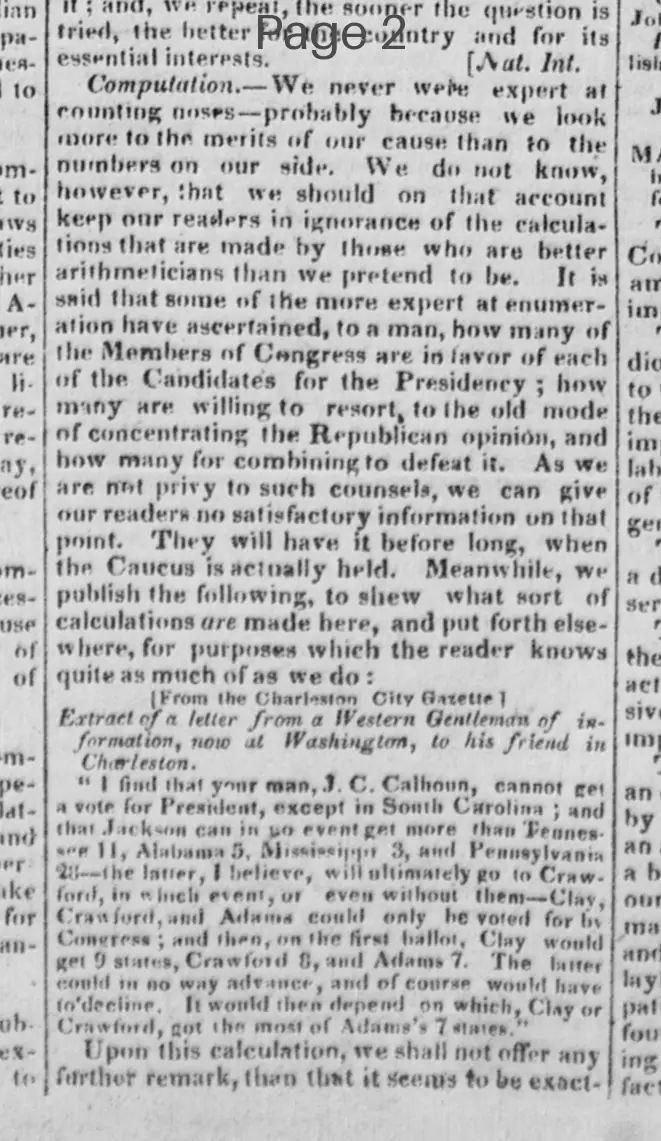
Computation.—We never were expert at counting noses—probably because we look more to the merits of our cause than to the numbers on our side. We do not know, however, that we should on that account keep our readers in ignorance of the calculations that are made by those who are better arithmeticians than we pretend to be. It is said that some of the more expert at enumeration have ascertained, to a man, how many of the Members of Congress are in favor of each of the Candidates for the Presidency; how many are willing to resort, to the old mode of concentrating the Republican opinion, and how many for combining to defeat it. As we are not privy to such counsels, we can give our readers no satisfactory information on that point. They will have it before long, when the Caucus is actually held. Meanwhile, we publish the following, to shew what sort of calculations are made here, and put forth elsewhere, for purposes which the reader knows quite as much of as we do:
[From the Charleston City Gazette]
Extract of a letter from a Western Gentleman of information, now at Washington, to his friend in Charleston.
“I find that your man, J. C. Calhoun, cannot get a vote for President, except in South Carolina; and that Jackson can in no event get more than Tennessee 11, Alabama 5, Mississippi 3, and Pennsylvania 28—the latter, I believe, will ultimately go to Crawford, in which event, or even without them—Clay, Crawford, and Adams could only be voted for by Congress; and then, on the first ballot, Clay would get 9 states, Crawford 8, and Adams 7. The latter could in no way advance, and of course would have to decline. It would then depend on which, Clay or Crawford, got the most of Adams’s 7 states.
Upon this calculation, we shall not offer any further remark, than that it seems to be exactly according to rule—for the writer, after having evidently begun with Enumeration, has gone through Addition, Subtraction, and Division, until he has fairly stated a Question in The Rule of Three, which, though we are no proficients in the science, we could work out for him, if we would.
Computation.—We never were expert at counting noses—probably because we look more to the merits of our cause than to the numbers on our side. We do not know, however, that we should on that account keep our readers in ignorance of the calculations that are made by those who are better arithmeticians than we pretend to be. It is said that some of the more expert at enumeration have ascertained, to a man, how many of the Members of Congress are in favor of each of the Candidates for the Presidency; how many are willing to resort, to the old mode of concentrating the Republican opinion, and how many for combining to defeat it. As we are not privy to such counsels, we can give our readers no satisfactory information on that point. They will have it before long, when the Caucus is actually held. Meanwhile, we publish the following, to shew what sort of calculations are made here, and put forth elsewhere, for purposes which the reader knows quite as much of as we do:
[From the Charleston City Gazette]
Extract of a letter from a Western Gentleman of information, now at Washington, to his friend in Charleston.
“I find that your man, J. C. Calhoun, cannot get a vote for President, except in South Carolina; and that Jackson can in no event get more than Tennessee 11, Alabama 5, Mississippi 3, and Pennsylvania 28—the latter, I believe, will ultimately go to Crawford, in which event, or even without them—Clay, Crawford, and Adams could only be voted for by Congress; and then, on the first ballot, Clay would get 9 states, Crawford 8, and Adams 7. The latter could in no way advance, and of course would have to decline. It would then depend on which, Clay or Crawford, got the most of Adams’s 7 states.
Upon this calculation, we shall not offer any further remark, than that it seems to be exactly according to rule—for the writer, after having evidently begun with Enumeration, has gone through Addition, Subtraction, and Division, until he has fairly stated a Question in The Rule of Three, which, though we are no proficients in the science, we could work out for him, if we would.
What sub-type of article is it?
Partisan Politics
What keywords are associated?
Presidential Election
1824 Candidates
Congressional Caucus
Vote Calculations
Party Combinations
What entities or persons were involved?
J. C. Calhoun
Jackson
Clay
Crawford
Adams
Members Of Congress
Editorial Details
Primary Topic
Calculations Of Congressional Support For 1824 Presidential Candidates
Stance / Tone
Satirical Mockery Of Election Predictions
Key Figures
J. C. Calhoun
Jackson
Clay
Crawford
Adams
Members Of Congress
Key Arguments
Calhoun Limited To South Carolina Vote
Jackson's Support Capped At Certain States
Pennsylvania Likely To Crawford
First Ballot: Clay 9 States, Crawford 8, Adams 7
Outcome Depends On Adams's States Shifting To Clay Or Crawford
Predictions Resemble Simplistic Math Problems