Thank you for visiting SNEWPapers!
Sign up free
Editorial
April 23, 1800
The Providence Journal, And Town And Country Advertiser
Providence, Providence County, Rhode Island
What is this article about?
Editorial from Gazette of the United States advocating political obedience to higher powers, using biblical prophecy from Esdras to decry the sedition, regicide, and anti-monarchy fervor of the French Revolution, contrasting it with ancient and biblical respect for authority.
Clipping
OCR Quality
95%
Excellent
Full Text
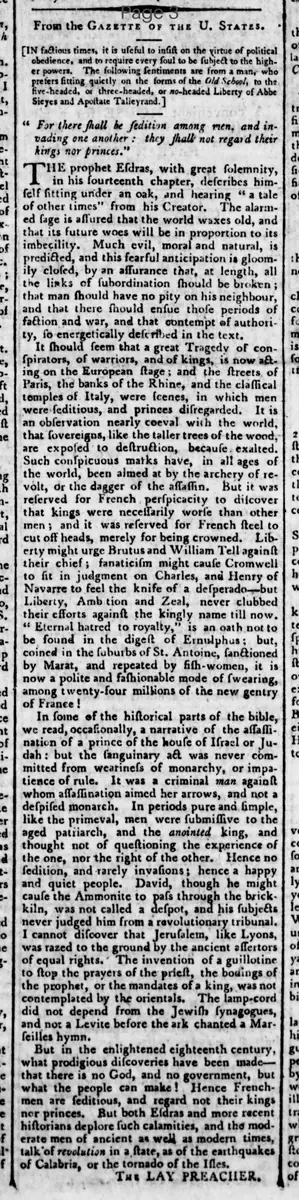
From the Gazette of the United States.
[IN factious times, it is useful to insist on the virtue of political obedience, and to require every soul to be subject to the higher powers. The following sentiments are from a man, who prefers sitting quietly on the forms of the Old School, to the five-headed, or three-headed, or no-headed Liberty of Abbe Sieyes and Apostate Talleyrand.]
"For there shall be sedition among men, and invading one another: they shall not regard their kings nor princes."
THE prophet Esdras in his fourteenth chapter, describes himself sitting under an oak, and hearing "a tale of other times" from his Creator. The alarmed sage is assured that the world waxes old, and that its future woes will be in proportion to its imbecility. Much evil, moral and natural, is predicted, and this fearful anticipation is gloomily closed, by an assurance that, at length, all the links of subordination should be broken; that man should have no pity on his neighbour, and that there should ensue those periods of faction and war, and that contempt of authority, so energetically described in the text.
It should seem that a great Tragedy of conspirators, of warriors, and of kings, is now acting on the European stage; and the streets of Paris, the banks of the Rhine, and the classical temples of Italy, were scenes, in which men were seditious, and princes disregarded. It is an observation nearly coeval with the world, that sovereigns, like the taller trees of the wood, are exposed to destruction, because exalted. Such conspicuous marks have, in all ages of the world, been aimed at by the archery of revolt, or the dagger of the assassin. But it was reserved for French perspicacity to discover that kings were necessarily worse than other men; and it was reserved for French steel to cut off heads, merely for being crowned. Liberty might urge Brutus and William Tell against their chiefs; fanaticism might cause Cromwell to sit in judgment on Charles, and Henry of Navarre to feel the knife of a desperado --but Liberty, Ambition and Zeal, never clubbed their efforts against the kingly name till now.
"Eternal hatred to royalty," is an oath not to be found in the digest of Ernulphus; but, coined in the suburbs of St. Antoine, sanctioned by Marat, and repeated by fish-women, it is now a polite and fashionable mode of swearing, among twenty-four millions of the new gentry of France!
In one of the historical parts of the bible, we read, occasionally, a narrative of the assassination of a prince of the house of Israel or Judah: but the sanguinary act was never committed from weariness of monarchy, or impatience of rule. It was a criminal man against whom assassination aimed her arrows, and not a despised monarch. In periods pure and simple, like the primeval, men were submissive to the aged patriarch, and the anointed king, and thought not of questioning the experience of the one, nor the right of the other. Hence no sedition, and rarely invasions; hence a happy and quiet people. David, though he might cause the Ammonite to pass through the brick-kiln, was not called a despot, and his subjects never judged him from a revolutionary tribunal.
I cannot discover that Jerusalem, like Lyons, was razed to the ground by the ancient assertors of equal rights. The invention of a guillotine to stop the prayers of the priest, the bodings of the prophet, or the mandates of a king, was not contemplated by the orientals. The lamp-cord did not depend from the Jewish synagogues, and not a Levite before the ark chanted a Marseilles hymn.
But in the enlightened eighteenth century, what prodigious discoveries have been made-- that there is no God, and no government, but what the people can make! Hence French-men are seditious, and regard not their kings nor princes. But both Esdras and more recent historians deplore such calamities, and the moderate men of ancient as well as modern times, talk of revolution in a state, as of the earthquakes of Calabria, or the tornado of the Isles.
THE LAY PREACHER.
[IN factious times, it is useful to insist on the virtue of political obedience, and to require every soul to be subject to the higher powers. The following sentiments are from a man, who prefers sitting quietly on the forms of the Old School, to the five-headed, or three-headed, or no-headed Liberty of Abbe Sieyes and Apostate Talleyrand.]
"For there shall be sedition among men, and invading one another: they shall not regard their kings nor princes."
THE prophet Esdras in his fourteenth chapter, describes himself sitting under an oak, and hearing "a tale of other times" from his Creator. The alarmed sage is assured that the world waxes old, and that its future woes will be in proportion to its imbecility. Much evil, moral and natural, is predicted, and this fearful anticipation is gloomily closed, by an assurance that, at length, all the links of subordination should be broken; that man should have no pity on his neighbour, and that there should ensue those periods of faction and war, and that contempt of authority, so energetically described in the text.
It should seem that a great Tragedy of conspirators, of warriors, and of kings, is now acting on the European stage; and the streets of Paris, the banks of the Rhine, and the classical temples of Italy, were scenes, in which men were seditious, and princes disregarded. It is an observation nearly coeval with the world, that sovereigns, like the taller trees of the wood, are exposed to destruction, because exalted. Such conspicuous marks have, in all ages of the world, been aimed at by the archery of revolt, or the dagger of the assassin. But it was reserved for French perspicacity to discover that kings were necessarily worse than other men; and it was reserved for French steel to cut off heads, merely for being crowned. Liberty might urge Brutus and William Tell against their chiefs; fanaticism might cause Cromwell to sit in judgment on Charles, and Henry of Navarre to feel the knife of a desperado --but Liberty, Ambition and Zeal, never clubbed their efforts against the kingly name till now.
"Eternal hatred to royalty," is an oath not to be found in the digest of Ernulphus; but, coined in the suburbs of St. Antoine, sanctioned by Marat, and repeated by fish-women, it is now a polite and fashionable mode of swearing, among twenty-four millions of the new gentry of France!
In one of the historical parts of the bible, we read, occasionally, a narrative of the assassination of a prince of the house of Israel or Judah: but the sanguinary act was never committed from weariness of monarchy, or impatience of rule. It was a criminal man against whom assassination aimed her arrows, and not a despised monarch. In periods pure and simple, like the primeval, men were submissive to the aged patriarch, and the anointed king, and thought not of questioning the experience of the one, nor the right of the other. Hence no sedition, and rarely invasions; hence a happy and quiet people. David, though he might cause the Ammonite to pass through the brick-kiln, was not called a despot, and his subjects never judged him from a revolutionary tribunal.
I cannot discover that Jerusalem, like Lyons, was razed to the ground by the ancient assertors of equal rights. The invention of a guillotine to stop the prayers of the priest, the bodings of the prophet, or the mandates of a king, was not contemplated by the orientals. The lamp-cord did not depend from the Jewish synagogues, and not a Levite before the ark chanted a Marseilles hymn.
But in the enlightened eighteenth century, what prodigious discoveries have been made-- that there is no God, and no government, but what the people can make! Hence French-men are seditious, and regard not their kings nor princes. But both Esdras and more recent historians deplore such calamities, and the moderate men of ancient as well as modern times, talk of revolution in a state, as of the earthquakes of Calabria, or the tornado of the Isles.
THE LAY PREACHER.
What sub-type of article is it?
Moral Or Religious
Foreign Affairs
Constitutional
What keywords are associated?
Political Obedience
French Revolution
Sedition
Monarchy
Biblical Prophecy
Regicide
Authority
What entities or persons were involved?
Prophet Esdras
Abbe Sieyes
Talleyrand
Marat
Brutus
William Tell
Cromwell
Charles
Henry Of Navarre
David
Editorial Details
Primary Topic
Defense Of Political Obedience Against French Revolutionary Sedition
Stance / Tone
Strongly Pro Authority And Anti Revolutionary
Key Figures
Prophet Esdras
Abbe Sieyes
Talleyrand
Marat
Brutus
William Tell
Cromwell
Charles
Henry Of Navarre
David
Key Arguments
Virtue Of Political Obedience To Higher Powers In Factious Times
Biblical Prophecy Foretells Sedition And Disregard For Kings
French Revolution Embodies Breaking Of Subordination Links
Regicide In France Targets Kings Merely For Being Crowned
Ancient And Biblical Eras Lacked Sedition Against Monarchy
Revolutions Are Calamitous Like Natural Disasters