Thank you for visiting SNEWPapers!
Sign up free
Letter to Editor
July 10, 1843
The Madisonian
Washington, District Of Columbia
What is this article about?
Extract from a letter by naturalist John James Audubon to Dr. Gideon B. Smith, dated May 24, 1843, describing his journey on the Missouri River: landscape changes, wildlife including buffaloes and new bird species, plants, geology, and challenging weather conditions.
Clipping
OCR Quality
98%
Excellent
Full Text
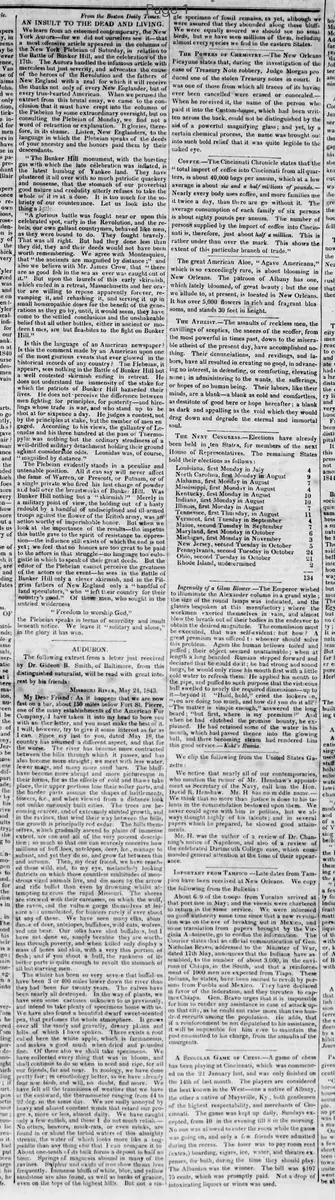
AUDUBON.
The following extract from a letter just received by Dr. Gideon B. Smith, of Baltimore, from this distinguished naturalist, will be read with great interest by his friends:
Missouri River, May 24, 1843.
My Dear Friend: As it happens that we are now fast on a bar, about 150 miles below Fort St. Pierre, one of the many establishments of the American Fur Company, I have taken it into my head to bore you with another letter, and you must make the best of it. I will, however, try to give it some interest as far as I can. Since my last to you, dated May 18, the country has assumed a different aspect, and that for the worse. The river has become more contracted between the hills through which it passes, and has also become more straight; we meet with less water, fewer snags, and many more sand bars. The bluffs have become more abrupt and more picturesque in their forms, for as the effects of cold and thaws take place, their upper portions lose their softer parts, and the harder parts assume the shapes of battlements, towers, &c., and when viewed from a distance look not unlike curiously built cities. The trees are becoming scarcer, and of extremely stunted growth, and in the ravines, that wind their way between the hills, the growth is principally red cedar. The hills themselves, which gradually ascend to plains of immense extent, are one and all of the very poorest description; so much so that one can scarcely conceive how millions of buffaloes, antelopes, deer, &c., manage to subsist, and yet they do so, and grow fat between this and autumn. Then, my dear friend, we have reached these wild, and, to my eye, melancholy looking districts on which those countless multitudes of monstrous sized animals live, and die more by the arrow and rifle bullet than even by drowning whilst attempting to cross the rapid Missouri. The shores are strewed with their carcasses, on which the wolf, the raven, and the vulture gorge themselves at leisure and unmolested, for hunters rarely if ever shoot at any of these. We have seen many elks, abundance of deer, antelopes, buffaloes, wild cats, wolves and one bear. Our folks have shot buffaloes, but I have not done so, simply because they are worthless through poverty, and when killed only display a mass of bones and skin, with a very thin portion of flesh; and if you shoot a bull, the rankness of its better parts is quite enough to revolt the stomach of all but starving men. The winter has been so very severe that buffaloes have been 3 or 400 miles lower down the river than they had been for twenty years. The calves have been nearly all destroyed. In the way of plants, we have seen some cactuses unknown to us previously, and intend to take plenty of specimens home with us. We have also found a beautiful dwarf sweet-scented pea, that perfumes the whole atmosphere. It grows over all the sandy and gravelly, dreary plains and hills of which I have spoken. There exists a root called here the white apple, which is farinaceous, and makes a good mush when dried and pounded fine. Of these also we shall take specimens. We have collected every thing that was in bloom, and shall continue to do so when in seed and ripe, for all our friends, far and near. In zoology, we have done pretty fair; in ornithology better, as we have already four new birds, and will, no doubt, find more. We have felt all the transitions of weather that we have at the eastward, the thermometer ranging from 44 to 92 deg. in the same day. We are sadly annoyed by heavy and almost constant winds that retard our progress, more or less, almost daily. We have caught only a few catfish, and these I do not much relish.—No otters, beavers, musk-rats, or even minks, are found in or about the turbid waters of this almighty stream, the water of which looks more like a hog-puddle than any thing else that I can compare it to. About one-tenth of its bulk forms a deposit in half an hour. Springs of magnesia abound in many of the ravines. "Sulphur and oxide of iron show themselves frequently. Immense bluffs of white, blue, and yellow sandstone are also found, as well as banks of granite, even on the tops of the highest hills. But not a single specimen of fossil remains, as yet, although we were assured that they abounded along these bluffs. We were equally assured we should see no small birds, but we have seen millions of them, including almost every species we find in the eastern States.
The following extract from a letter just received by Dr. Gideon B. Smith, of Baltimore, from this distinguished naturalist, will be read with great interest by his friends:
Missouri River, May 24, 1843.
My Dear Friend: As it happens that we are now fast on a bar, about 150 miles below Fort St. Pierre, one of the many establishments of the American Fur Company, I have taken it into my head to bore you with another letter, and you must make the best of it. I will, however, try to give it some interest as far as I can. Since my last to you, dated May 18, the country has assumed a different aspect, and that for the worse. The river has become more contracted between the hills through which it passes, and has also become more straight; we meet with less water, fewer snags, and many more sand bars. The bluffs have become more abrupt and more picturesque in their forms, for as the effects of cold and thaws take place, their upper portions lose their softer parts, and the harder parts assume the shapes of battlements, towers, &c., and when viewed from a distance look not unlike curiously built cities. The trees are becoming scarcer, and of extremely stunted growth, and in the ravines, that wind their way between the hills, the growth is principally red cedar. The hills themselves, which gradually ascend to plains of immense extent, are one and all of the very poorest description; so much so that one can scarcely conceive how millions of buffaloes, antelopes, deer, &c., manage to subsist, and yet they do so, and grow fat between this and autumn. Then, my dear friend, we have reached these wild, and, to my eye, melancholy looking districts on which those countless multitudes of monstrous sized animals live, and die more by the arrow and rifle bullet than even by drowning whilst attempting to cross the rapid Missouri. The shores are strewed with their carcasses, on which the wolf, the raven, and the vulture gorge themselves at leisure and unmolested, for hunters rarely if ever shoot at any of these. We have seen many elks, abundance of deer, antelopes, buffaloes, wild cats, wolves and one bear. Our folks have shot buffaloes, but I have not done so, simply because they are worthless through poverty, and when killed only display a mass of bones and skin, with a very thin portion of flesh; and if you shoot a bull, the rankness of its better parts is quite enough to revolt the stomach of all but starving men. The winter has been so very severe that buffaloes have been 3 or 400 miles lower down the river than they had been for twenty years. The calves have been nearly all destroyed. In the way of plants, we have seen some cactuses unknown to us previously, and intend to take plenty of specimens home with us. We have also found a beautiful dwarf sweet-scented pea, that perfumes the whole atmosphere. It grows over all the sandy and gravelly, dreary plains and hills of which I have spoken. There exists a root called here the white apple, which is farinaceous, and makes a good mush when dried and pounded fine. Of these also we shall take specimens. We have collected every thing that was in bloom, and shall continue to do so when in seed and ripe, for all our friends, far and near. In zoology, we have done pretty fair; in ornithology better, as we have already four new birds, and will, no doubt, find more. We have felt all the transitions of weather that we have at the eastward, the thermometer ranging from 44 to 92 deg. in the same day. We are sadly annoyed by heavy and almost constant winds that retard our progress, more or less, almost daily. We have caught only a few catfish, and these I do not much relish.—No otters, beavers, musk-rats, or even minks, are found in or about the turbid waters of this almighty stream, the water of which looks more like a hog-puddle than any thing else that I can compare it to. About one-tenth of its bulk forms a deposit in half an hour. Springs of magnesia abound in many of the ravines. "Sulphur and oxide of iron show themselves frequently. Immense bluffs of white, blue, and yellow sandstone are also found, as well as banks of granite, even on the tops of the highest hills. But not a single specimen of fossil remains, as yet, although we were assured that they abounded along these bluffs. We were equally assured we should see no small birds, but we have seen millions of them, including almost every species we find in the eastern States.
What sub-type of article is it?
Informative
Reflective
What themes does it cover?
Science Nature
What keywords are associated?
Missouri River
Audubon Expedition
Buffaloes
New Birds
Plants Specimens
Geology Bluffs
Wildlife Observations
What entities or persons were involved?
John James Audubon
Dr. Gideon B. Smith
Letter to Editor Details
Author
John James Audubon
Recipient
Dr. Gideon B. Smith
Main Argument
describes the challenging landscape, wildlife, plants, and geological features encountered on the missouri river expedition, noting discoveries of new species and the impacts of severe winter on animals.
Notable Details
Four New Birds Discovered
Severe Winter Displaced Buffaloes
Collected Plant Specimens Including Unknown Cactuses And White Apple Root
No Fossil Remains Found Despite Assurances
Thermometer Ranges From 44 To 92 Degrees In A Day