Thank you for visiting SNEWPapers!
Sign up free
Kentucky Gazette
Lexington, Fayette County, Kentucky
What is this article about?
In July 1815, U.S. Commissioners Decatur and Shaler negotiated and secured a peace treaty with the Dey of Algiers aboard the USS Guerriere, ending hostilities without tribute, securing restitution of captured property, and returning prisoners. The U.S. gifted back captured ships as a gesture.
Clipping
OCR Quality
Full Text
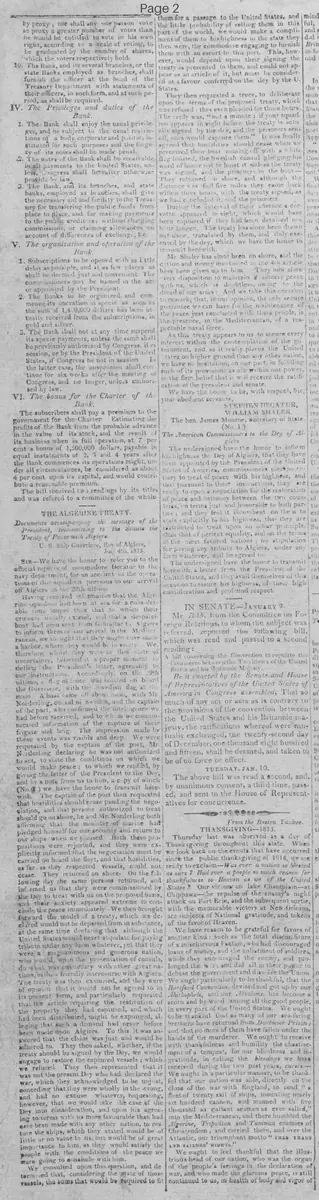
Documents accompanying the message of the President, transmitting to the Senate the Treaty of Peace with Algiers.
U. S. Ship Guerriere, Bay of Algiers, July 4th, 1815.
SIR—We have the honor to refer you to the official reports of commodore Decatur to the navy department, for an account of the operations of this squadron previous to our arrival off Algiers on the 28th ultimo.
Having received information that the Algerine squadron had been at sea for a considerable time longer than that to which their cruisers usually extend, and that a dispatch boat had been sent from Gibraltar to Algiers to inform them of our arrival in the Mediterranean, we thought that they might have made a harbor, where they would be in safety. We therefore whilst they were in this state of uncertainty, believed it a proper moment to deliver the President's letter, agreeably to our instructions. Accordingly, on the 9th ultimo, a flag of truce was hoisted on board the Guerriere. A boat came off about noon, with Mr. Norderling, consul of Sweden, and the captain of the port, who confirmed the intelligence we had before received, and to whom we communicated information of the capture of their frigate and brig. The impression made by these events was visible and deep. We were requested by the captain of the port, Mr. Norderling declaring he was not authorized to act, to state the conditions on which we would make peace; to which we replied, by giving the letter of the President to the Dey, and by a note from us to him, a copy of which (No. 1) we have the honor to transmit herewith. The captain of the port then requested that hostilities should cease pending the negotiation, and that persons authorized to treat should go on shore, he and Mr. Norderling both affirming that the minister of marine had pledged himself for our security and return to our ships when we pleased. Both these propositions were rejected, and they were explicitly informed that the negotiation must be carried on board the fleet, and that hostilities, as far as they respected vessels, could not cease. They returned on shore. On the following day the same persons returned, and informed us that they were commissioned by the Dey to treat with us on the proposed basis, and their anxiety appeared extreme to conclude the peace immediately. We then brought forward the model of a treaty, which we declared would not be departed from in substance, at the same time declaring that although the United States would never stipulate for paying tribute under any form whatever, yet that they were a magnanimous and generous nation, who would, upon the presentation of consuls, do what was customary with other great nations, in the friendly intercourse with Algiers. The treaty was then examined, and they were of opinion that it would not be agreed to in its present form, and particularly requested that the article requiring the restitution of the property they had captured, and which had been distributed, might be expunged, alleging that such a demand had never before been made upon Algiers. To this it was answered that the claim was just and would be adhered to. They then asked, whether, if the Dey would engage to restore the captured vessels; which treaty should be signed by the Dey, we would relinquish the demand for the property. To this we refused. They then represented that it was not the present Dey who had declared the war, which they acknowledged to be unjust, conceding that they were wholly in the wrong, and had no excuse whatever, requesting, however, that we would take the case of the Dey into consideration, and upon his agreeing to terms with us more favourable than had ever been made with any other nation, to restore the ships, which they stated would be of little or no value to us, but would be of great importance to him, as they would satisfy the people with the conditions of the peace we were going to conclude with him.
We consulted upon this question, and determined that, considering the state of those vessels, the sums that would be required to fit them for a passage to the United States, and the little probability of selling them in this part of the world, we would make a compliment of them to his highness in the state they then were, the commodore engaging to furnish them with an escort to this port. This, however, would depend upon their signing the treaty as presented to them, and could not appear as an article of it, but must be considered as a favour conferred on the dey by the U. States.
They then requested a truce, to deliberate upon the terms of the proposed treaty, which was refused: they even pleaded for three hours. The reply was, "not a minute; if your squadron appears in sight before the treaty is actually signed by the dey, and the prisoners sent off, ours would capture them." It was finally agreed that hostilities should cease when we perceived their boat coming off with a white flag hoisted, the Swedish consul pledging his word of honor not to hoist it unless the treaty was signed, and the prisoners in the boat—
They returned on shore, and although the distance was full five miles they came back within three hours, with the treaty signed, as we had concluded it, and the prisoners. During the interval of their absence a corvette appeared in sight, which would have been captured if they had been detained one hour longer. The treaty has since been drawn out anew, translated by them, and duly executed by the dey, which we have the honor to transmit herewith.
Mr. Shaler has since been on shore, and the cotton and money mentioned in the 4th article have been given up to him. They now show every disposition to maintain a sincere peace with us, which is doubtless, owing to the dread of our arms: And we take this occasion to remark, that, in our opinion, the only secure guarantee we can have for the maintenance of the peace just concluded with these people, is the presence, in the Mediterranean, of a respectable naval force.
As this treaty appears to us to secure every interest within the contemplation of the government, and as it really places the United States on higher ground than any other nation, we have no hesitation, on our part in fulfilling such of its provisions as are within our power, in the firm belief that it will receive the ratification of the president and senate.
We have the honor to be, with respect, Sir, your obedient servants,
STEPHEN DECATUR,
WILLIAM SHALER
The hon. James Monroe, Secretary of State.
(No. 1)
The American Commissioners to the Dey of Algiers.
The undersigned have the honor to inform his highness the Dey of Algiers, that they have been appointed by the President of the United States of America, commissioners plenipotentiary to treat of peace with his highness, and that pursuant to their instructions, they are ready to open a negotiation for the restoration of peace and harmony between the two countries, on terms just and honorable to both parties; and they feel it incumbent on them to state explicitly to his highness, that they are instructed to treat upon no other principle than that of perfect equality, and on the terms of the most favored nations: no stipulation for paying any tribute to Algiers, under any form whatever, will be agreed to.
The undersigned have the honor to transmit herewith, a letter from the President of the United States, and they avail themselves of this occasion to assure his highness, of their high consideration and profound respect.
What sub-type of article is it?
What keywords are associated?
What entities or persons were involved?
Where did it happen?
Foreign News Details
Primary Location
Bay Of Algiers
Event Date
July 4th, 1815
Key Persons
Outcome
treaty signed without tribute payment; restitution of captured property including cotton and money; return of american prisoners; u.s. gifts captured ships back to dey; hostilities ceased.
Event Details
U.S. squadron under Commodore Decatur arrived off Algiers on June 28, 1815. On June 9, commissioners delivered President's letter and note insisting on equality and no tribute. Negotiations aboard USS Guerriere rejected Algerian requests for truce and property restitution waiver. Algerians conceded war's injustice; treaty signed June 10 with prisoners returned. Formal execution followed; peace maintained via naval presence.