Thank you for visiting SNEWPapers!
Sign up free
Poem
May 18, 1802
Alexandria Advertiser And Commercial Intelligencer
Alexandria, Virginia
What is this article about?
A poem addressed to young Lucy, celebrating her natural beauty superior to May's, while reminding her of mortality and urging devotion to religion for spiritual preparation and salvation.
Clipping
OCR Quality
98%
Excellent
Full Text
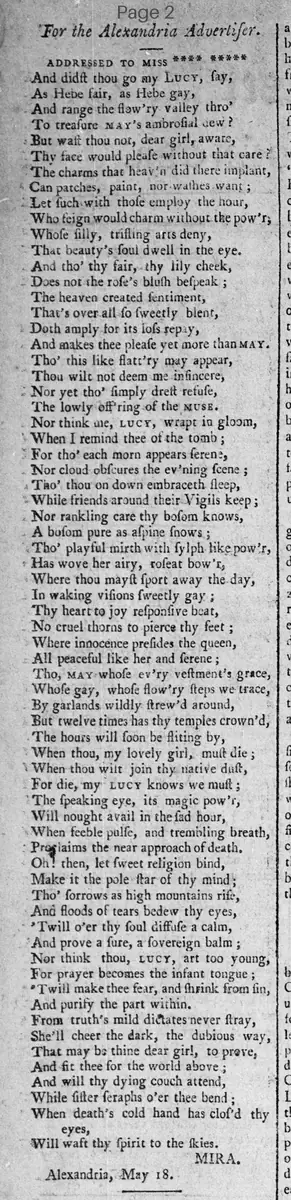
For the Alexandria Advertiser
ADDRESSED TO MISS **** ******
And didst thou go my Lucy, ay,
As Hebe fair, as Hebe gay,
And range the flow'ry valley thro'
To treasure May's ambrosial dew?
But wast thou not, dear girl, aware,
Thy face would please without that care?
The charms that heav'n did there implant,
No patches, paint, nor washes want:
Let such with those employ the hour,
Who feign would charm without the pow'r;
Whose silly, trifling arts deny,
That beauty's soul dwell in the eye.
And tho' thy fair, thy lily cheek,
Does not the rose's blush bespeak;
The heaven created sentiment,
That's over all so sweetly blent,
Doth amply for its loss repay,
And makes thee please yet more than May.
Tho' this like flattery may appear,
Thou wilt not deem me insincere,
Nor yet tho' simply drest refuse,
The lowly offering of the Muse.
Nor think me, Lucy, wrapt in gloom,
When I remind thee of the tomb:
For tho' each morn appears serene,
Nor cloud obscures the ev'ning scene;
Tho' thou on down embraceth sleep,
While friends around their Vigils keep;
Nor rankling care thy bosom knows,
A bosom pure as alpine snows.
Tho' playful mirth with sylph like pow'r,
Has wove her airy, roseate bow'r,
Where thou mayst sport away the day,
In waking visions sweetly gay;
Thy heart to joy responsive beat,
No cruel thorns to pierce thy feet;
Where innocence presides the queen,
All peaceful like her and serene;
Tho', May whose ev'ry vestment's grace,
Whose gay, whose flow'ry steps we trace,
By garlands, wildly strew'd around,
But twelve times has thy temples crown'd,
The hours will soon be flitting by.
When thou, my lovely girl, must die;
When thou wilt join thy native dust,
For die, my Lucy knows we must;
The speaking eye, its magic pow'r,
Will nought avail in the last hour,
When feeble pulse, and trembling breath,
Proclaims the near approach of death.
Oh! then, let sweet religion bind,
Make it the pole star of thy mind;
Tho' sorrows as high mountains rise,
And floods of tears bedew thy eyes,
'Twill o'er thy soul diffuse a calm,
And prove a sure, a sovereign balm;
Nor think thou, Lucy, art too young,
For prayer becomes the infant tongue;
Twill make thee fear, and shrink from sin,
And purify the heart within.
From truth's mild dictates never stray,
She'll cheer the dark, the dubious way,
That may be thine dear girl!, to prove,
And fit thee for the world above;
And will thy dying couch attend,
While sister seraphs o'er thee bend:
When death's cold hand has closed thy eyes,
Will waft thy spirit to the skies.
MIRA.
Alexandria, May 18.
ADDRESSED TO MISS **** ******
And didst thou go my Lucy, ay,
As Hebe fair, as Hebe gay,
And range the flow'ry valley thro'
To treasure May's ambrosial dew?
But wast thou not, dear girl, aware,
Thy face would please without that care?
The charms that heav'n did there implant,
No patches, paint, nor washes want:
Let such with those employ the hour,
Who feign would charm without the pow'r;
Whose silly, trifling arts deny,
That beauty's soul dwell in the eye.
And tho' thy fair, thy lily cheek,
Does not the rose's blush bespeak;
The heaven created sentiment,
That's over all so sweetly blent,
Doth amply for its loss repay,
And makes thee please yet more than May.
Tho' this like flattery may appear,
Thou wilt not deem me insincere,
Nor yet tho' simply drest refuse,
The lowly offering of the Muse.
Nor think me, Lucy, wrapt in gloom,
When I remind thee of the tomb:
For tho' each morn appears serene,
Nor cloud obscures the ev'ning scene;
Tho' thou on down embraceth sleep,
While friends around their Vigils keep;
Nor rankling care thy bosom knows,
A bosom pure as alpine snows.
Tho' playful mirth with sylph like pow'r,
Has wove her airy, roseate bow'r,
Where thou mayst sport away the day,
In waking visions sweetly gay;
Thy heart to joy responsive beat,
No cruel thorns to pierce thy feet;
Where innocence presides the queen,
All peaceful like her and serene;
Tho', May whose ev'ry vestment's grace,
Whose gay, whose flow'ry steps we trace,
By garlands, wildly strew'd around,
But twelve times has thy temples crown'd,
The hours will soon be flitting by.
When thou, my lovely girl, must die;
When thou wilt join thy native dust,
For die, my Lucy knows we must;
The speaking eye, its magic pow'r,
Will nought avail in the last hour,
When feeble pulse, and trembling breath,
Proclaims the near approach of death.
Oh! then, let sweet religion bind,
Make it the pole star of thy mind;
Tho' sorrows as high mountains rise,
And floods of tears bedew thy eyes,
'Twill o'er thy soul diffuse a calm,
And prove a sure, a sovereign balm;
Nor think thou, Lucy, art too young,
For prayer becomes the infant tongue;
Twill make thee fear, and shrink from sin,
And purify the heart within.
From truth's mild dictates never stray,
She'll cheer the dark, the dubious way,
That may be thine dear girl!, to prove,
And fit thee for the world above;
And will thy dying couch attend,
While sister seraphs o'er thee bend:
When death's cold hand has closed thy eyes,
Will waft thy spirit to the skies.
MIRA.
Alexandria, May 18.
What sub-type of article is it?
Verse Letter
Ode
What themes does it cover?
Love Courtship
Death Mourning
Religious Faith
What keywords are associated?
Lucy
Beauty
Death
Religion
Mira
Alexandria
Mortality
Faith
What entities or persons were involved?
Mira.
Poem Details
Title
Addressed To Miss **** ******
Author
Mira.
Subject
To Lucy On Her Beauty And Mortality
Form / Style
Rhymed Couplets
Key Lines
And Didst Thou Go My Lucy, Ay, / As Hebe Fair, As Hebe Gay, / And Range The Flow'ry Valley Thro' / To Treasure May's Ambrosial Dew?
For Die, My Lucy Knows We Must; / The Speaking Eye, Its Magic Pow'r, / Will Nought Avail In The Last Hour,
Oh! Then, Let Sweet Religion Bind, / Make It The Pole Star Of Thy Mind; / ... / Will Waft Thy Spirit To The Skies.