Thank you for visiting SNEWPapers!
Sign up free
The Rhode Island American, And General Advertiser
Providence, Providence County, Rhode Island
What is this article about?
Commentary from Connecticut and Massachusetts newspapers on the 1824 presidential race, predicting party realignments, defending candidates' Federalist pasts, urging support for Calhoun over Crawford if Adams falters, and analyzing New York's anti-Crawford vote. Emphasizes principles over partisanship.
Merged-components note: Series of related articles and commentary on the presidential election and party dynamics.
Clipping
OCR Quality
Full Text
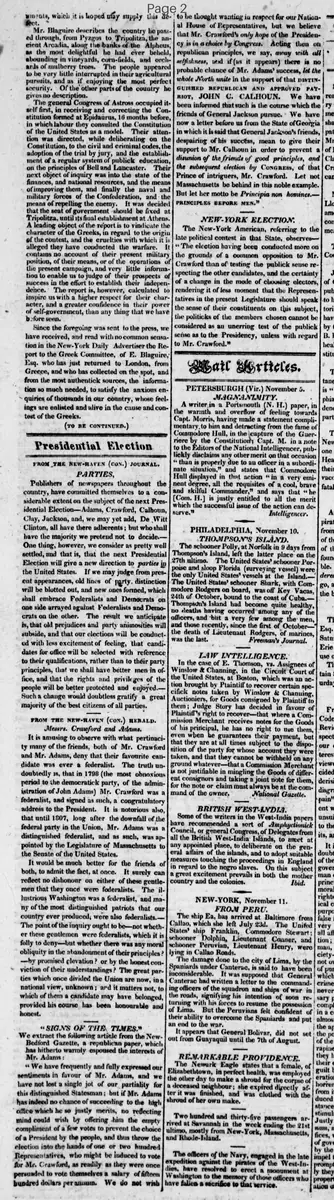
FROM THE NEW-HAVEN (CON.) JOURNAL,
PARTIES,
Publishers of newspapers throughout the country, have committed themselves to a considerable extent on the subject of the next Presidential Election—Adams, Crawford, Calhoun, Clay, Jackson, and, we may yet add, De Witt Clinton, all have their adherents; but who shall have the majority we pretend not to decide.
One thing, however, we consider as pretty well settled, and that is, that the next Presidential Election will give a new direction to parties in the United States. If we may judge from present appearances, old lines of party distinction will be blotted out, and new ones formed, which shall embrace Federalists and Democrats on one side arrayed against Federalists and Democrats on the other. The result we anticipate is, that old prejudices and party animosities will subside, and that our elections will be conducted with less excitement of feeling, that candidates for office will be selected with reference to their qualifications, rather than to their party principles, that we shall have better men in office, and that the rights and privileges of the people will be better protected and enjoyed.
Such a change would doubtless gratify a great majority of the best citizens of all parties.
FROM THE NEW-HAVEN (CON.) HERALD.
Messrs. Crawford and Adams.
It is amusing to observe with what pertinacity many of the friends, both of Mr. Crawford and Mr. Adams, deny that their favourite candidate was ever a federalist. The truth undoubtedly is, that in 1798 (the most obnoxious period to the democratick party, of the administration of John Adams) Mr. Crawford was a federalist, and signed as such, a congratulatory address to the President. It is notorious also, that until 1807, long after the downfall of the federal party in the Union, Mr. Adams was a distinguished federalist, and as such, was appointed by the Legislature of Massachusetts to the Senate of the United States.
It would be much better for the friends of both, to admit the fact, at once. It surely can reflect no dishonour on either of these gentlemen that they once were federalists. The illustrious Washington was a federalist, and many of the most distinguished patriots that our country ever produced, were also federalists.
The point of the inquiry ought to be—not whether these gentlemen were federalists, which it is folly to deny—but whether there was any moral obliquity in the abandonment of their principles? —by promised elevation? or by the honest conviction of their understandings? The great parties which once divided the Union are now, in a national view, unknown; and it matters not, to which of them a candidate may have belonged, provided his course has been honourable and honest.
"SIGNS OF THE TIMES."
We extract the following article from the New-Bedford Gazette, a republican paper, which has hitherto warmly espoused the interests of Mr. Adams:
"We have frequently and fully expressed our sentiments in favour of Mr. Adams, and we have not lost a single jot of our partiality for this distinguished Statesman; but if Mr. Adams has indeed no chance of succeeding to the high office which he so justly merits, no reflecting mind could wish by offering him the empty compliment of a few votes to prevent the choice of a President by the people, and thus throw the election into the hands of one or two hundred Representatives, who might be induced to vote for Mr. Crawford, as readily as they were once persuaded to vote themselves a salary of fifteen hundred dollars per annum. We do not wish to be thought wanting in respect for our National House of Representatives, but we believe that Mr. Crawford's only hope of the Presidency is in a choice by Congress. Acting then on republican principles, we say, away with all selfishness, and if (as it appears) there is no probable chance of Mr. Adams' success, let the whole North unite in the support of that distinguished Republican and approved Patriot, JOHN C. CALHOUN. We have been informed that such is the course which the friends of General Jackson pursue. We have now a letter before us from the State of Georgia in which it is said that General Jackson's friends, despairing of his success, mean to give their support to Mr. Calhoun in order to prevent a disunion of the friends of good principles, and the subsequent election by Congress, of that Prince of intriguers, Mr. Crawford. Let not Massachusetts be behind in this noble example. But let her motto be Principia non homines.— PRINCIPLES BEFORE MEN."
NEW-YORK ELECTION.
The New-York American, referring to the late political contest in that State, observes—
"The election having been conducted more on the grounds of a common opposition to Mr. Crawford than of testing the publick sense respecting the other candidates, and the certainty of a change in the mode of choosing electors, rendering it of less moment that the Representatives in the present Legislature should speak the sense of their constituents on this subject, the politicks of the members chosen cannot be considered as an unerring test of the publick sense as to the Presidency, unless with regard to Mr. Crawford."
What sub-type of article is it?
What keywords are associated?
What entities or persons were involved?
Where did it happen?
Domestic News Details
Primary Location
New Haven, Connecticut
Key Persons
Event Details
Excerpts from New-Haven Journal and Herald discuss shifting party lines in the upcoming presidential election, former Federalist affiliations of Crawford and Adams, and the importance of principles over past party loyalty. New-Bedford Gazette suggests supporting Calhoun if Adams cannot win to avoid congressional election of Crawford. New-York American notes the state election opposed Crawford but does not fully test public sentiment on other candidates.