Thank you for visiting SNEWPapers!
Sign up free
Norfolk Gazette And Publick Ledger
Norfolk, Virginia
What is this article about?
Commodore John Rodgers reports on his five-month cruise aboard USS President, departing Boston in April 1813, pursuing British commerce across the North Atlantic, making several captures, avoiding superior enemy forces, enduring shortages, and returning to Newport on September 27 with 271 prisoners paroled.
Clipping
OCR Quality
Full Text
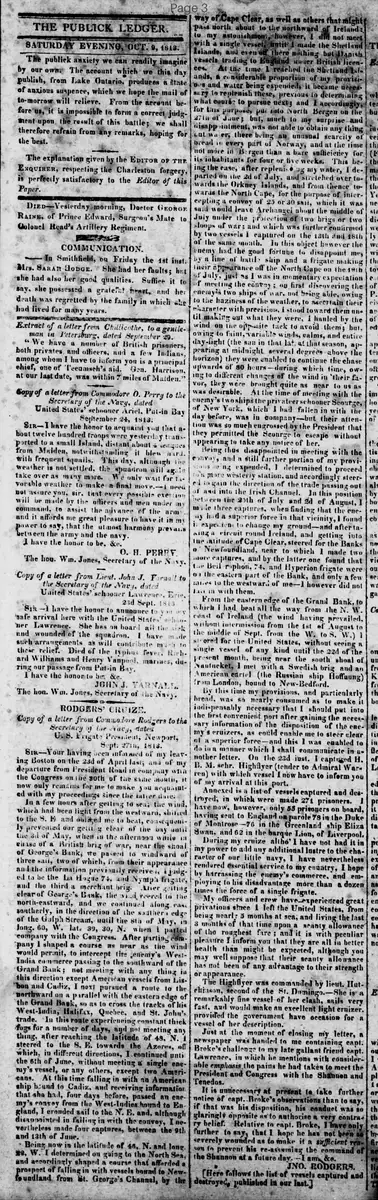
Copy of a letter from Commodore Rodgers to the Secretary of the Navy, dated U. S. Frigate President, Newport. Sept. 27th, 1813.
Sir—Your having been informed of my leaving Boston on the 23d of April last; and of my departure from President Road in company with the Congress on the 30th of the same month, it now only remains for me to make you acquainted with my proceedings since the latter date:
In a few hours after getting to sea; the wind, which had been light from the westward, shifted to the S. E. and obliged me to beat, consequently prevented our getting clear of the bay until the 3d of May, when in the afternoon while in chase of a British brig of war, near the shoal of George's Bank; we passed to windward of three sail, two of which, from their appearance and the information previously received, judged to be the La Hogue 74, and Nymph frigate, and the third a merchant brig: there getting clear of George's Bank, the wind veered to the north-eastward, and we continued along east southerly, in the direction of the southern edge of the Gulph Stream,—until the 5th of May, in long. 60, W. lat. 39, 30, N. when I parted company with the Congress. After parting company I shaped a course as near as the wind would permit, to intercept the enemy's West-India commerce passing to the southward of the Grand Bank; not meeting with any thing in this direction except American vessels from Lisbon and Cadiz, I next pursued a route to the northward on a parallel with the eastern edge of the Grand Bank, so as to cross the tracks of his West-India, Halifax, Quebec, and St. John's trade. In this route experiencing constant thick fogs for a number of days, and not meeting any thing, after reaching the latitude of 45. N. I steered to the S. E. towards the Azores, off which, in different directions, I continued until the 6th of June, without meeting a single enemy's vessel, or any others, except two Americans. At this time falling in with an American ship bound to Cadiz, and receiving information that she had, two days before, passed an enemy's convoy from the West-Indies bound to England, I crowded sail to the N. E. and, although disappointed in falling in with the convoy, I nevertheless made four captures, between the 6th and 13th of June.
Being now in the latitude of 40,. N. and long. 39. W. I determined on going to the North Sea, and accordingly shaped a course that afforded a prospect of falling in with vessels bound to Newfoundland: from St. George's Channel, way of Cape Clear, as well as others that might pass north about to the northward of Ireland: to my astonishment however, I did not meet with a single vessel until I made the Shetland Islands, and even not there nothing but Danish vessels trading to England under British licenses. At the time I reached the Shetland Islands, a considerable proportion of my provisions and water being expended it became necessary to replenish these, previous to determining what course to pursue next; and I accordingly, for this purpose, put into North Bergen on the 27th of June; but, much to my surprise—and disappointment, was not able to obtain any thing but water; there being an unusual scarcity of bread in every part of Norway, and at the time not more in Bergen than a bare sufficiency for its inhabitants for four or five weeks. This being the case, after replenishing my water, I departed on the 2d of July, and stretched over towards the Orkney Islands, and from thence towards the North Cape, for the purpose of intercepting a convoy of 25 or 30 sail, which it was said would leave Archangel about the middle of July under the protection of two brigs or two sloops of war; and which was further confirmed by two vessels I captured on the 13th and 18th of the same month. In this object however the enemy had the good fortune to disappoint me by a line of battle ship and a frigate making their appearance off the North Cape on the 10th of July, just as I was in momentary expectation of meeting the convoy: on first discovering the enemy's two ships of war, not being able, owing to the haziness of the weather, to ascertain their character with precision, I stood toward them until making out what they were, I hauled by the wind on the opposite tack to avoid them; but, owing to faint, variable winds, calms, and entire day-light (the sun in that lat. at that season, appearing at midnight several degrees above the horizon) they were enabled to continue the chase upwards of 50 hours—during which time, owing to different changes of the wind in their favor, they were brought quite as near to us as was desirable. At the time of meeting with the enemy's two ships the privateer schooner Scourge, of New York, which I had fallen in with the day before, was in company—but their attention was so much engrossed by the President that they permitted the Scourge to escape without appearing to take any notice of her.
Being thus disappointed in meeting with the convoy, and a still farther portion of my provisions now being expended, I determined to proceed to a more westerly station, and accordingly steered to gain the direction of the trade passing out of and into the Irish Channel. In this position between the 20th of July and 2d of August, I made three captures, when finding that the enemy had a superior force in that vicinity, I found it expedient to change my ground—and after taking a circuit round Ireland, and getting into the latitude of Cape Clear, steered for the Banks of Newfoundland, near to which I made two more captures, and by the latter one found that the Belle Poule, 74. and Hyperion frigate were on the eastern part of the Bank, and only a few miles to the westward of me—I however did not fall in with them.
From the eastern edge of the Grand Bank, to which I had beat all the way from the N. W. coast of Ireland (the wind having prevailed, without intermission from the 1st of August to the middle of Sept. from the W. to S. W.) I steered for the United States, without seeing a single vessel of any kind until the 22d of the present month, being near the south shoal of Nantucket, I met with a Swedish brig and an American cartel (the Russian ship Hoffnung) from London, bound to New-Bedford.
By this time my provisions, and particularly bread, was so nearly consumed as to make it indispensably necessary that I should put into the first convenient port after gaining the necessary information of the disposition of the enemy's cruisers, as could enable me to steer clear at a superior force—and this I was enabled to do in a manner which I shall communicate in another letter. On the 23d inst. I captured H. B. M. schr. Highflyer (tender to Admiral Warren) with which vessel I now have to inform you of my arrival at this port.
Annexed is a list of vessels captured and destroyed; in which were made 271 prisoners. I have now, however, only 55 prisoners on board, having sent to England on parole 78 in the Duke of Montrose—70 in the Greenland ship Eliza Swan, and 62 in the barque Lion, of Liverpool.
During my cruize altho' I have not had it in my power to add any additional lustre to the character of our little navy, I have nevertheless rendered essential service to my country, I hope by harrassing the enemy's commerce, and employing to his disadvantage more than a dozen times the force of a single frigate.
My officers and crew have experienced great privations since I left the United States, from being nearly 5 months at sea; and living the last 3 months of that time upon a scanty allowance of the roughest fare; and it is with peculiar pleasure I inform you that they are all in better health than might be expected, although you may well suppose that their scanty allowance has not been of any advantage to their strength or appearance.
The Highflyer was commanded by lieut. Hutchinson, second of the St. Domingo.—She is a remarkably fine vessel—of her class, sails very fast, and would make an excellent light cruizer, provided the government have occasion for a vessel of her description.
Just at the moment of closing my letter, a newspaper was handed to me containing capt. Broke's challenge to my late gallant friend capt. Lawrence, in which he mentions with considerable emphasis the pains he had taken to meet the President and Congress with the Shannon and Tenedos.
It is unnecessary at present to take further notice of capt. Broke's observations than to say, if that was his disposition, his conduct was so glaringly opposite as to authorise a very contrary belief: Relative to capt. Broke, I have only further to say, that I hope he has not been so severely wounded as to make it a sufficient reason to prevent his re-assuming the command of the Shannon at a future day.—I am &c.
JNO. RODGERS.
Here follows the list of vessels captured and destroyed published in our last.
What sub-type of article is it?
What themes does it cover?
What keywords are associated?
What entities or persons were involved?
Where did it happen?
Story Details
Key Persons
Location
North Atlantic, From Boston To Newport Via George's Bank, Gulf Stream, Azores, Shetland Islands, North Bergen, Orkney Islands, North Cape, Irish Channel, Banks Of Newfoundland, Nantucket
Event Date
April 23, 1813 To September 27, 1813
Story Details
Commodore Rodgers details his cruise on USS President, departing Boston April 30, 1813, separating from Congress May 5, pursuing British commerce routes, making nine captures between June and August, avoiding enemy warships including a chase off North Cape July 10, enduring provision shortages, paroling 271 prisoners, and capturing HMS Highflyer before arriving Newport September 27.