Thank you for visiting SNEWPapers!
Sign up free
Letter to Editor
February 9, 1799
Gazette Of The United States, & Philadelphia Daily Advertiser
Philadelphia, Philadelphia County, Pennsylvania
What is this article about?
A remote subscriber writes to Mr. Fenno criticizing George Logan's unofficial diplomatic mission to France in 1798, arguing it usurps national authority, questions obligations to the post-revolutionary French regime, and satirically doubts its impact on Franco-American relations.
Clipping
OCR Quality
88%
Good
Full Text
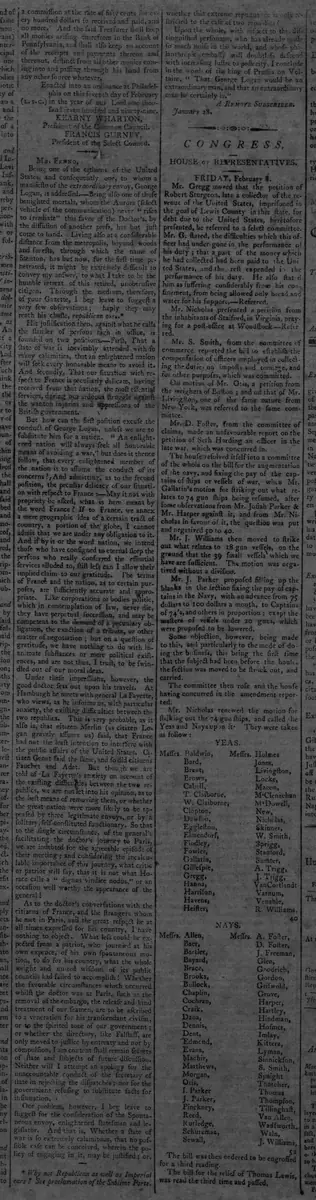
Mr. FENNO,
Being one of the citizens of the United States, and consequently one, to whom a manifesto of the extraordinary envoy, George Logan, is addressed. Being also one of those benighted mortals, whom the Aurora (elect vehicle of the communication) never "rises to irradiate" this favor of the Doctor's, by the diffusion of another press, has but just come to hand. Living also at a considerable distance from the metropolis, beyond woods and forests, through which the name of Stenton, has but now, for the first time penetrated, it might be extremely difficult to convey my answer, to what I take to be the humble retreat of this retired, unobtrusive citizen. Through the medium, therefore, of your Gazette, I beg leave to suggest a very few observations; haply they may reach his chaste, republican ears.*
His justification then, against what he calls the slander of persons high in office, is founded on two positions. First, That a state of war is inevitably attended with so many calamities, that an enlightened nation will seek every honorable means to avoid it. And secondly. That our situation with respect to France is peculiarly delicate, having received from that nation, the most essential services, during our arduous struggle against the wanton injuries and oppressions of the British government.
But how can the first position excuse the conduct of George Logan, unless we are to substitute him for a nation. "An enlightened nation will always seek all honorable means of avoiding a war," but does it thence follow, that every enlightened member of the nation is to assume the conduct of its concerns? And admitting, as to the second position, the peculiar delicacy of our situation with respect to France: May it not with propriety be asked, what is here meant by the word France? If to France, we annex a mere geographic idea of a certain tract of country, a portion of the globe, I cannot admit that we are under any obligation to it. And if by it or the word nation, we intend those who have consigned to eternal sleep the persons who really conferred the essential services alluded to, till less can I allow their implied claim to our gratitude. The terms of France and the nation, as to certain purposes, are sufficiently accurate and appropriate. Like corporations or bodies politic, which in contemplation of law, never die, they have perpetual succession, and may be competent to the demand of a pecuniary obligation, the exaction of a tribute, or other matter of negotiation; but on a question of gratitude, we have nothing to do with inanimate substances or mere political existences, and are not thus, I trust, to be windled out of our moral ideas.
Under these impressions, however, the good doctor sets out upon his travels. At Hamburgh he meets with general La Fayette, who views, as he informs us, with particular anxiety, the existing difficulties between the two republics. This is very probable, as it also is, that citizen Merlin (as citizen Logan gravely assures us) said, that France had not the least intention to interfere with the public affairs of the United States. Citizen Genet said the same, and so did citizens Fauchet and Adet. But though we are told of La Fayette's anxiety on account of the existing difficulties between the two republics, we are not let into his opinion, as to the best means of removing them, or whether the great nation were more likely to be appeased by three legitimate envoys, or by a solitary, self-constituted functionary. So that to the single circumstance, of the general's facilitating the doctor's journey to Paris, we are indebted for the agreeable episode of their meeting; and considering the incalculable importance of this journey, what critic or patriot will say, that it is not what Horace calls a "dignus vindice nodus," or an occasion well worthy the appearance of the general!
As to the doctor's conversations with the citizens of France, and the strangers whom he met in Paris, and the great respect he at all times expressed for his country, I have nothing to object. What less could be expected from a patriot, who journeyed at his own expense, of his own spontaneous motion, to do for his country, what the whole weight and united wisdom of its public councils had failed to accomplish! Whether the favorable circumstances which occurred whilst the doctor was at Paris, such as the removal of the embargo, the release and kind treatment of our seamen, are to be ascribed to a veneration for his transcendent civism, or to the spirited tone of our government; or whether the directory, like Falstaff, are only moved to justice by entreaty and not by compulsion, I am content shall remain secrets of state and subjects of future discussion.
Neither will I attempt an apology for the unaccountable conduct of the secretary of state in rejecting the dispatches; nor for the government refusing to substitute facts for insinuation.
One problem, however, I beg leave to suggest for the consideration of the Spontaneous envoy, enlightened statesman and legislator. And that is, Whether a state of war is so extremely calamitous, that no possible case can be conceived, wherein the policy of engaging in it, may be justified; or, why not Republican as well as Imperial ears? See proclamation of the Sublime Porte. wicketnker tis extreme repugnance is only restricted to the case of two republics?
Upon the whole, with respect to this distinguished personage, who has already made so much noise in the world, and whose philanthropic embassy will doubtless descend with increasing lustre to posterity, I conclude in the words of the king of Prussia on Voltaire, "That George Logan would be an extraordinary man, and that an extraordinary man he certainly is."
A REMOTE SUBSCRIBER.
January 28.
Being one of the citizens of the United States, and consequently one, to whom a manifesto of the extraordinary envoy, George Logan, is addressed. Being also one of those benighted mortals, whom the Aurora (elect vehicle of the communication) never "rises to irradiate" this favor of the Doctor's, by the diffusion of another press, has but just come to hand. Living also at a considerable distance from the metropolis, beyond woods and forests, through which the name of Stenton, has but now, for the first time penetrated, it might be extremely difficult to convey my answer, to what I take to be the humble retreat of this retired, unobtrusive citizen. Through the medium, therefore, of your Gazette, I beg leave to suggest a very few observations; haply they may reach his chaste, republican ears.*
His justification then, against what he calls the slander of persons high in office, is founded on two positions. First, That a state of war is inevitably attended with so many calamities, that an enlightened nation will seek every honorable means to avoid it. And secondly. That our situation with respect to France is peculiarly delicate, having received from that nation, the most essential services, during our arduous struggle against the wanton injuries and oppressions of the British government.
But how can the first position excuse the conduct of George Logan, unless we are to substitute him for a nation. "An enlightened nation will always seek all honorable means of avoiding a war," but does it thence follow, that every enlightened member of the nation is to assume the conduct of its concerns? And admitting, as to the second position, the peculiar delicacy of our situation with respect to France: May it not with propriety be asked, what is here meant by the word France? If to France, we annex a mere geographic idea of a certain tract of country, a portion of the globe, I cannot admit that we are under any obligation to it. And if by it or the word nation, we intend those who have consigned to eternal sleep the persons who really conferred the essential services alluded to, till less can I allow their implied claim to our gratitude. The terms of France and the nation, as to certain purposes, are sufficiently accurate and appropriate. Like corporations or bodies politic, which in contemplation of law, never die, they have perpetual succession, and may be competent to the demand of a pecuniary obligation, the exaction of a tribute, or other matter of negotiation; but on a question of gratitude, we have nothing to do with inanimate substances or mere political existences, and are not thus, I trust, to be windled out of our moral ideas.
Under these impressions, however, the good doctor sets out upon his travels. At Hamburgh he meets with general La Fayette, who views, as he informs us, with particular anxiety, the existing difficulties between the two republics. This is very probable, as it also is, that citizen Merlin (as citizen Logan gravely assures us) said, that France had not the least intention to interfere with the public affairs of the United States. Citizen Genet said the same, and so did citizens Fauchet and Adet. But though we are told of La Fayette's anxiety on account of the existing difficulties between the two republics, we are not let into his opinion, as to the best means of removing them, or whether the great nation were more likely to be appeased by three legitimate envoys, or by a solitary, self-constituted functionary. So that to the single circumstance, of the general's facilitating the doctor's journey to Paris, we are indebted for the agreeable episode of their meeting; and considering the incalculable importance of this journey, what critic or patriot will say, that it is not what Horace calls a "dignus vindice nodus," or an occasion well worthy the appearance of the general!
As to the doctor's conversations with the citizens of France, and the strangers whom he met in Paris, and the great respect he at all times expressed for his country, I have nothing to object. What less could be expected from a patriot, who journeyed at his own expense, of his own spontaneous motion, to do for his country, what the whole weight and united wisdom of its public councils had failed to accomplish! Whether the favorable circumstances which occurred whilst the doctor was at Paris, such as the removal of the embargo, the release and kind treatment of our seamen, are to be ascribed to a veneration for his transcendent civism, or to the spirited tone of our government; or whether the directory, like Falstaff, are only moved to justice by entreaty and not by compulsion, I am content shall remain secrets of state and subjects of future discussion.
Neither will I attempt an apology for the unaccountable conduct of the secretary of state in rejecting the dispatches; nor for the government refusing to substitute facts for insinuation.
One problem, however, I beg leave to suggest for the consideration of the Spontaneous envoy, enlightened statesman and legislator. And that is, Whether a state of war is so extremely calamitous, that no possible case can be conceived, wherein the policy of engaging in it, may be justified; or, why not Republican as well as Imperial ears? See proclamation of the Sublime Porte. wicketnker tis extreme repugnance is only restricted to the case of two republics?
Upon the whole, with respect to this distinguished personage, who has already made so much noise in the world, and whose philanthropic embassy will doubtless descend with increasing lustre to posterity, I conclude in the words of the king of Prussia on Voltaire, "That George Logan would be an extraordinary man, and that an extraordinary man he certainly is."
A REMOTE SUBSCRIBER.
January 28.
What sub-type of article is it?
Satirical
Persuasive
Political
What themes does it cover?
Politics
Military War
What keywords are associated?
George Logan
France Relations
Unofficial Envoy
La Fayette
French Directory
Foreign Policy
Republican Gratitude
War Avoidance
What entities or persons were involved?
A Remote Subscriber
Mr. Fenno
Letter to Editor Details
Author
A Remote Subscriber
Recipient
Mr. Fenno
Main Argument
george logan's unofficial mission to france is presumptuous, as individuals cannot substitute for national diplomacy, and the u.s. owes no gratitude to the current french regime that executed its former allies.
Notable Details
Meets With General La Fayette At Hamburgh
References To Citizens Merlin, Genet, Fauchet, Adet
Sarcasm On Logan's Journey As 'Dignus Vindice Nodus' From Horace
Comparison Of French Directory To Falstaff
Quote From King Of Prussia On Voltaire